
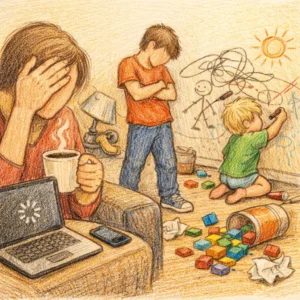
Let’s set the scene.
It’s Tuesday.
You’ve reheated your coffee for the third time.
Your Wi-Fi is moving at the speed of dial-up nostalgia.
And your toddler has just turned the living room wall into a modern art gallery using a permanent marker.
In that exact moment, your carefully curated Parenting Zen™ vanishes.
You snap.
Your voice gets louder than you intended.
You ground them longer than the situation deserves.
Or maybe—without even realizing it—you’re harder on one child because “they should know better.”
Welcome to parenting.
It’s the only job where you’re expected to perform like a CEO, regulate emotions like a therapist, and still make snacks on demand—while being critiqued by someone who can’t tie their own shoes.
But here’s the uncomfortable truth many of us don’t talk about enough:
When biased parenting and negative punishment become patterns, they don’t just shape behavior.
They quietly shape a child’s mental health, physical health, self-worth, and stress response—sometimes for life.
This article isn’t about guilt.
It’s about awareness, science, and doing better—without aiming for perfection.
What Is Biased Parenting (And What It’s Not)
Before we go further, let’s clear something up.
This is not an attack on discipline.
Kids need structure.
They need boundaries.
They need consequences.
If your child throws a toy and the toy gets taken away, that’s a logical consequence.
Healthy. Fair. Effective.
Biased parenting, on the other hand, shows up differently.
It often looks like:
1. Inconsistency
What’s “cute” one day becomes “unacceptable” the next—depending on your mood, stress level, or exhaustion.
2. Unfair Targeting
One child is punished more harshly because of:
- Gender (“Boys will be boys”)
- Birth order (“You’re the older one”)
- Personality (“You’re the difficult one”)
3. Shame-Based Discipline
Instead of correcting behavior, the punishment attacks the child’s identity:
- “Why are you so careless?”
- “You always ruin things.”
- “What’s wrong with you?”
That’s not discipline.
That’s emotional weight a child carries long after the moment is over.
Why Biased Parenting Affects Health — Not Just Behavior
Many parents believe children are “resilient enough to bounce back.”
And yes—kids are resilient.
But resilience doesn’t mean immune.
According to child development research and pediatric associations, repeated exposure to harsh or biased punishment creates chronic stress, and stress doesn’t stay in the mind—it lives in the body.
Let’s break it down.
1. The Cortisol Effect: When Stress Becomes the Norm
When a child feels unfairly punished or emotionally unsafe, their body activates fight-or-flight mode.
This releases cortisol, the primary stress hormone.
In short bursts, cortisol helps us react to danger.
But when cortisol stays high—because the home environment feels unpredictable or emotionally unsafe—it begins to harm:
- Immune function
- Brain development
- Emotional regulation
Children exposed to ongoing biased parenting may:
- Get sick more often
- Struggle to calm themselves
- Become hyper-vigilant or withdrawn
Their bodies are constantly “on alert.”
2. Sleep Problems: The Silent Warning Sign
Think about the last time you tried to sleep after an emotional argument.
Now imagine being five years old—and the argument came from the person you depend on for safety.
Children experiencing harsh or inconsistent punishment often struggle with:
- Night terrors
- Difficulty falling asleep
- Restless sleep
Sleep is essential for:
- Brain growth
- Emotional processing
- Physical development
When sleep suffers, everything else follows.
3. Anxiety in Disguise: The “My Tummy Hurts” Signal
Children don’t always have the words to say:
“I feel anxious because I never know what reaction I’ll get.”
So their bodies speak instead.
Frequent stomach aches
Headaches
Nausea
Appetite changes
These physical symptoms are often stress responses—not medical mysteries.
4. Long-Term Emotional Impact
Over time, biased parenting can shape how children see themselves:
- “I’m the problem.”
- “I’m never good enough.”
- “Love is conditional.”
This increases the risk of:
- Anxiety disorders
- Depression
- Low self-esteem
- Difficulty forming healthy relationships
Discipline should guide behavior—not damage identity.
Why Parents Become Biased (And Why You’re Not a Bad Parent)
Here’s something important:
Most parents don’t choose biased parenting.
They repeat what feels familiar.
Many of us were raised with:
- Shame-based discipline
- Fear-based obedience
- Unequal expectations
When stress hits, the brain defaults to learned patterns.
Bias can also show up when:
- A child reminds you of your younger self
- One child is “easier” than another
- You expect emotional maturity beyond their age
Awareness isn’t about blame. It’s about breaking cycles—consciously.
5 Practical Ways to Break Biased Parenting Patterns
This isn’t about becoming a “perfect gentle parent.”
It’s about gentle authority—calm, fair, and consistent.
1. Practice the “Pause Before Punish” Rule
When emotions spike, pause for 10 seconds.
Ask yourself:
“Am I responding to the behavior—or my stress?”
Sometimes you need the timeout first.
2. Connection Before Correction
Children listen better when they feel safe.
Get to eye level.
Say their name.
Acknowledge feelings before addressing behavior.
Connection calms the nervous system—on both sides.
3. Be Predictable, Not Permissive
Consistency creates emotional safety.
When rules are clear and fairly enforced:
- Anxiety decreases
- Cooperation increases
- Trust grows
Children don’t need harshness.
They need clarity.
4. Replace Shame With Solutions
Instead of:
“You’re so careless.”
Try:
“Looks like something spilled. Let’s fix it together.”
Problem-solving activates growth—not fear.
5. Check Your Bias Regularly
Ask yourself:
- Do I discipline all children with the same respect?
- Do I excuse behavior in one child but punish another?
- Am I expecting emotional maturity beyond age?
Equity matters more than equality.
The Healing Truth: It’s Never Too Late
If this article made you uncomfortable—good.
Growth often starts there.
If you recognize moments of biased parenting in yourself, it doesn’t mean you’ve failed.
It means you’re paying attention.
Children don’t need perfect parents.
They need parents who repair, reflect, and evolve.
Even small changes—calmer responses, fairer discipline, more empathy—can:
- Improve sleep
- Reduce anxiety
- Strengthen immunity
- Build emotional resilience
You’re not raising robots.
You’re raising humans—with nervous systems, emotions, and memories.
Lead with awareness.
Lead with fairness.
Lead with heart.
Your child’s health—mental and physical—depends on it.
References
American Academy of Pediatrics (AAP) – Effective Discipline and Child Development
Center on the Developing Child, Harvard University – Toxic Stress and Child Health
UNICEF – Parenting and Emotional Well-Being
Positive Discipline Association – Connection Before Correction
World Health Organization (WHO) – Child Mental Health and Family Environment