
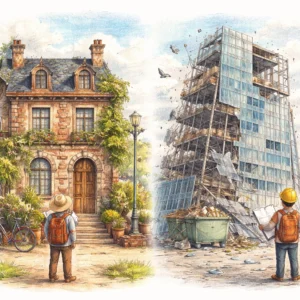
Towering glass skyscrapers reflect the sunlight, looking sleek and futuristic. Yet somehow, it’s the old buildings—the weathered brick homes, the stone churches, the centuries-old structures—that quietly steal your attention. They feel grounded, almost stubborn, as if they’ve decided they’re not going anywhere anytime soon.
And honestly… many of them aren’t.
We’ve all heard the phrase: “They just don’t build them like they used to.” It sounds like something your grandparents would say—but is it actually true?
Why do old buildings last so long, while some modern structures seem to age twice as fast?
Let’s unpack this fascinating mystery.
1. Built Like Tanks: The Era of Over-Engineering
Before computers, before simulation software, and before precise structural calculations, builders relied on something much simpler: caution.
And lots of it.
When engineers centuries ago designed a structure, they didn’t aim for “just enough” strength. They couldn’t afford to. Without accurate models, the safest approach was to overbuild everything.
- Walls were thicker than necessary
- Foundations were deeper than required
- Beams were stronger than they needed to be
This approach is known as over-engineering, and it’s one of the biggest reasons old buildings still stand today.
Modern construction, on the other hand, is incredibly precise. Engineers can calculate the exact load a beam must carry and design it to meet that requirement—no more, no less. This is efficient and cost-effective, but it leaves little margin for unexpected stress over time.
Old buildings? They were built to survive worst-case scenarios—storms, time, and sometimes even war.
2. Materials That Get Better With Age
One of the biggest differences between old buildings and modern ones lies in the materials.
Old Materials: Natural and Durable
Traditional construction relied heavily on:
- Stone
- Fired brick
- Lime mortar
- Old-growth timber
These materials weren’t just strong—they were resilient over time.
Old-growth wood, for example, came from trees that grew slowly over decades (or even centuries). This made the wood denser, stronger, and far more resistant to decay compared to today’s fast-grown timber.
The Case of Ancient Concrete
One of the most fascinating examples is ancient Roman concrete. Unlike modern concrete, which often weakens over time, Roman concrete actually gets stronger, especially when exposed to water.
Modern concrete relies on steel reinforcement (rebar), which can rust. When steel corrodes, it expands, causing cracks from within. That’s why some modern structures deteriorate faster than expected.
Old buildings didn’t depend on such vulnerable combinations—they used materials that aged more gracefully.
3. The “Breathing” Building Concept
Here’s something surprising:
Old buildings last longer partly because they are… imperfect.
They’re drafty. They leak a little air. They “breathe.”
And that’s actually a good thing.
Why Breathability Matters
Traditional construction allowed moisture to move in and out of walls naturally. If water got in, it could evaporate just as easily.
Modern buildings, however, are designed to be airtight for energy efficiency. While this helps reduce heating and cooling costs, it creates a hidden risk:
- Moisture gets trapped
- Mold begins to grow
- Materials slowly weaken from the inside
Old buildings were designed to handle moisture cycles—getting wet and drying out repeatedly without significant damage.
In a way, they were more forgiving.
4. Survivorship Bias: The Hidden Reality
Now, let’s be honest for a moment.
Not every old building was built to last.
In fact, many of them didn’t.
What we see today are the survivors—the strongest, best-built, and luckiest structures that made it through decades (or centuries).
This is called survivorship bias.
Think about it:
- Poorly built houses from the past? Gone.
- Weak structures? Collapsed long ago.
- Cheap materials? Didn’t survive the test of time.
What remains are the architectural champions—the ones that were either exceptionally well-built or carefully maintained.
So yes, old buildings can be incredibly durable—but we’re only seeing the best examples.
5. Maintenance: The Real Secret to Longevity
Here’s the truth most people overlook:
Old buildings don’t survive on strength alone. They survive because people care for them.
Just like a classic car, a building needs ongoing maintenance:
- Roof repairs
- Wall restoration
- Structural reinforcement
- Periodic upgrades
Many historic structures have been continuously maintained for generations. They’ve been repaired, adapted, and sometimes completely renovated while preserving their core structure.
Meanwhile, many modern buildings are designed with a limited lifespan—often 30 to 50 years.
When they start to deteriorate, owners may find it cheaper to demolish and rebuild rather than repair.
Old buildings last longer not just because they were built well—but because they were valued enough to be preserved.
6. Purpose vs. Profit: A Shift in Philosophy
Another major difference lies in intent.
Then: Built for Legacy
Historically, many buildings were constructed with permanence in mind:
- Cathedrals meant to last centuries
- Government structures symbolizing power and stability
- Homes built to be passed down through generations
Now: Built for Efficiency
Modern construction often prioritizes:
- Cost efficiency
- Speed of construction
- Return on investment
This doesn’t mean modern buildings are poorly made—but it does mean they are rarely designed with a 200-year lifespan in mind.
In short:
- Old buildings were built to endure
- Modern buildings are built to perform
7. Sustainability Lessons from Old Buildings
In today’s world, where sustainability is becoming more important than ever, old buildings offer valuable lessons.
Why Preservation Matters
Demolishing and rebuilding consumes:
- Massive amounts of energy
- Raw materials
- Labor resources
Preserving old buildings helps:
- Reduce waste
- Lower carbon emissions
- Maintain cultural heritage
In many ways, restoring an old building is far more environmentally friendly than constructing a new one.
8. Character, Craftsmanship, and Human Touch
Beyond durability, old buildings have something modern ones often lack: personality.
You’ll notice:
- Intricate carvings
- Handcrafted details
- Unique imperfections
These features weren’t mass-produced—they were created by skilled craftsmen who took pride in their work.
Modern construction, while efficient, often relies on standardized materials and designs. The result? Buildings that may look clean and polished—but sometimes feel a little… soulless.
Old buildings, on the other hand, tell stories.
Final Thoughts: More Than Just Bricks and Stone
So, why do old buildings last longer?
It’s not just one reason—it’s a combination of many:
- Over-engineering created stronger structures
- Durable materials aged gracefully
- Breathable designs prevented hidden damage
- Survivorship bias shows us only the best examples
- Continuous maintenance kept them alive
- A different mindset prioritized longevity over cost
But perhaps the most important reason is this:
Old buildings were built with time in mind.
They weren’t just meant to exist—they were meant to endure.
Conclusion: Seeing Old Buildings Differently
The next time you pass by an old building, don’t just see cracks, moss, or faded walls.
See resilience.
See history.
See a structure that has survived decades—maybe centuries—of change, weather, and human activity.
Because while modern architecture races toward the future, old buildings quietly remind us of something powerful:
Sometimes, the strongest things are the ones built to last, not just to impress.
References
Scientific Breakdown of Ancient Materials
Comparison: Ancient vs Modern Concrete