
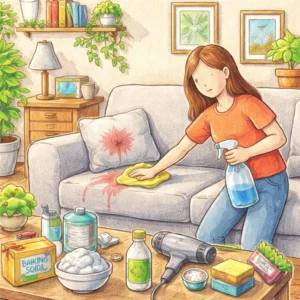
Let’s be honest—furniture stains never happen at a convenient time.
It’s always when you’ve just cleaned the house, lit a candle, and finally sat down to enjoy the vibe. That’s when life decides to test your patience. A glass tips over. A child gets “creative.” A pet leaves behind something… questionable.
And just like that, your beautiful space feels ruined.
But here’s the truth most people don’t realize: you don’t need new furniture—you need better tricks.
Learning how to clean stained furniture isn’t just about saving money (though that’s a huge bonus). It’s about reclaiming control over your space, your comfort, and honestly, your peace of mind.
So before you panic, cover the stain with a cushion, or start scrolling for a replacement sofa—pause. You’re about to turn that “disaster” into something that feels designer again.
Step 1: Identify the Enemy Before You Fight It
Not all stains are created equal—and neither is furniture.
A spill on a velvet chair behaves very differently from a stain on polished wood. Treating them the same is like using shampoo as body lotion. Technically possible… but not ideal.
Most upholstered furniture actually comes with cleaning codes:
- W – Water-based cleaning (your easiest option)
- S – Solvent-based cleaners only (no water!)
- WS – You can use either
- X – Vacuum only (time to call professionals)
Taking 30 seconds to check this tag can save you from turning a small stain into a permanent scar.
Step 2: Dish Soap & Cool Water – The Everyday Hero
Sometimes, the solution is sitting right next to your kitchen sink.
Think about it—dish soap is literally designed to break down grease, food, and stubborn residue. That’s exactly what most stains are.
What to do:
- Mix a few drops of clear dish soap with cool water
- Dip a clean cloth into the solution
- Blot gently (never rub!)
Blotting lifts the stain. Rubbing pushes it deeper.
If furniture were clothing, this would be your go-to “quick fix.” Simple, effective, and surprisingly powerful.
Step 3: The White Ring Fix (Yes, It’s That Easy)
You know that dreaded white ring on wooden tables? The one that silently judges every guest who forgot a coaster?
Good news: it’s not permanent damage—it’s trapped moisture.
Your secret weapon? A hairdryer.
- Set it to medium heat
- Keep it moving over the ring
- Watch as the moisture evaporates
It’s oddly satisfying—like watching fog disappear from a mirror.
Step 4: Baking Soda – The Silent Absorber
When stains involve oil, grease, or lingering smells, liquids won’t help much. In fact, they can make things worse.
That’s where baking soda shines.
How it works:
- Sprinkle generously over the stain
- Let it sit for 20–30 minutes
- Vacuum it away
It absorbs oil like a sponge and neutralizes odors at the same time.
Perfect for those “pizza box left overnight” situations we all pretend don’t happen.
Step 5: Red Wine Spills Don’t Have to Be Tragic
Red wine has a reputation—and honestly, it’s deserved.
But here’s the trick: speed matters more than strength.
Act fast:
- Pour salt directly onto the spill OR
- Add a splash of white wine
Salt absorbs the pigment before it sets. Once dry, vacuum it off.
It won’t always erase everything, but it can reduce a disaster to a minor inconvenience.
Step 6: Shaving Cream – Your Unexpected Ally
It sounds strange, but classic white shaving cream (not gel!) is basically whipped soap.
And it works beautifully on upholstery.
Steps:
- Apply a small amount to the stain
- Let it sit for about 30 minutes
- Blot with a damp cloth
It’s gentle, effective, and leaves things smelling fresh—like your furniture just came back from a spa day.
Step 7: Microfiber Needs Special Treatment
Microfiber furniture looks luxurious—but it can be tricky.
Water often leaves marks that look worse than the original stain.
Solution: Rubbing alcohol
- Pour into a spray bottle
- Lightly mist the stain
- Gently scrub with a white sponge
- Let dry, then brush to restore texture
Because alcohol evaporates quickly, it doesn’t leave behind water marks.
Step 8: Vinegar – The Natural Restorer
When wood furniture starts looking dull, sticky, or cloudy, it’s usually buildup—not damage.
Vinegar cuts through that layer effortlessly.
How to use:
- Mix equal parts white vinegar and water
- Wipe down the surface
- Follow with a tiny bit of olive oil for shine
It’s like giving your furniture a detox—removing years of invisible grime.
Step 9: Toothpaste for Crayon & Marker Mishaps
If you live with kids, you already know: walls and furniture are “art canvases.”
Before you panic, grab toothpaste.
Why it works:
Crayon is wax-based, and toothpaste has just enough grit to lift it.
Steps:
- Use plain white toothpaste
- Rub gently with a soft cloth
- Wipe clean
It’s one of those hacks that feels too simple to work—but it does.
Step 10: Don’t Skip the Final Touch – The Buff
Sometimes furniture isn’t stained—it’s just tired.
Dust, sunlight, and everyday use slowly dull its finish.
Bring back the glow:
- Apply a small amount of beeswax or furniture polish
- Buff in circular motions
This doesn’t just improve appearance—it protects against future stains.
Think of it as skincare… but for your furniture.
Why Learning to Clean Stained Furniture Matters
We live in a world where replacing things is easier than fixing them.
But there’s something deeply satisfying about restoring what you already have.
When you learn how to clean stained furniture, something shifts:
- You stop stressing over small accidents
- You feel more comfortable using your space
- You save money (a lot of it)
- You create a home that feels lived-in, not “untouchable”
Because let’s be real—a perfect home isn’t one without mess.
It’s one where the mess doesn’t scare you.
Your 5-Minute Action Plan
Don’t just read this—use it.
Right now, walk through your home and find:
- That chair you’ve been covering with a throw
- That table with the “mystery stain”
- That sofa spot you avoid sitting on
Pick one method from this guide.
Give it five minutes.
That’s it.
Because once you see even a small improvement, something clicks—you realize your furniture isn’t ruined.
It just needed a little care.
Final Thought
Your furniture tells your story.
Every scratch, every stain, every mark—it’s part of a life being lived.
But that doesn’t mean those marks have to stay forever.
With a little effort and a few simple tools, you can turn “worn out” into “wow.”
So go ahead—host the dinner, let the kids play, invite the chaos.
Because now?
You know how to fix it.
References
Good Housekeeping – Cleaning Advise
The Spruce–Cleaning Naturally with Lemons, Vinegar, and Baking Soda