
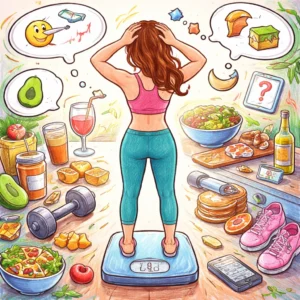
You’ve done everything right this week.
You swapped your snacks for salads. You showed up at the gym—even when your bed was begging you not to. You resisted that box of office doughnuts like a warrior in battle. Honestly? You deserve a medal.
So when you step on the scale expecting a victory… and it doesn’t move (or worse, goes up), it feels like betrayal.
That tiny number suddenly has way too much power.
It whispers: “See? None of this is working.”
And just like that, motivation crashes.
But here’s the truth most people don’t tell you:
If you’re Not Losing Weight, it’s rarely because you’re failing.
More often, it’s because of small, sneaky habits quietly working against you.
Think of it like filling a bucket with a hole at the bottom—you’re putting in the effort, but something’s leaking.
Let’s find those leaks—and fix them, one by one.
1. The “Healthy Food Means Unlimited” Trap
Somewhere along the way, we started believing that “healthy” equals “eat as much as you want.”
Spoiler: your body doesn’t work like that.
Yes, foods like avocados, nuts, quinoa, and olive oil are incredibly good for you—but they’re also calorie-dense.
Imagine this:
You make a “healthy” meal—avocado toast with thick bread, a drizzle of olive oil, maybe some nuts on the side.
Sounds perfect, right?
But that one meal could easily hit 600–800 calories.
Now, if your body only needs around 2,000 calories a day and you’re eating 2,500 (even from “clean” foods), guess what?
👉 You’re still Not Losing Weight.
The shift:
You don’t need to stop eating healthy foods—you just need to respect their portion sizes.
2. The Weekend Reset (That Actually Resets Nothing)
Monday to Friday—you’re disciplined. Focused. Glowing.
Then the weekend arrives… and everything changes.
Suddenly it’s:
- Late-night takeout
- Sugary drinks
- “Treat yourself” mode activated
And hey, you deserve to enjoy your life—but here’s the catch:
A weekend of overeating can quietly erase your entire week’s progress.
It’s like saving money all week… then blowing it all in one shopping spree.
The reality check:
Consistency beats perfection.
You don’t need to be strict—you just need to stay somewhat mindful even on weekends.
3. You’re Drinking More Calories Than You Think
Here’s one of the biggest hidden reasons people are Not Losing Weight:
👉 Liquid calories.
They sneak in quietly:
- Creamy coffees
- “Healthy” smoothies
- Packaged juices
- Soft drinks
- Even that nightly glass of wine
The problem?
Your body doesn’t register drinks the same way it does food.
So you consume calories… but still feel hungry.
A fancy latte can easily match the calories of a full meal—and yet, it doesn’t fill you up.
The fix:
Start noticing what you drink. You don’t need to cut everything—just become aware.
4. “I Worked Out, So I Earned This”
This one feels fair… but it’s misleading.
You finish a workout and think:
“I burned so many calories—I can treat myself.”
But here’s the uncomfortable truth:
👉 Most workouts burn fewer calories than we think.
👉 And most treats contain more calories than we realize.
So what happens?
You eat back (and often exceed) what you burned.
Example:
30-minute workout → ~200 calories burned
Post-workout snack → 400–500 calories
That’s not progress—it’s a surplus.
The mindset shift:
Exercise is not punishment for food. It’s support for your body.
5. Sleep: The Silent Game-Changer
If you’re constantly tired and Not Losing Weight, your body might not be the problem—your sleep is.
When you don’t sleep enough:
- Your hunger increases
- Your cravings skyrocket
- Your self-control drops
Suddenly, that sugary snack feels necessary.
It’s not just lack of discipline—it’s biology.
Your body is trying to compensate for lost energy.
The upgrade:
Better sleep = better decisions (without forcing them).
6. Stress is Working Against You
Life stress doesn’t just affect your mind—it affects your body too.
When stress levels stay high, your body releases cortisol.
And cortisol basically says:
“Let’s hold onto fat… just in case.”
Especially around your belly.
So even if you’re doing everything “right,” chronic stress can slow your progress.
What helps:
- Short walks
- Deep breathing
- Quiet time (even 5 minutes)
You don’t need to eliminate stress—just manage it better.
7. The “Tiny Bites Don’t Count” Illusion
A bite here. A taste there. A quick nibble while cooking.
It feels harmless.
But those small moments? They add up—fast.
This is known as:
👉 BLTs – Bites, Licks, and Tastes
Individually, they seem insignificant.
But over a week? They can quietly stack up to hundreds (even thousands) of extra calories.
And because you don’t track them, they go unnoticed.
The simple rule:
If it goes in your mouth—it counts.
8. Not Enough Protein = More Hunger
If your meals leave you hungry shortly after eating, there’s a good chance you’re missing one key thing:
👉 Protein.
Protein keeps you full longer. It stabilizes energy. It reduces cravings.
Without it, your body keeps asking for more food.
Think about this:
- Salad without protein → hungry in 20 minutes
- Salad with chicken, beans, or tofu → satisfied for hours
The tweak:
Add a protein source to every meal. It makes a bigger difference than you think.
9. The “Active but Actually Sedentary” Life
You might be working out regularly—but what about the rest of your day?
If you:
- Sit at a desk
- Drive long hours
- Relax on the couch
…then your overall movement might still be low.
This is called being “actively sedentary.”
One workout can’t cancel out an entire day of inactivity.
Think of it like this:
A workout is a spark—but daily movement keeps the fire alive.
Easy wins:
- Take short walks
- Use stairs
- Stand while talking on the phone
Small movements matter more than you think.
10. The Scale is Not Telling the Whole Story
This is the part that changes everything.
👉 The scale only shows your weight—not your progress.
If you’re:
- Building muscle
- Losing fat
- Improving strength
…your body is changing—even if the number isn’t.
Muscle is denser than fat. So your body might look leaner, feel stronger, and fit better into clothes…
…but the scale stays the same.
Or even goes up.
So ask yourself:
- Do your clothes fit better?
- Do you feel stronger?
- Is your energy improving?
If yes—you are making progress.
Final Thoughts: You’re Not Stuck—You’re Learning
If you’ve been feeling frustrated because you’re Not Losing Weight, take a breath.
You’re not broken.
You’re not failing.
You’re just human.
Weight loss isn’t about perfection—it’s about awareness.
You don’t need to fix everything overnight.
👉 Just pick one thing from this list.
👉 Focus on it this week.
That’s how real, lasting change happens.
Slowly. Steadily. Sustainably.
And remember:
The scale is just a tool—not the judge of your success.
References
Harvard Health Publishing – Understanding weight loss basics
Mayo Clinic – Weight loss strategies and common mistakes
National Institutes of Health (NIH) – Sleep and metabolism research