
Let’s start with a simple thought experiment.
Take a second and look around you. The floor beneath your feet, the walls around you, the building across the street, the bridge you cross on your way to work—what if I told you they all share the same quiet hero?
Not glass. Not paint. Not even bricks.
It’s RCC (Reinforced Cement Concrete).
Now, I know what you’re thinking. That sounds like something buried deep inside a heavy engineering textbook. But here’s the truth: RCC isn’t complicated—it’s just misunderstood. And once you get it, you’ll start noticing it everywhere.
This isn’t just about construction. This is about the material that literally holds modern life together.
The Origin Story: A Perfect Partnership
Every superhero story starts with a powerful duo. RCC is no different.
At its core, RCC is a combination of two very different materials:
- Concrete
- Steel
Individually, they’re impressive. Together, they’re unstoppable.
Concrete: The Strong but Stubborn One
Concrete is incredibly strong when you push down on it. Engineers call this compressive strength, but think of it like this—it’s great at holding weight.
You can stack tons of pressure on concrete, and it won’t complain.
But here’s the catch:
Try to pull it, bend it, or stretch it—and it cracks.
Concrete is strong, but it’s not flexible.
Steel: The Flexible Fighter
Steel is the complete opposite.
It thrives when stretched. It bends without breaking. It absorbs tension like a pro.
But steel alone isn’t ideal for everything—it needs support when it comes to handling heavy compressive loads.
RCC: When Strength Meets Flexibility
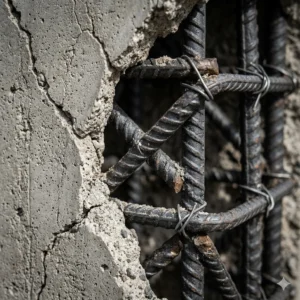
Now imagine embedding steel bars (called rebars) inside wet concrete.
As the concrete hardens, it locks the steel in place.
The result?
- Concrete handles the pressure
- Steel handles the stretching
Together, they create a structure that can handle both force and flexibility.
It’s not just strong—it’s smart.
Why RCC Works So Perfectly
Here’s where things get surprisingly fascinating.
Most materials expand when heated and shrink when cooled. But not all materials do this at the same rate.
Concrete and steel?
They expand and contract almost equally.
That means:
- No internal stress
- No separation
- No cracking from temperature changes
This natural compatibility is one of the biggest reasons RCC works so well.
It’s like they were designed for each other.
The Recipe Behind RCC
Think of RCC like baking a very serious, very heavy cake.
Each ingredient matters—and getting the balance right is everything.
Cement – The Binder
This is the glue that holds everything together. When mixed with water, it creates a paste that binds materials.
Aggregates – The Body
These include sand and crushed stone. They give concrete its volume and strength.
Water – The Activator
Water triggers the chemical reaction that hardens the mix. Too much weakens it. Too little prevents proper bonding.
Steel Reinforcement – The Backbone
Steel bars provide the tensile strength that concrete lacks.
When combined properly, these ingredients don’t just form a mixture—they create something entirely new:
A man-made stone reinforced with a hidden skeleton.
Why RCC Dominates Modern Construction
Walk onto any construction site anywhere in the world, and you’ll see RCC in action.
Why?
Because it checks all the right boxes.
1. Fire Resistance
Unlike wood, RCC doesn’t burn. In the event of a fire, it can withstand high temperatures long enough to protect the structure and allow people to escape.
It acts like a shield.
2. Design Flexibility
Since RCC starts as a liquid, it can be molded into almost any shape.
Curved walls. Circular columns. Complex architectural designs.
If you can build the mold, RCC can fill it.
3. Durability
RCC structures can last for decades—often over 50–100 years—with proper maintenance.
It doesn’t rot. It’s not vulnerable to termites. It doesn’t decay like wood.
4. Cost-Effectiveness
The materials used in RCC—cement, sand, and aggregates—are widely available.
This makes it a practical and affordable choice for both small homes and massive infrastructure projects.
5. Low Maintenance
Once it sets, RCC requires minimal upkeep.
It’s not completely maintenance-free, but compared to other materials, it’s incredibly reliable.
The Challenges: When Things Go Wrong
Even the strongest systems have weaknesses.
For RCC, the biggest enemy is corrosion.
How It Happens
- Cracks develop in concrete
- Water seeps in
- Steel reinforcement gets exposed
- Steel rusts and expands
This expansion creates internal pressure, causing the concrete to crack and break apart—a process known as spalling.
Why You See “Concrete Cancer”
Those ugly cracks and rust stains on old buildings or bridges?
That’s corrosion at work.
It’s not just cosmetic—it’s structural damage.
Prevention Matters
Good RCC construction includes:
- Proper concrete quality
- Adequate thickness (clear cover) over steel
- Proper curing techniques
These steps protect the steel and extend the life of the structure.
RCC in Your Everyday Life
You might not notice it, but RCC is everywhere.
- Your home’s structure
- Office buildings
- Bridges and flyovers
- Parking garages
- Water tanks
- Foundations
Even the cities we live in—stacked vertically and stretching outward—exist because of RCC.
Without it, buildings would be shorter, weaker, and far less reliable.
A Deeper Perspective: The Human Connection
There’s something quietly powerful about RCC beyond engineering.
From the outside, it looks solid, rigid, unbreakable.
But its real strength lies within—in the steel you can’t see.
That hidden reinforcement is what allows it to carry immense weight, withstand pressure, and adapt without breaking.
And honestly, that feels familiar.
People are a lot like that.
We all have an outer layer—the part the world sees. But what truly holds us together is internal:
- Our resilience
- Our values
- Our ability to adapt under pressure
Just like RCC, strength isn’t just about being hard—it’s about being reinforced from within.
The Future of RCC
RCC continues to evolve.
Engineers are constantly improving:
- High-performance concrete
- Fiber-reinforced concrete
- Self-healing concrete
These innovations aim to make RCC even stronger, more durable, and more sustainable.
The goal?
To build structures that last longer, require less maintenance, and have a lower environmental impact.
Final Thoughts
RCC isn’t just a construction material.
It’s a quiet revolution.
It’s the reason skyscrapers touch the sky.
It’s the reason bridges stretch across rivers.
It’s the reason your home feels solid when the wind blows.
It’s proof that true strength comes from balance—between rigidity and flexibility, between visible structure and hidden support.
So next time you walk past a construction site or step into a building, take a moment.
Look a little closer.
Because beneath that grey surface lies one of the most important inventions in human history.
And now—you know its secret.
References