
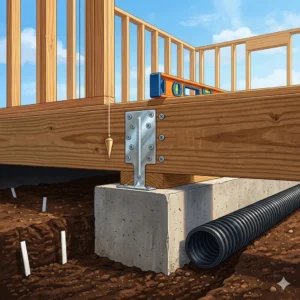
We’ve all laughed at those “You Had One Job” moments—a staircase leading nowhere, a door opening into a wall, or a beam that looks like it’s slowly surrendering to gravity. They’re funny… until you realize something similar could happen in your own home.
Because when it comes to construction, mistakes aren’t always visible right away. And they’re rarely harmless.
A slightly off paint color? Annoying.
A crooked tile? Fixable.
But structural Site Mistakes? Those are the ones that quietly turn your dream home into a long-term problem.
Whether you’re building from scratch, renovating, or hiring professionals, understanding these mistakes is what separates a safe, lasting home from one that slowly falls apart behind the scenes.
Let’s walk through the most critical Site Mistakes, in a way that actually makes sense—and more importantly, helps you avoid them.
1. The “I’ll Just Eyeball It” Foundation
Everything starts beneath your feet.
The foundation isn’t just concrete—it’s the promise that your house will stand still, no matter what life throws at it. And yet, one of the most common Site Mistakes happens before construction even begins: skipping proper soil testing.
Not all soil behaves the same. Some are firm and stable. Others expand, shrink, or shift depending on moisture and weather.
Imagine placing a heavy structure on something unpredictable—it’s like building on a sponge.
Over time, this leads to differential settlement—a fancy term for uneven sinking. You might notice:
- Cracks in walls
- Doors that won’t shut properly
- Sloping floors
And eventually, serious structural damage.
✔ The Fix:
Never skip a soil investigation report. It may not feel exciting, but it’s one of the smartest investments you’ll make.
2. Treating Load-Bearing Walls Like Decorations
Open-concept homes look amazing. Spacious, bright, modern.
But here’s the problem: not every wall is just a wall.
Some walls are carrying the weight of your entire house. Removing or weakening them without proper support is one of the most dangerous Site Mistakes out there.
Think of load-bearing walls as the skeleton of your home. Remove one carelessly, and everything above it loses support.
Even small actions—like cutting into beams or drilling oversized holes—can weaken the structure over time.
✔ The Fix:
Before knocking anything down, consult a structural engineer. If a wall needs to go, it must be replaced with proper support like steel beams or columns.
3. Ignoring Water Drainage (The Silent Destroyer)
Water doesn’t crash into your house like a storm—it creeps in slowly, patiently, and quietly.
Poor drainage is one of the most underestimated Site Mistakes, yet it causes some of the most expensive damage.
If your land slopes toward your house, rainwater collects near the foundation. Over time, this creates hydrostatic pressure, pushing water against your walls until cracks form.
Then come:
- Damp basements
- Mold growth
- Wood rot
- Structural weakening
✔ The Fix:
Ensure proper site grading—your land should slope away from the house. Also, install functional drainage systems and keep gutters clear.
Water should always move away, not settle in.
4. The “Close Enough” Fastener Problem
It’s easy to underestimate the small things.
But in construction, small components often carry big responsibility.
Using the wrong screws, nails, or connectors is a classic Site Mistake. For example:
- Indoor screws used outdoors will rust quickly
- Weak fasteners can fail under pressure
- Missing connectors reduce structural stability
In extreme weather areas, skipping reinforcements like hurricane straps can literally lead to roofs lifting off.
✔ The Fix:
Use the correct materials for each environment and purpose. There is no such thing as “close enough” when safety is involved.
5. Mixing Concrete the Wrong Way
Concrete might look simple—but it’s actually a precise science.
One of the most common Site Mistakes is adding too much water to the mix. It makes pouring easier, yes—but it weakens the final structure.
As excess water evaporates, it leaves tiny air pockets inside the concrete. This reduces its strength significantly.
The result?
- Crumbling edges
- Reduced load-bearing capacity
- Long-term structural risks
✔ The Fix:
Stick to the exact mix ratio. Concrete isn’t something you “adjust by feel”—it requires precision.
6. Ignoring Weather Conditions
Construction doesn’t happen in a vacuum.
Weather plays a huge role, yet it’s often ignored in the rush to meet deadlines—leading to major Site Mistakes.
Examples:
- Pouring concrete in freezing temperatures prevents proper curing
- Painting or sealing wet wood traps moisture inside
- Working during heavy rain weakens materials
These shortcuts might save time today—but they create hidden problems for years.
✔ The Fix:
Plan around the weather, not against it. Delays are temporary—structural damage isn’t.
7. Communication Breakdowns on Site
Here’s the truth: most Site Mistakes don’t happen because people don’t know better.
They happen because people don’t communicate.
When:
- Architects design one thing
- Contractors interpret it differently
- Workers follow assumptions
…mistakes are inevitable.
A small misunderstanding can lead to incorrect materials, wrong dimensions, or unsafe structural choices.
✔ The Fix:
Clear communication is non-negotiable. Always:
- Review plans regularly
- Ask questions
- Confirm details before execution
If something doesn’t match the design—pause and verify.
Why These Site Mistakes Really Matter
Let’s step away from the technical side for a moment.
Building a home isn’t just about bricks and cement. It’s about creating a space where life happens.
It’s where:
- Families grow
- Memories are made
- You feel safe
And safety doesn’t come from luck. It comes from doing things right—even when it’s harder, slower, or more expensive.
Avoiding Site Mistakes isn’t about perfection—it’s about responsibility.
A well-built home doesn’t demand attention. It doesn’t creak, leak, or make you worry.
It simply stands—quietly, reliably, and strong.
The Real Takeaway
Structural integrity is never accidental.
It’s the result of hundreds of small, correct decisions:
- Choosing the right materials
- Following proper methods
- Respecting the process
And sometimes, it’s about having the courage to say:
“This needs to be done again.”
Because fixing a mistake early is always cheaper—and safer—than living with it later.
Final Thoughts
The difference between a safe home and a risky one often comes down to awareness.
You don’t need to be an engineer to spot potential Site Mistakes. You just need to stay informed, ask questions, and refuse to settle for shortcuts.
Because in the end, you’re not just building a structure—you’re building a life inside it.
And that deserves nothing less than solid ground.
References
National Institute of Building Sciences – Whole Building Design Guide
American Society of Civil Engineers (ASCE) – Structural Safety
Federal Emergency Management Agency (FEMA) – Building Safety Guidelines
International Code Council (ICC) – Building Codes & Standards