
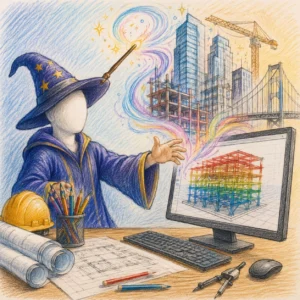
 Picture a structural engineer from the 1970s. A giant drafting table dominates the room. Sheets of blueprints are stacked everywhere. Mechanical pencils, rulers, calculators, and endless handwritten equations cover every inch of the workspace. The engineer spends hours calculating loads, forces, and stress by hand while praying that a single misplaced decimal does not ruin an entire project.
Back then, designing a skyscraper was not only difficult—it was exhausting. Every calculation required patience, repetition, and intense concentration. If one formula was wrong, the entire structure could fail on paper before construction even began.
Now jump to the modern world.
Today’s engineers sit in front of powerful computers capable of simulating earthquakes, hurricanes, moving traffic loads, and structural failures in real time. Massive towers, futuristic bridges, curved stadium roofs, and complex architectural masterpieces are now designed digitally before a single brick is laid.
The secret behind this transformation is structural engineering software.
Programs like AutoCAD, ETABS, and SAP2000 have revolutionized the construction industry. They allow engineers to create digital twins of buildings, test structural behavior under extreme conditions, and optimize designs with incredible precision.
These tools are not just software programs. They are the invisible backbone behind the modern cities we live in.
The Evolution of Structural Engineering Software
Structural engineering has always been a blend of creativity and mathematics. Ancient civilizations built pyramids, temples, and bridges without computers, relying entirely on practical knowledge and experience. While many of those structures still stand today, the design process was slow and filled with uncertainty.
The arrival of computers changed everything.
During the late twentieth century, engineering software introduced automation into calculations that once consumed weeks of manual work. What previously required entire teams of engineers could suddenly be completed in hours.
This technological shift allowed engineers to:
- Design taller buildings
- Create complex curved structures
- Improve earthquake resistance
- Reduce construction costs
- Increase safety standards
- Speed up project timelines
Modern software transformed engineering from a labor-intensive drafting process into a highly intelligent digital workflow.
AutoCAD: The Legendary Digital Drafting Tool
The Software That Changed Engineering Forever
Before engineers can analyze a structure, they first need to draw it. That is where AutoCAD enters the story.
Developed by Autodesk, AutoCAD became one of the most influential design tools ever created. Since its introduction in the 1980s, it has completely transformed drafting and technical drawing.
Instead of drawing blueprints by hand, engineers can now create highly accurate digital drawings with perfect measurements.


Why Engineers Still Rely on AutoCAD
Even though newer 3D modeling software exists today, AutoCAD remains one of the most trusted engineering tools in the world.
Precision Beyond Human Ability
AutoCAD allows engineers to draw with extreme accuracy. Lines can be measured down to tiny fractions of a millimeter. This precision eliminates many errors common in manual drafting.
Universal Industry Language
Architects, contractors, electricians, plumbers, and structural engineers all understand AutoCAD files. It acts like a universal language across the construction industry.
Faster Design Revisions
In the past, changing a single wall or beam meant redrawing entire sections of a blueprint. AutoCAD allows instant modifications without starting from scratch.
Clean and Organized Documentation
Construction projects require thousands of technical details. AutoCAD organizes floor plans, sections, elevations, and structural layouts into professional drawing packages.
Without drafting software like AutoCAD, modern construction would move far slower than it does today.
ETABS: The Guardian of Skyscrapers
The Specialist for High-Rise Buildings
Once the building layout is complete, engineers need to determine whether the structure can survive real-world forces.
This is where ETABS becomes essential.
Created by Computers and Structures, Inc., ETABS is specifically designed for buildings. It helps engineers understand how structures behave under gravity, wind, and earthquakes.


What Makes ETABS So Powerful?
Intelligent Building Modeling
ETABS understands floors, beams, columns, slabs, and walls automatically. Engineers can rapidly create multi-story structures without manually defining every component.
Earthquake Simulation
One of ETABS’ greatest strengths is seismic analysis.
Engineers can simulate powerful earthquakes and observe how the building reacts. Weak structural areas become visible instantly, allowing engineers to strengthen vulnerable sections before construction begins.
Wind Load Analysis
Tall buildings constantly face wind pressure. ETABS calculates how much a building sways during storms and determines whether the movement stays within safe limits.
Material Optimization
The software helps engineers avoid waste by identifying oversized beams or under-reinforced concrete sections.
This optimization saves enormous amounts of money while maintaining structural safety.
SAP2000: The Creative Engineering Genius
Engineering Without Limits
While ETABS focuses mainly on buildings, SAP2000 is built for almost every type of structure imaginable.
Bridges. Stadiums. Towers. Airports. Industrial plants. Curved roofs. Suspension systems.
SAP2000 handles them all.
It is widely respected because it gives engineers complete freedom to analyze unusual and highly creative designs.


The Magic of Finite Element Analysis
SAP2000 uses something called Finite Element Analysis (FEA).
That sounds intimidating, but the concept is surprisingly simple.
The software breaks complex structures into thousands—or even millions—of tiny elements. It then calculates how each small piece behaves under stress and combines the results to understand the entire structure.
This allows engineers to analyze incredibly complicated designs with astonishing accuracy.
Why Engineers Love SAP2000
Freedom for Complex Geometry
Unlike building-focused software, SAP2000 does not rely heavily on floors or walls. Engineers can create curved, twisted, or irregular structures with complete flexibility.
Dynamic Load Analysis
The software can simulate moving loads such as:
- Vehicles crossing bridges
- Aircraft forces
- Vibrations
- Machinery movement
- Wind-induced oscillations
Real-Time Structural Visualization
SAP2000 visually displays stress distribution across structures. Engineers can instantly identify areas experiencing dangerous force concentrations.
This visualization makes problem-solving faster and more intuitive.
How Structural Engineering Software Works Together
Modern engineering projects rarely rely on a single software program. Instead, engineers create a connected workflow where multiple tools cooperate.
The process usually looks like this:
Step 1: Concept Design
Architects create the initial vision of the building or structure.
Step 2: Drafting and Layout
Engineers use AutoCAD to prepare structural layouts, floor plans, beam arrangements, and technical drawings.
Step 3: Structural Analysis
The design is imported into ETABS or SAP2000 for stress testing and safety analysis.
Step 4: Optimization
Engineers modify beam sizes, wall thicknesses, and reinforcement details based on software feedback.
Step 5: Construction Documentation
Final drawings are produced and delivered to construction teams.
This digital ecosystem dramatically improves efficiency and reduces human error.
The Human Side of Structural Engineering Software
Despite all this incredible technology, software does not replace engineers.
It assists them.
Every calculation still depends on human judgment.
Engineers must understand:
- Structural behavior
- Material properties
- Construction methods
- Soil conditions
- Load paths
- Safety codes
A computer can produce beautiful results while still being completely wrong if incorrect information is entered.
Engineers often repeat a famous phrase:
“Garbage In, Garbage Out.”
If the input data is incorrect, the software will generate inaccurate results regardless of how advanced it is.
That is why engineering knowledge remains more important than the software itself.
How Software Makes Structures Safer
Structural engineering software directly protects human lives.
Every digital simulation helps prevent catastrophic failures in the real world.
Earthquake Protection
Engineers can design structures that absorb seismic energy and remain standing during major earthquakes.
Hurricane Resistance
Wind analysis helps prevent dangerous building sway and structural collapse during storms.
Bridge Safety
Dynamic load analysis ensures bridges can safely carry heavy traffic for decades.
Fire and Structural Stability
Software also helps evaluate how structures respond to high temperatures and material weakening.
The ultimate goal is not just stronger buildings.
It is safer communities.
The Future of Structural Engineering Software
The next generation of engineering software is becoming even more advanced.
Emerging technologies include:
- Artificial Intelligence (AI)
- Machine Learning
- Cloud Collaboration
- Real-Time Data Monitoring
- Digital Twins
- Virtual Reality Integration
- Automated Design Optimization
Future software may eventually predict structural failures before they happen and automatically recommend repairs.
Engineers are moving toward a world where buildings continuously communicate their structural health through sensors and smart systems.
The future of infrastructure is becoming intelligent.
Why Learning Structural Engineering Software Matters
For students and aspiring engineers, learning structural engineering software opens the door to exciting career opportunities.
Mastering tools like:
- AutoCAD
- ETABS
- SAP2000
- Revit
- STAAD.Pro
can significantly improve employability in the engineering and construction industry.
These tools are now essential skills for:
- Structural Engineers
- Civil Engineers
- Architects
- BIM Specialists
- Construction Consultants
- Infrastructure Designers
As cities continue growing worldwide, demand for skilled structural software professionals will only increase.
Final Thoughts
Structural engineering software has completely transformed the way humanity designs and builds.
Programs like AutoCAD, ETABS, and SAP2000 allow engineers to create safer, smarter, and more innovative structures than ever before. They turn imagination into reality while protecting millions of lives through precise analysis and intelligent design.
The skyscrapers dominating modern skylines, the bridges connecting cities, and the stadiums hosting global events all begin as digital simulations inside powerful engineering software.
Behind every breathtaking structure is an engineer using technology to solve invisible problems long before construction starts.
The next time you stand beneath a towering building or cross a massive bridge, remember this:
Long before concrete was poured or steel was lifted into the sky, that entire structure existed first inside a computer screen.
And that is the true magic of structural engineering software.
References
SAP2000 Official Software Page