
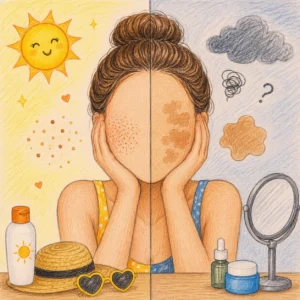
Have you ever walked into the bathroom, switched on the light, leaned a little too close to the mirror, and suddenly noticed something new on your skin?
Maybe it was a scattering of tiny brown dots across your nose. Maybe it was a larger shadowy patch on your cheek that seemed to appear overnight. Whatever it was, it probably sent your mind into detective mode.
You start asking questions.
“Are these freckles?”
“Is this sun damage?”
“Why wasn’t this here last month?”
“Do I need to do something about it?”
If that sounds familiar, you’re not alone.
One of the most common skincare concerns people experience is uneven pigmentation. The problem is that most people don’t know whether they’re looking at harmless freckles or stubborn dark patches. Since both appear as darker areas on the skin, it’s easy to confuse them.
The good news is that freckles and dark patches are actually very different. They have different causes, different behaviors, and often require different approaches.
Understanding which one you’re dealing with can save you a lot of frustration, money, and unnecessary skincare experiments.
Let’s break it all down in simple language.
Why Does Skin Develop Dark Spots in the First Place?
To understand freckles and dark patches, we first need to talk about melanin.
Melanin is the natural pigment that gives your skin, hair, and eyes their color. Think of it as your skin’s built-in defense system.
Whenever your skin encounters stress—whether from sunlight, heat, inflammation, or hormonal changes—it may produce more melanin as a protective response.
Sometimes that melanin spreads evenly, creating a tan.
Other times it collects in certain areas.
When melanin gathers in tiny concentrated spots, freckles appear.
When melanin spreads unevenly across larger areas, dark patches develop.
Although they may look similar from a distance, they’re completely different skin stories.
Understanding Freckles: The Tiny Sun-Loving Dots
Freckles are small, flat spots that usually range from light brown to dark brown.
They’re among the most recognizable forms of pigmentation and are often associated with youthful, sun-kissed skin.
In fact, freckles have become so popular that many people now create fake freckles using makeup products.
But natural freckles have a few unique characteristics.
Freckles Are Often Genetic
If your parents or grandparents have freckles, there’s a good chance you’ll have them too.
People with fair skin, light eyes, and red or blonde hair tend to develop freckles more easily, although freckles can appear on any skin tone.
Genetics determine your tendency to freckle, while sun exposure helps bring them to the surface.
Freckles Are Small and Well Defined
One of the easiest ways to identify freckles is their size.
Freckles usually look like tiny dots.
They often appear on:
- The nose
- Cheeks
- Forehead
- Shoulders
- Arms
- Upper chest
Each spot has clear borders and looks separate from the others.
Freckles Change With the Seasons
This is perhaps the biggest clue.
True freckles tend to darken during spring and summer when UV exposure increases.
When winter arrives and sunlight decreases, freckles often fade significantly.
Some may almost disappear until the next sunny season.
This seasonal behavior is one of the defining characteristics of freckles.
Should You Remove Freckles?
In most cases, freckles are completely harmless.
Many dermatologists consider them a natural variation in pigmentation rather than a skin problem.
If you like your freckles, there is absolutely no need to remove them.
The best thing you can do is protect them.
Daily sunscreen helps prevent excessive darkening while reducing long-term UV damage.
Think of sunscreen as maintenance rather than treatment.
Understanding Dark Patches: The Stubborn Shadows
Dark patches are very different from freckles.
Instead of appearing as small dots, they show up as larger areas of discoloration.
They often look like shadows resting on the skin.
Unlike freckles, dark patches usually don’t fade dramatically during winter.
They’re often persistent and can become more noticeable over time.
Common Causes of Dark Patches
1. Melasma: The Hormonal Trigger
Melasma is one of the most common causes of facial pigmentation.
It often appears as symmetrical patches across:
- Both cheeks
- Forehead
- Upper lip
- Jawline
Many people describe melasma as looking like a faint brown mask.
Hormonal changes are a major trigger.
Melasma frequently develops during:
- Pregnancy
- Hormonal contraceptive use
- Hormonal fluctuations
- Certain medical conditions
Sun exposure can make melasma significantly darker.
2. Post-Inflammatory Hyperpigmentation (PIH)
Have you ever had a pimple disappear but leave a dark mark behind?
That’s post-inflammatory hyperpigmentation.
The skin remembers trauma.
When acne, eczema, burns, irritation, or injuries heal, the skin may leave behind excess pigment.
The original problem disappears, but the discoloration remains.
Fortunately, PIH is usually temporary and can improve with proper skincare.
3. Sun-Induced Hyperpigmentation
Years of cumulative sun exposure can create larger pigmented areas.
Unlike freckles, these patches tend to remain visible regardless of season.
Repeated UV exposure encourages excess melanin production, eventually leading to stubborn discoloration.
Freckles vs Dark Patches: The Easy Comparison
Feature | Freckles | Dark Patches |
|---|---|---|
| Size | Tiny dots | Larger areas |
| Shape | Defined borders | Irregular borders |
| Appearance | Scattered spots | Shadow-like patches |
| Seasonal Changes | Fade in winter | Usually remain |
| Main Causes | Genetics + sun | Hormones, inflammation, aging |
| Common Locations | Nose, cheeks, shoulders | Cheeks, forehead, upper lip |
| Treatment Need | Usually unnecessary | Often treated cosmetically |
If your pigmentation fades significantly when sunlight decreases, you’re likely dealing with freckles.
If it stays year-round and appears as larger blotchy areas, dark patches are more likely.
How to Fade Dark Patches Safely
If you’ve identified your pigmentation as dark patches rather than freckles, there are several effective ways to improve their appearance.
The key word is patience.
Pigmentation doesn’t disappear overnight.
Most improvements happen gradually over several weeks or months.
Step 1: Sunscreen Every Single Day
No skincare ingredient can outperform sunscreen.
Even the most expensive brightening serum will struggle if UV exposure continues.
Choose:
- Broad-spectrum SPF 30 or higher
- Daily application
- Reapplication when outdoors
Consistent sun protection prevents dark patches from becoming darker and supports fading.
Step 2: Add Vitamin C
Vitamin C is one of the most popular brightening ingredients for a reason.
Benefits include:
- Supporting skin brightness
- Fighting oxidative stress
- Improving overall radiance
- Helping fade discoloration over time
Apply it in the morning before sunscreen.
Step 3: Try Niacinamide
Niacinamide is one of skincare’s most versatile ingredients.
It can help:
- Improve uneven skin tone
- Support the skin barrier
- Reduce redness
- Minimize the appearance of discoloration
It’s gentle enough for most skin types.
Step 4: Consider Alpha Arbutin
Alpha arbutin specifically targets excess pigmentation.
Many people use it to improve:
- Post-acne marks
- Uneven skin tone
- Melasma-related discoloration
- Sun spots
Because it’s generally well tolerated, it’s often a great choice for beginners.
Step 5: Exfoliate Gently
One of the biggest mistakes people make is scrubbing dark patches aggressively.
Harsh scrubbing creates irritation.
Irritation can lead to even more pigmentation.
Instead, choose gentle exfoliating acids such as:
- Lactic acid
- Mandelic acid
Using them once or twice weekly can help encourage healthy skin turnover.
A Simple Daily Routine for Freckles and Dark Patches
You don’t need 15 products.
You need consistency.
Morning Routine
- Gentle cleanser
- Vitamin C serum
- Moisturizer
- SPF 30 or higher
Evening Routine
- Gentle cleanser
- Niacinamide or alpha arbutin
- Moisturizer
Two nights per week:
- Add a gentle exfoliant
Simple routines are easier to maintain and often produce better long-term results.
When Should You See a Dermatologist?
Most freckles and dark patches are harmless.
However, any spot should be professionally evaluated if it:
- Changes color rapidly
- Becomes asymmetrical
- Develops irregular borders
- Bleeds or crusts
- Changes size unexpectedly
- Causes concern
When in doubt, it’s always worth getting expert advice.
Final Thoughts
Freckles and dark patches may seem similar at first glance, but they’re very different forms of pigmentation.
Freckles are typically small, genetic, sun-enhanced dots that often fade with reduced sun exposure.
Dark patches are larger, more persistent areas of pigmentation that may result from hormones, acne, inflammation, aging, or long-term sun exposure.
Neither condition means your skin is unhealthy.
Neither means you’ve done something wrong.
Your skin is constantly responding to the world around it, protecting itself the best way it knows how.
Whether you embrace your freckles or decide to fade stubborn dark patches, the foundation remains the same: gentle skincare, consistent sun protection, and patience.
Healthy skin isn’t about perfection.
It’s about understanding what your skin needs and giving it the care it deserves.