
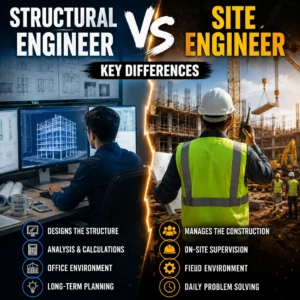
Imagine standing in front of a massive construction project. Tower cranes stretch across the skyline, workers move with purpose, concrete trucks arrive one after another, and steel beams rise into place like pieces of a giant puzzle.
At first glance, it may seem like everyone is doing the same thing—building a structure. But behind every successful project are two professionals whose responsibilities are very different, yet equally important: the structural engineer and the site engineer.
One spends countless hours calculating loads, analyzing forces, and ensuring the structure can stand safely for decades. The other coordinates people, materials, machinery, and construction activities to bring those designs to life.
This raises a common question among engineering students and aspiring professionals:
Structural Engineer vs Site Engineer: Which role is better, and who actually controls the job site?
The answer is not as simple as choosing a winner. Both roles are essential, and understanding the difference can help you choose the right career path and appreciate how modern construction projects succeed.
Let’s dive into the ultimate showdown.
Understanding the Structural Engineer
Think of a building as a human body.
The architect creates the appearance. The electrical engineer handles the nervous system. The plumbing engineer manages the circulation system.
The structural engineer designs the skeleton.
Without a strong skeleton, nothing else matters.
What Does a Structural Engineer Do?
A structural engineer is responsible for ensuring a structure can safely withstand all forces acting upon it throughout its lifespan.
These forces include:
- Gravity loads
- Wind loads
- Earthquake forces
- Snow loads
- Live loads from occupants and equipment
- Environmental stresses
Structural engineers analyze and design beams, columns, slabs, foundations, retaining walls, bridges, towers, and other load-bearing components. Their primary objective is safety, stability, and durability.
Daily Responsibilities of a Structural Engineer
A typical day may involve:
- Performing structural calculations
- Designing steel, concrete, timber, or masonry structures
- Using software like ETABS, STAAD.Pro, SAP2000, and Revit
- Reviewing design codes and standards
- Preparing drawings and reports
- Coordinating with architects and contractors
- Conducting structural inspections
While many people imagine structural engineers simply drawing plans, much of their work involves solving complex engineering problems and ensuring every component works together safely.
The Structural Engineer Mindset
Structural engineers love questions like:
- Will this beam support the load?
- What happens during an earthquake?
- How much steel reinforcement is required?
- Can we reduce costs without compromising safety?
Their work requires strong analytical thinking, mathematics, physics, and attention to detail.
One small calculation error can have serious consequences.
That is why precision becomes a way of life.
Understanding the Site Engineer
Now let’s step away from the office and onto the construction site.
This is where the site engineer takes center stage.
If the structural engineer designs the skeleton, the site engineer ensures that skeleton is built correctly.
What Does a Site Engineer Do?
A site engineer supervises and manages day-to-day construction activities.
Their job revolves around execution.
They ensure that construction follows approved drawings, specifications, schedules, and safety standards.
Every day presents new challenges.
The weather changes.
Materials arrive late.
Equipment breaks down.
Workers need guidance.
Unexpected site conditions appear.
The site engineer handles it all.
Daily Responsibilities of a Site Engineer
Typical duties include:
- Supervising construction activities
- Managing contractors and labor crews
- Checking dimensions and levels
- Coordinating material deliveries
- Monitoring project progress
- Ensuring quality control
- Maintaining site safety
- Resolving on-site issues
- Communicating with project stakeholders
Site engineers are often the first people called when a problem occurs during construction.
And on construction sites, problems occur regularly.
The Site Engineer Mindset
Site engineers think differently.
Instead of asking whether a beam can carry a load, they ask:
- Has the beam arrived on site?
- Is the crane available?
- Are workers ready for installation?
- Is the weather suitable?
- Will this delay affect the schedule?
Their role requires leadership, communication, decision-making, and practical problem-solving.
Structural Engineer vs Site Engineer: The Core Differences
Although both professionals work on the same project, they approach it from entirely different perspectives.
1. Primary Focus
Structural Engineer
Focuses on:
- Design
- Analysis
- Safety
- Stability
- Structural performance
Site Engineer
Focuses on:
- Construction execution
- Quality control
- Scheduling
- Coordination
- Site management
One designs.
The other delivers.
2. Working Environment
Structural Engineer
Typically works in:
- Design offices
- Consulting firms
- Engineering companies
Most work involves computers, drawings, calculations, and meetings.
Site Engineer
Typically works in:
- Construction sites
- Industrial facilities
- Infrastructure projects
Their office may be a temporary site cabin surrounded by concrete mixers and excavators.
3. Skills Required
Structural Engineer Skills
- Structural analysis
- Mathematics
- Engineering design
- Building codes
- CAD and modeling software
- Technical reporting
Site Engineer Skills
- Communication
- Leadership
- Construction management
- Quality assurance
- Safety management
- Time management
Both require technical knowledge, but the emphasis is very different.
4. Problem-Solving Style
A structural engineer solves theoretical and design-related challenges.
For example:
“Can this building safely support an additional floor?”
A site engineer solves practical construction challenges.
For example:
“The concrete pump has failed and the slab pour starts in one hour. What’s the backup plan?”
Both are solving problems.
The nature of those problems is completely different.
5. Tools They Use
Structural Engineer
Common tools include:
- ETABS
- SAP2000
- STAAD.Pro
- SAFE
- Revit Structure
- AutoCAD
Site Engineer
Common tools include:
- Total stations
- Laser levels
- Survey equipment
- Construction management software
- Smartphones and tablets
- Inspection checklists
The structural engineer relies heavily on digital modeling.
The site engineer relies heavily on field verification.
Who Has More Responsibility?
This question often sparks debate.
The truth is that responsibility exists at different stages.
Structural Engineer Responsibility
The structural engineer is responsible for ensuring the design is safe and compliant.
Their calculations directly affect public safety.
A design mistake can impact an entire structure.
Site Engineer Responsibility
The site engineer is responsible for ensuring the structure is built according to the approved design.
Even the best design can fail if construction quality is poor.
In reality, both roles carry enormous responsibility.
One protects the structure through design.
The other protects it through execution.
Salary Comparison
Salary varies significantly based on:
- Country
- Experience
- Industry
- Certifications
- Employer
Generally:
- Entry-level salaries are often similar.
- Site engineers may earn additional compensation for overtime and remote projects.
- Senior structural engineers can command high salaries due to specialized expertise.
- Site engineers often transition into project management roles with significant earning potential.
Neither role is automatically more profitable.
Career growth depends on skill development and experience.
Career Growth Opportunities
Structural Engineer Career Path
Typical progression:
Graduate Engineer → Design Engineer → Structural Engineer → Senior Structural Engineer → Principal Engineer → Structural Consultant
Many eventually specialize in:
- High-rise buildings
- Bridges
- Industrial structures
- Earthquake engineering
- Offshore structures
Site Engineer Career Path
Typical progression:
Graduate Site Engineer → Site Engineer → Senior Site Engineer → Construction Manager → Project Manager → Project Director
Many move into leadership positions overseeing entire projects.
Why Structural Engineers and Site Engineers Need Each Other
Imagine a project with only structural engineers.
You would have beautiful calculations and perfect drawings.
But no building.
Now imagine a project with only site engineers.
You would have hardworking teams and machinery.
But no safe design to follow.
Construction succeeds because these professionals work together.
The structural engineer creates the roadmap.
The site engineer follows that roadmap while adapting to real-world conditions.
Their collaboration transforms ideas into reality.
Successful projects depend on both.
Which Career Should You Choose?
Choose Structural Engineering If:
You enjoy:
- Mathematics
- Physics
- Analysis
- Design software
- Detailed calculations
- Technical problem-solving
You prefer:
- Office environments
- Design work
- Long-term engineering challenges
Choose Site Engineering If:
You enjoy:
- Working outdoors
- Leadership
- Fast-paced environments
- Construction activities
- Team coordination
- Practical problem-solving
You prefer:
- Dynamic workplaces
- Direct project involvement
- Visible daily progress
Neither path is superior.
They simply suit different personalities.
The Final Verdict
In the debate of structural engineer vs site engineer, there is no true winner.
The structural engineer provides the intelligence behind the structure.
The site engineer provides the execution that turns drawings into reality.
One calculates.
One coordinates.
One designs.
One delivers.
Together, they create the buildings, bridges, towers, and infrastructure that shape our world.
The next time you pass a construction project, remember that behind every beam, column, and foundation are professionals working from two completely different perspectives toward one common goal:
Building something safe, functional, and lasting.
So which role sounds more like you?
Would you rather spend your day designing the future from a workstation or leading the action directly on the construction site?
Whatever your answer, both careers offer exciting opportunities, meaningful challenges, and the chance to leave a lasting mark on the world around you.
References
Institution of Structural Engineers (IStructE) – What is a Structural Engineer?
Structural Engineers Association of Oregon – About Structural Engineering
TWI Global – What Do Structural Engineers Do?
Virginia Military Institute – Structural Engineering Overview