
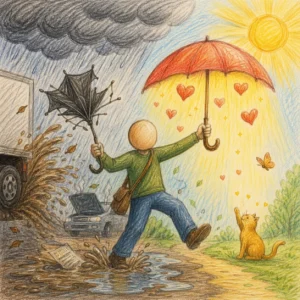
Have you ever had one of those days that feels like the universe accidentally put your name on the wrong list?
You wake up on time, drink your coffee, and head out the door with every intention of having a productive day. Then, within a few hours, everything starts falling apart. Your phone slips from your hand and cracks. Your carefully planned meeting gets canceled. Someone snaps at you for no reason. The package you’ve been waiting for arrives damaged.
And somewhere in the middle of all that frustration, a thought quietly sneaks into your mind:
“Why is this happening to me? I’m a good person.”
It’s a deeply human reaction.
Most of us grow up believing that life operates according to a simple equation. If you are kind, honest, generous, and considerate, then life should reward you. Maybe not immediately, but eventually.
Yet adulthood has a way of exposing the flaw in that belief.
The truth is both uncomfortable and freeing: being a good person does not protect you from bad experiences.
That doesn’t mean kindness is pointless. It simply means life doesn’t work like a reward program where good deeds automatically earn immunity from pain.
Understanding this reality can save you from unnecessary disappointment and help you build genuine emotional resilience.
The Invisible Contract We Think We Signed
Many people carry around an unwritten agreement with life.
Without realizing it, we believe that if we behave well enough, life will behave well in return.
We hold doors open for strangers.
We help friends move furniture.
We stay loyal in relationships.
We work hard at our jobs.
We avoid causing problems for other people.
And somewhere deep down, we expect these actions to earn us protection from misfortune.
The problem is that life never signed that contract.
A flat tire doesn’t know you’re generous.
A storm doesn’t care how many people you’ve helped.
An illness doesn’t check whether you’ve donated to charity.
Life events aren’t distributed according to moral worth. They happen because we live in a world governed by probability, biology, timing, and countless variables outside our control.
When we expect goodness to guarantee smooth sailing, every setback feels personal.
Instead of simply dealing with the problem, we start questioning ourselves.
“Did I do something wrong?”
“Am I being punished?”
“Why do bad things happen to good people?”
These questions often create more suffering than the original problem itself.
Why We Struggle With Life’s Unfairness
Human beings naturally crave fairness.
Psychologists have long observed something called the “just-world belief.” It is the tendency to assume that people generally get what they deserve.
This belief feels comforting because it makes the world seem predictable.
If good actions lead to good outcomes and bad actions lead to bad outcomes, then life feels controllable.
But reality is far more complicated.
Sometimes hardworking people fail.
Sometimes dishonest people succeed.
Sometimes caring partners get their hearts broken.
Sometimes wonderful people experience devastating losses.
When reality collides with our expectations, it creates emotional whiplash.
The disappointment isn’t just about what happened.
It’s about the realization that life isn’t following the script we expected.
Character and Circumstances Are Different Things
One of the healthiest mindset shifts you can make is learning to separate your character from your circumstances.
Your character is who you choose to be.
Your circumstances are the events happening around you.
These two things are not the same.
You can be a compassionate, honest, hardworking person and still experience setbacks.
Likewise, someone can make poor choices and still experience periods of success.
The weather doesn’t evaluate your morals before it rains.
Traffic doesn’t disappear because you’re polite.
Economic downturns don’t avoid good people.
Once you understand this distinction, setbacks become easier to process.
Instead of asking, “What did I do to deserve this?” you can ask, “What is the best way to respond?”
That question immediately puts your power back into your hands.
The Hidden Cost of Taking Everything Personally
When bad experiences happen, it’s easy to assume they’re somehow connected to our worth.
We think:
- I failed because I’m not good enough.
- They left because I’m not valuable.
- I got rejected because I don’t deserve success.
- This setback happened because I made a mistake.
Sometimes our actions do contribute to outcomes.
But often, setbacks are simply part of being human.
Not every disappointment is a verdict on your value.
Not every rejection is evidence of inadequacy.
Not every obstacle is a punishment.
Many events occur because life is complicated.
People have their own struggles.
Markets change.
Opportunities disappear.
Accidents happen.
Timing shifts.
The sooner you stop personalizing every setback, the faster you’ll recover from it.
Five Powerful Ways to Stay Kind in an Unfair World
1. Stop Keeping Score
Many people unknowingly keep a mental scoreboard.
They tally every good deed and expect positive outcomes in return.
But kindness isn’t meant to be a transaction.
The moment you start viewing goodness as a bargaining chip, disappointment becomes inevitable.
Do the right thing because it aligns with your values, not because you’re expecting a reward.
2. Accept That Chaos Is Part of Life
No matter how organized, intelligent, or responsible you are, some things will always remain outside your control.
Unexpected expenses happen.
People make mistakes.
Plans fall apart.
Technology fails.
Accepting this reality doesn’t make you pessimistic.
It makes you adaptable.
The strongest people aren’t those who avoid chaos.
They’re the ones who learn how to function despite it.
3. Stop Trying to Earn Respect From Everyone
One of the most exhausting habits is believing that enough kindness will eventually convince difficult people to treat you well.
Unfortunately, it doesn’t always work.
Some people are dealing with wounds, insecurities, or emotional immaturity that have nothing to do with you.
Your kindness should never require self-sacrifice.
Being a good person includes setting healthy boundaries.
4. Focus on Who You Become
External outcomes come and go.
Character stays.
You may not control every result in your life, but you control who you become through those experiences.
Every challenge gives you an opportunity to develop patience, courage, resilience, and wisdom.
That growth often becomes more valuable than the outcome you originally wanted.
5. Let Yourself Feel Human
Resilience is not pretending everything is fine.
It’s okay to feel disappointed.
It’s okay to cry.
It’s okay to vent to a trusted friend.
It’s okay to admit that life feels unfair sometimes.
Healthy emotional processing isn’t weakness.
It’s part of healing.
The goal isn’t to avoid emotions.
The goal is to experience them without letting them define your future.
The Real Reward of Being a Good Person
Many people eventually discover something surprising.
The greatest reward for being a good person isn’t protection from hardship.
The reward is peace.
When you act with integrity, you can look at yourself honestly.
You don’t have to carry guilt from hurting others.
You don’t have to constantly manipulate situations.
You don’t have to wonder whether your success came at someone else’s expense.
A good character creates inner stability.
And that stability becomes incredibly valuable during difficult seasons.
When life gets messy, your values become an anchor.
Strength Is Revealed During Difficult Times
Anyone can be kind when everything is going perfectly.
It’s easy to smile when life feels generous.
The true test comes when life disappoints you.
Can you remain respectful after rejection?
Can you remain compassionate after heartbreak?
Can you remain hopeful after failure?
Can you remain honest when dishonesty seems easier?
Those moments reveal the depth of your character.
They show whether your values are genuine or merely convenient.
Real strength isn’t found in perfect circumstances.
It’s found in how you respond when circumstances become imperfect.
Reclaiming Your Power
Life will never be completely fair.
Some chapters will challenge you.
Some losses won’t make sense.
Some disappointments won’t feel deserved.
But your power has never been in controlling every event.
Your power is in choosing your response.
You can allow setbacks to make you bitter.
Or you can allow them to make you wiser.
You can allow unfair experiences to harden your heart.
Or you can use them to deepen your compassion.
The choice belongs to you.
And that choice is where true freedom begins.
Final Thoughts
Being a good person doesn’t guarantee an easy life.
It doesn’t protect you from heartbreak, setbacks, disappointment, or unexpected challenges.
But it does give you something far more valuable.
It gives you the ability to face those challenges with integrity.
The world may not always reward your kindness immediately.
People may not always appreciate your efforts.
Life may occasionally feel unfair.
Keep being a good person anyway.
Not because it guarantees perfect outcomes.
But because your character is worth protecting.
The storms of life will come and go.
Your values can remain.
And in the long run, that is one of the greatest victories anyone can achieve.
References
American Psychological Association – Resilience Guide
Greater Good Science Center – The Science of Kindness
Psychology Today – The Just World Hypothesis