
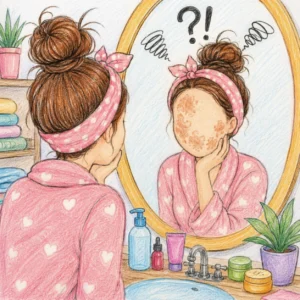
You finally did it.
After months—or maybe even years—of battling stubborn breakouts, trying every cleanser on the shelf, resisting the urge to pick at pimples, and faithfully following a skincare routine, your skin is finally… clear.
No angry acne.
No painful bumps.
No surprise visitors on your chin before an important event.
You happily walk toward the bathroom mirror expecting a glowing, flawless complexion worthy of a skincare commercial.
Then reality hits.
Your skin feels silky smooth, yet your reflection tells a completely different story.
Your cheeks have mysterious brown spots.
Your forehead looks darker than the rest of your face.
Your upper lip seems to have developed a shadow overnight.
Your complexion somehow manages to look both clear and uneven at the same time.
Sound familiar?
You’re far from alone.
Having Uneven Tone despite clear skin is one of the most common skincare frustrations. Many people assume acne is the biggest obstacle to healthy skin, only to discover that discoloration often sticks around long after pimples disappear.
The good news?
An uneven complexion doesn’t mean your skin is damaged forever. In most cases, it’s simply your skin remembering everything it has experienced over the years—from breakouts and sun exposure to hormones and pollution.
Once you understand why those patches appear, you’ll know exactly how to fade them and reveal the naturally radiant skin hiding underneath.
Let’s uncover what’s really happening beneath the surface.
What Is Uneven Tone?
Simply put, Uneven Tone means different areas of your skin contain different amounts of pigment.
Instead of having one consistent color, your complexion may appear:
- Darker around the mouth
- Red across the cheeks
- Brown on the forehead
- Blotchy around the jawline
- Patchy after acne heals
Your skin texture may actually be perfectly smooth.
The problem isn’t the surface.
It’s the color.
This happens because your skin produces melanin—the natural pigment responsible for your skin, hair, and eye color. Whenever your skin experiences stress, injury, inflammation, or excessive UV exposure, it often creates extra melanin as protection.
Unfortunately, it doesn’t always distribute that pigment evenly.
Imagine painting a wall with a roller that occasionally drips paint. Most of the wall looks perfect, but random darker patches remain.
That’s essentially what’s happening with your complexion.
Why Does Uneven Tone Happen?
Your skin doesn’t randomly decide to become patchy.
There is always a reason behind it.
Let’s meet the biggest culprits.
1. Post-Acne Marks: The Breakout That Refuses to Leave
One of the biggest causes of Uneven Tone is Post-Inflammatory Hyperpigmentation (PIH).
Every pimple creates inflammation.
As your skin repairs itself, it sometimes produces extra melanin in that exact spot.
The pimple disappears.
The discoloration stays.
These aren’t true scars.
Think of them like coffee stains on a white shirt.
The shirt isn’t damaged—it simply needs time and the right treatment to remove the stain.
Picking, squeezing, or popping pimples makes things much worse because it creates even more inflammation.
The more inflammation your skin experiences, the darker those leftover marks usually become.
2. Years of Sun Exposure
The sun has an incredible memory.
That beach vacation five summers ago?
Your daily walks without sunscreen?
Driving with sunlight hitting one side of your face?
Your skin remembers all of it.
UV rays stimulate melanin production because your body is trying to protect itself.
Over time, repeated exposure causes pigment to collect in certain areas, creating:
- Age spots
- Sun spots
- Freckles
- Overall uneven pigmentation
Even people who rarely burn can develop discoloration from years of unprotected exposure.
3. Hormonal Changes (Melasma)
Hormones can completely change the way your skin behaves.
Many women notice symmetrical brown patches appearing across:
- Forehead
- Upper lip
- Cheeks
- Chin
This condition is called melasma.
It commonly appears during:
- Pregnancy
- Birth control use
- Hormonal changes
- Perimenopause
Unlike regular dark spots, melasma becomes worse with both sunlight and heat.
That explains why many people notice it becoming darker during summer.
4. Pollution and Environmental Stress
If you live in a busy city, your skin faces invisible attacks every single day.
Tiny pollution particles settle on your skin.
These particles generate unstable molecules called free radicals.
Free radicals damage healthy skin cells and weaken your skin barrier.
Eventually this damage contributes to:
- Dullness
- Uneven pigmentation
- Premature aging
- Increased sensitivity
Your skin isn’t just fighting acne anymore.
It’s fighting your environment.
5. Skin Irritation
Sometimes the products meant to improve your skin actually create new problems.
Over-exfoliating…
Using harsh scrubs…
Trying too many active ingredients…
All of these can irritate your skin enough to trigger inflammation.
Inflammation often leads directly to more pigmentation.
More isn’t always better.
Healthy skin prefers consistency over aggression.
How to Improve Uneven Tone Naturally
Fortunately, improving Uneven Tone doesn’t require a cabinet full of expensive products.
A few well-chosen ingredients used consistently often outperform a complicated twenty-step routine.
Here are five habits that truly make a difference.
1. Start Every Morning with Vitamin C
Vitamin C is one of the most researched skincare ingredients available.
Think of it as your skin’s daily bodyguard.
It helps by:
- Neutralizing free radicals
- Brightening dull skin
- Reducing excess melanin production
- Supporting collagen production
- Protecting against environmental stress
With consistent use, Vitamin C gradually helps fade discoloration while preventing future damage.
Apply a Vitamin C serum after cleansing and before moisturizer every morning.
Then seal everything with sunscreen.
2. Gently Exfoliate with AHAs
Dead skin cells don’t disappear overnight.
They build up.
When those dead cells contain excess pigment, your complexion looks darker and more uneven.
Instead of rough scrubs, choose gentle Alpha Hydroxy Acids (AHAs) like:
- Glycolic Acid
- Lactic Acid
- Mandelic Acid
These ingredients dissolve the bonds holding dead skin cells together.
Fresh, brighter skin gradually appears underneath.
Start slowly.
Using an AHA once or twice weekly is usually enough for beginners.
3. Add Niacinamide to Your Routine
Niacinamide is one of skincare’s true multitaskers.
Also known as Vitamin B3, it helps:
- Strengthen the skin barrier
- Reduce redness
- Minimize oiliness
- Improve hydration
- Fade discoloration
- Smooth skin texture
One fascinating benefit is that niacinamide slows the movement of pigment into skin cells.
That means less visible discoloration over time.
Even better?
It’s suitable for nearly every skin type, including sensitive skin.
4. Never Skip Sunscreen
If there’s one skincare habit that makes the biggest difference, it’s sunscreen.
Without it, brightening ingredients have to fight against fresh UV damage every day.
Think about trying to mop a floor while someone keeps spilling juice onto it.
That’s exactly what happens when you treat pigmentation but skip SPF.
Choose a broad-spectrum sunscreen with SPF 30 or higher every morning.
Yes—even when it’s cloudy.
Yes—even when you’re indoors near windows.
Consistency matters more than perfection.
5. Keep Your Skin Cool
Many people focus only on sunlight.
But heat itself can worsen Uneven Tone, especially melasma.
To reduce unnecessary heat exposure:
- Wash your face with lukewarm water.
- Limit extremely hot showers.
- Avoid prolonged exposure to saunas if pigmentation worsens afterward.
- Cool your skin after outdoor exercise.
- Wear wide-brimmed hats during hot weather.
Lower inflammation often means lower pigment production.
Lifestyle Habits That Support Even Skin
Healthy skin isn’t created only by skincare.
Your everyday habits matter too.
Prioritize Sleep
Your skin repairs itself while you sleep.
Aim for 7–9 hours each night whenever possible.
Eat Colorful Foods
Bright fruits and vegetables contain antioxidants that support healthy skin.
Include foods rich in:
- Vitamin C
- Vitamin E
- Beta-carotene
- Omega-3 fatty acids
Stay Hydrated
Hydrated skin reflects light better and often appears brighter.
Drinking enough water won’t erase pigmentation overnight, but it supports your skin’s natural repair process.
Manage Stress
Chronic stress increases inflammation throughout the body.
Meditation, walking, deep breathing, or even reading for a few minutes each day can support healthier skin over time.
Mistakes That Make Uneven Tone Worse
Sometimes avoiding mistakes is just as important as adding new products.
Avoid these common habits:
- Picking pimples
- Skipping sunscreen
- Using harsh physical scrubs daily
- Mixing too many active ingredients at once
- Expecting overnight results
- Forgetting to moisturize
- Trying a new skincare routine every week
Healthy skin thrives on consistency.
When Should You See a Dermatologist?
While many forms of Uneven Tone improve with good skincare, professional advice is helpful if:
- Pigmentation suddenly appears
- Dark patches continue spreading
- Over-the-counter products aren’t helping after several months
- Melasma becomes severe
- You notice unusual moles or changing spots
A dermatologist can recommend prescription creams, chemical peels, laser treatments, or other procedures tailored to your skin.
Patience Is the Secret Ingredient
Here’s something every skincare lover eventually learns.
Pigmentation takes time.
Those spots didn’t appear overnight.
They’re not disappearing overnight either.
Most people begin noticing visible improvement after 4–8 weeks of consistent care, while deeper pigmentation may take several months to fade.
That’s completely normal.
Celebrate the small wins.
Maybe your foundation blends more easily.
Maybe one stubborn spot has become a little lighter.
Maybe your skin simply looks brighter overall.
Those tiny improvements eventually add up to a complexion you’ll love seeing in the mirror.
Final Thoughts
Having clear skin doesn’t automatically mean having perfectly even skin.
Acne may be gone, but your skin often carries reminders of past inflammation, years of sunshine, hormonal shifts, and everyday environmental stress.
Thankfully, Uneven Tone is one of the most treatable skincare concerns when approached with patience and consistency.
A simple routine built around Vitamin C, gentle exfoliation, niacinamide, sunscreen, and healthy daily habits can gradually restore balance to your complexion.
Remember, glowing skin isn’t about chasing perfection.
It’s about giving your skin the care, protection, and time it needs to heal naturally.
One day you’ll glance in the mirror—not because you’re searching for flaws—but because you’re admiring how healthy, even, and radiant your skin has become.
References
American Academy of Dermatology – Hyperpigmentation