
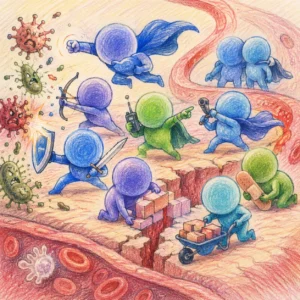
We usually think of the immune system as a kind of emergency response team. You get a cut, and platelets rush in to help stop the bleeding. You catch a virus, and white blood cells begin working to identify and control the threat.
But behind all that activity is a remarkably sophisticated group of cells that can recognize specific threats, communicate with other immune cells, destroy infected cells, remember previous encounters, and help keep inflammation under control.
Meet T cells.
The name might sound ordinary, but their responsibilities are anything but. T cells are central players in adaptive immunity, meaning they help your body mount targeted responses against specific threats. Some T cells coordinate the immune response. Some directly destroy infected or abnormal cells. Others prevent the immune system from becoming too aggressive. And some remain behind as a kind of biological memory bank, ready to respond faster if a familiar threat appears again.
Even more fascinating, researchers now understand that certain T-cell populations also participate in tissue repair and regeneration. They don’t single-handedly heal every cut or rebuild every damaged muscle—that would give them far too much credit—but they can influence the inflammatory environment and communicate with other cells involved in repair.
So, let’s take a closer look at these microscopic members of your body’s defense team.
What Exactly Are T Cells?
Imagine your immune system as a huge organization rather than one giant army.
There are patrol officers, cleanup crews, communication specialists, emergency responders, investigators, and long-term record keepers. T cells are one important branch of that organization.
T cells are a type of white blood cell called a lymphocyte. They originate from blood-forming stem cells in the bone marrow, but immature T cells travel to the thymus, where they develop and undergo selection.
That thymus connection explains the “T” in T cell.
The thymus sits behind your breastbone and is especially active during childhood. Inside it, immature T cells go through a demanding developmental process. Cells that cannot function properly or that pose a significant risk of attacking the body’s own tissues are eliminated or redirected, while useful cells continue developing.
The result is a population of specialized cells capable of recognizing particular molecular signals associated with infections, abnormal cells, or other targets.
Think of it less like a military boot camp and more like an extremely selective training and quality-control center.
Once mature, T cells circulate through the blood and lymphatic system and spend their lives moving between different parts of the immune system.
And they don’t all have the same job.
Meet the T-Cell Team
Calling all T cells “killer cells” is like calling every employee in a hospital a surgeon. They belong to the same broad family, but their jobs can be dramatically different.
Helper T Cells: The Coordinators
Helper T cells, generally known as CD4+ T cells, are some of the immune system’s major communication specialists.
When activated, they can release signaling molecules called cytokines that influence other immune cells.
Think of cytokines as biological text messages.
A helper T cell might essentially send a message saying:
“We have a problem over here. Increase the response.”
Depending on the type of helper T cell and the situation, these signals can encourage other immune cells to become more active, support antibody-producing B cells, or influence the type of immune response that develops.
They don’t simply shout “ATTACK!” all day. Different helper T-cell subsets are involved in different kinds of immune responses, and the communication is carefully regulated.
That coordination is essential because an immune response needs both strength and precision.
Too little response can allow an infection to gain ground.
Too much response can cause unnecessary inflammation and tissue damage.
Cytotoxic T Cells: The Precision Team
Cytotoxic T cells, often called CD8+ T cells, have a much more direct role.
Some viruses hide inside your own cells. Once inside, they can use those cells to produce more copies of themselves.
That’s a problem.
A cytotoxic T cell can recognize infected cells displaying particular abnormal signals and, when appropriately activated, trigger their destruction.
This is a remarkably useful strategy. Instead of trying to hunt down every virus particle individually, the immune system can eliminate the infected cell that is acting as the virus’s production facility.
Cytotoxic T cells can also recognize and destroy certain abnormal cells, including some cancer cells.
Of course, this system isn’t perfect. Some infections evade immune detection, and cancer cells can develop strategies that interfere with immune responses. That’s one reason researchers are so interested in T cells when developing modern cancer immunotherapies.
Regulatory T Cells: The Brakes
Here’s an important detail that is sometimes overlooked: a powerful immune system needs brakes.
Regulatory T cells, commonly called Tregs, help prevent immune responses from becoming excessive.
Imagine driving a car with an enormous engine but no brakes. Impressive for about five seconds. Terrifying afterward.
Your immune system needs similar restraint.
Tregs help maintain immune tolerance and regulate inflammation. They can suppress excessive immune activity and help prevent the body from attacking its own tissues.
This balancing act becomes particularly important during healing.
Inflammation is useful at the beginning of an injury because it helps recruit cells and molecules needed to deal with potential infection and damaged tissue. But inflammation that refuses to switch off can interfere with repair.
Research increasingly shows that Tregs can help regulate this transition from inflammation toward repair in several tissues.
Memory T Cells: The Biological Filing Cabinet
Then there are memory T cells.
After an immune response, some T cells remain as long-lived memory cells. Their job is essentially to remember aspects of a previous immune encounter.
If the same or closely related threat appears again, these cells can contribute to a faster and stronger adaptive immune response.
This is one reason immune memory is so important to vaccination.
However, there’s a small misconception worth clearing up: memory T cells don’t mean you’ll never get the same cold twice. “The common cold” isn’t one single virus. Many different viruses can cause cold-like symptoms, and viruses can also change over time.
So your immune system may remember one particular pathogen while remaining completely unfamiliar with another one.
Biology loves making simple explanations complicated.
T Cells and the Healing Process
Here’s where the story becomes particularly interesting.
For a long time, it was easy to think of immune cells as soldiers whose only mission was to kill germs.
Modern research paints a much more complicated picture.
Your immune system doesn’t just defend you from infection. It also communicates with tissues and helps regulate what happens after injury.
When you scrape your knee, for example, healing doesn’t happen in one dramatic moment. It unfolds through overlapping stages involving clotting, inflammation, tissue formation, and remodeling.
Platelets help create the initial clot.
Immune cells help deal with potential microbes and remove damaged material.
Then various cells—including fibroblasts, epithelial cells, endothelial cells, macrophages, and specialized immune cells—work together to rebuild and remodel the damaged area.
T cells are one part of this larger conversation.
Research has identified T-cell populations, particularly regulatory T cells, that can influence inflammation and tissue repair. They can communicate with immune and non-immune cells and release signaling molecules that affect the local tissue environment.
That doesn’t mean T cells arrive at a wound and personally construct your new skin like microscopic contractors.
Your body doesn’t have tiny hard hats.
Instead, they influence the biological environment in which repair takes place.
Why Controlling Inflammation Matters
Imagine you spill water on your kitchen floor.
A little cleanup is necessary.
But imagine responding by flooding the entire kitchen with another thousand gallons of water because you’re worried about missing one drop.
That’s roughly the problem with uncontrolled inflammation.
Inflammation is an important part of defense and repair, but it needs to be properly regulated.
Researchers studying wound healing have found that regulatory T cells can help control immune activity and contribute to the transition from inflammatory responses toward tissue repair. Their effects may involve communication with macrophages, fibroblasts, epithelial cells, and other cells involved in rebuilding damaged tissue.
Recent reviews continue to explore how tissue-resident Tregs participate in repair and regeneration in organs ranging from skin and muscle to the heart, lungs, kidneys, and nervous system. Much of this field is still developing, and some mechanisms remain better established in experimental models than in humans.
That’s an important distinction.
Science isn’t saying, “T cells heal everything.”
It’s saying something much more interesting: the immune system and the body’s repair machinery are deeply connected.
T Cells Don’t Work Alone
One of the biggest mistakes we can make when learning about immunity is imagining individual cells working independently.
They don’t.
Your immune system is more like a massive group chat where everyone keeps sending messages.
T cells communicate with B cells, macrophages, dendritic cells, natural killer cells, and many other immune and tissue cells.
Meanwhile, tissues send signals back to immune cells.
The nervous system and hormones can also influence immune activity.
The result is a constantly changing network of communication.
When an infection appears, the body doesn’t simply press one giant “immune response” button. Different cells respond at different times and in different ways.
When an injury occurs, the body similarly coordinates clotting, inflammation, cell growth, blood-vessel formation, extracellular matrix production, and remodeling.
T cells are participants in that enormous biological conversation—not the entire conversation.
How Can You Support Your T Cells?
You cannot micromanage your T cells.
Thankfully.
You don’t need to sit at breakfast saying, “Come on, CD8 cells. We’re having a productive day.”
Your best strategy is much less exciting and much more practical: support your overall health.
1. Eat a Nutrient-Dense Diet
Your immune cells require energy and nutrients to develop and function normally.
Rather than chasing one “immune-boosting” food, focus on variety.
Include vegetables, fruits, legumes, whole grains, nuts and seeds, and appropriate protein sources. Nutrients such as zinc, vitamin C, vitamin D, selenium, and protein are involved in normal immune function, but taking extra supplements isn’t automatically better.
The goal is to meet your nutritional needs—not turn your kitchen into a chemistry laboratory.
2. Get Enough Sleep
Sleep is not merely the time when your body powers down.
Your immune system has its own rhythms, and research has found meaningful relationships between sleep and T-cell behavior. One human study found that sleep promotes the movement of T-cell subsets toward signals involved in lymph-node trafficking and adaptive immune responses.
So yes, occasionally staying up late to watch “just one more episode” probably won’t destroy your immune system.
But consistently poor sleep is not a great long-term strategy.
Give your body regular opportunities to rest.
3. Move Your Body
Regular physical activity supports overall health and interacts with the immune system in complex ways.
You don’t need to train like an Olympic athlete.
Walking, cycling, swimming, strength training, dancing, or simply being less sedentary can all be worthwhile forms of movement.
The goal isn’t to punish your body.
It’s to keep it functioning well.
4. Don’t Let Chronic Stress Run the Show
Stress is part of being human.
A deadline, an argument, an unexpected bill, or a difficult day can all trigger temporary stress responses.
The bigger concern is persistent, poorly managed stress.
Long-term psychological stress can influence immune regulation through hormonal and nervous-system pathways. That doesn’t mean every stressful Tuesday is going to shut down your T cells, but it does give us another reason to take recovery seriously.
Take walks.
Talk to people you trust.
Laugh.
Get outside.
Practice slow breathing.
Take breaks.
Your immune system is not separate from the rest of you. Your whole body is one interconnected system.
The Bigger Lesson From T Cells
There is something wonderfully humbling about learning how T cells work.
You don’t consciously command them.
You don’t remind them to clock in.
You don’t send them performance reviews.
Yet billions of immune cells are continuously developing, communicating, responding, adapting, and regulating activity throughout your body.
And their work isn’t limited to fighting infections.
T cells help create immune memory. They coordinate immune responses. They eliminate certain infected or abnormal cells. Regulatory T cells help prevent excessive immune activity and participate in the complex process of tissue repair.
At the same time, they depend on an enormous network of other cells and systems.
That is the real miracle.
Not one microscopic superhero saving the day.
A whole community working together.
Your Body Is More Collaborative Than You Think
The next time you recover from a scrape, shake off an infection, or simply go about your day without thinking about your immune system, remember what’s happening beneath the surface.
Your body is constantly sensing its environment.
Cells are exchanging signals.
Immune defenses are being adjusted.
Old cells are being removed.
New cells are being produced.
Tissues are being maintained and repaired.
And T cells are part of that extraordinary network.
So, rather than thinking of your immune system as a bunch of tiny warriors permanently fighting an invisible war, imagine something more sophisticated: a constantly communicating maintenance and defense network that knows when to attack, when to remember, when to communicate, and—just as importantly—when to stop.
That balance is what makes T cells so fascinating.
They aren’t simply microscopic soldiers.
They’re coordinators, defenders, regulators, and memory keepers—and researchers are still discovering just how much these remarkable cells can influence the health of the tissues around them.
Your body doesn’t need you to control every microscopic detail.
It needs you to give it a reasonable environment in which to do its job.
Eat well. Sleep enough. Move regularly. Manage stress where you can. Seek appropriate medical care when you’re sick or injured.
Then let your extraordinary cellular workforce get on with the work it has been doing all along.
References
NIH/PMC — Reparative T Lymphocytes in Organ Injury
PubMed — Regulatory T Cells in Cutaneous Wound Healing
PMC — The Emerging Role of Tissue Regulatory T Cells in Tissue Repair and Regeneration
PMC — Regulatory T Cells in Skin Regeneration and Wound Healing
PubMed — Sleep Promotes T-Cell Migration and Adaptive Immunity