
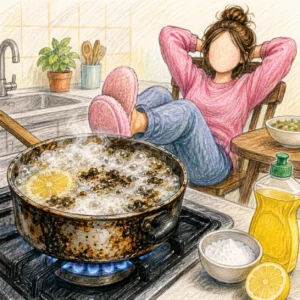
There is a universal truth nobody likes to admit: cooking the meal is usually more enjoyable than cleaning the kitchenware afterward.
Picture the scene.
You have just spent an hour preparing a beautiful homemade dinner. Maybe it is bubbling lasagna with a heroic amount of cheese. Maybe it is a perfectly browned skillet meal. Maybe you finally attempted that complicated recipe you saved six months ago.
You sit down, take the first bite, and think, Wow. I actually nailed this.
For a few glorious minutes, you feel unstoppable.
Then you walk back into the kitchen.
And there it is.
The baking dish.
Blackened around the edges. Grease glued to the bottom. Cheese fossilized into something that appears to have survived several geological eras.
Your happiness immediately evaporates.
You pick up the sponge and stare at the pan.
The pan stares back.
You already know what comes next: twenty minutes of scrubbing, a sore wrist, a ruined sponge, and the nagging suspicion that the brown mark you cannot remove has officially become part of the cookware.
Sound familiar?
For years, my solution was what I called The Great Soak Standoff.
I would fill the pan with warm water, add a little dish soap, place it beside the sink, and confidently announce to myself, “I’ll deal with this later.”
Later became tomorrow.
Tomorrow became three days later.
And eventually, the pan was no longer soaking. It was simply living there.
The good news is that stubborn kitchenware does not always require an exhausting wrestling match with a sponge. Heat, water, gentle cleaning agents, and a little patience can often loosen baked-on food far more effectively than aggressive scrubbing.
But there is one important correction to the popular internet-style cleaning trick involving lemon, baking soda, and dish soap: more ingredients do not automatically mean better cleaning. Baking soda and lemon juice react with each other, creating fizzing carbon dioxide, but that does not make them a magical super-cleaner. The American Chemical Society explains that lemon juice is acidic while baking soda is basic; mixing them produces an acid-base reaction.
So instead of turning your kitchen into a chemistry laboratory, let’s look at a genuinely useful, low-effort approach to cleaning stubborn kitchenware—and how to do it without damaging your cookware or accidentally creating a countertop volcano.
Why Burnt Kitchenware Is So Annoying
Fresh food residue is easy.
A little warm water and ordinary dish soap can usually handle it.
Burnt food is a completely different creature.
When food is exposed to high temperatures for too long, its sugars, proteins, and fats can become tightly bonded to the cooking surface. That is why the little bit of tomato sauce you forgot about for ten minutes can transform into something resembling construction adhesive.
Grease can become especially stubborn after being heated repeatedly.
And then there is the classic dried cheese situation.
Fresh cheese?
Delicious.
Dried cheese welded to a casserole dish?
A personal attack.
The mistake many people make is immediately reaching for the roughest sponge available and attacking the surface with maximum force.
That can work on some uncoated cookware, but it can also damage finishes. Nonstick cookware deserves particular care because abrasive scrubbers can scratch the coating. Poison Control recommends using detergent, water, and a soft sponge or cloth for coated cookware and avoiding abrasive steel wool or scouring pads.
The smarter approach is simple:
Soften first. Remove second.
Let the water and heat do the exhausting part.
The Lazy Person’s Secret: Let Water Do the Work
Here is the most useful part of the entire hack.
You do not necessarily need an elaborate cleaning cocktail.
For many stubborn messes, plain water plus controlled heat can loosen the residue surprisingly well.
If the cookware is suitable for stovetop heating, add enough water to cover the stuck-on food. Add a small amount of ordinary dish soap if the cookware manufacturer’s instructions allow it.
Then gently heat the water.
The goal is not to create a dramatic, overflowing boil.
The goal is to warm and loosen the residue.
As the water heats, hardened food begins to soften. Once the residue has loosened, you can turn off the heat, allow the cookware to cool enough to handle safely, and wipe it with a soft sponge.
Suddenly, the “impossible” mess becomes a much more manageable one.
And that is the real five-minute mentality:
Don’t scrub harder. Soak smarter.
A Better 5-Minute Kitchenware Cleaning Method
Let’s turn this into a practical routine you can actually remember.
Step 1: Remove the Loose Stuff
Before adding water, scrape away anything that comes off easily.
Use a wooden, silicone, or plastic utensil when appropriate for your cookware.
Do not immediately reach for a knife.
Yes, that sounds obvious.
But desperate people do desperate things when confronted with a burnt casserole dish.
A knife may scratch the cooking surface, damage a coating, or leave you wondering why you are performing minor surgery on a saucepan.
Step 2: Cover the Mess With Water
Add enough water to cover the stuck-on residue.
For a pot or pan, that usually means covering the affected area rather than filling the entire vessel.
If the mess is mostly around the bottom, you do not need to create an indoor swimming pool.
Just give the water access to the problem.
Step 3: Add a Small Amount of Dish Soap
A modest amount of regular hand dishwashing liquid can help loosen grease.
You do not need half the bottle.
Dish soaps contain surfactants that help lift oils and grease so they can be rinsed away with water. Poison Control notes that dish soap is specifically formulated to help remove oils and grease.
And remember: hand dish soap is not the same thing as dishwasher detergent.
Do not improvise with laundry detergent, dishwasher detergent, bleach, or random household cleaners.
Cleaning experiments are entertaining on television.
Your kitchen sink is not a laboratory.
Step 4: Warm It Gently
Place appropriate cookware on the stovetop and warm the water.
Keep an eye on it.
You want controlled heating—not a bubbling disaster.
If your cookware is nonstick or otherwise coated, follow the manufacturer’s cleaning and heating instructions. High heat is particularly important to avoid with PTFE-coated cookware, and Poison Control recommends low-to-medium heat, good ventilation, and avoiding overheating or heating an empty pan.
This is also why the original idea of putting a mystery mixture into every type of cookware and boiling it aggressively is not something I would recommend.
Cookware materials are different.
Stainless steel, cast iron, enamel, aluminum, ceramic, and nonstick cookware do not all have identical care requirements.
Step 5: Give It a Few Minutes
Once the water is hot, turn the heat down or off as appropriate and let the warm water loosen the residue.
This is where the lazy magic happens.
You can make tea.
Check your phone.
Put away the ingredients from dinner.
Stare dramatically out the window and contemplate your life choices.
Whatever works.
The important part is that the water is doing the work while you are not.
Step 6: Wipe, Rinse, Repeat if Necessary
Once the residue has softened, carefully discard the water once it is safe to do so.
Then use a soft sponge or cloth to wipe the surface.
If a little residue remains, repeat the process.
That is still better than spending twenty minutes attacking the pan from the beginning.
For nonstick cookware, avoid abrasive scrubbers and metal utensils that could damage the coating.
But What About Baking Soda and Lemon?
Ah, yes.
The internet’s favorite cleaning couple.
Baking soda and lemon juice certainly make a dramatic fizz.
You sprinkle baking soda into a pan.
Add lemon juice.
FIZZ.
Suddenly it looks like you have discovered the cure for every household problem.
But here is the less exciting truth: the fizz itself does not mean the mixture has become a superpowered cleaning solution.
Lemon juice contains citric acid, while baking soda is a base. When they meet, they react and release carbon dioxide gas—the bubbles you see. The American Chemical Society uses lemon juice and baking soda as a straightforward example of acid-base chemistry.
Once they react, they are partially neutralizing one another.
That does not mean baking soda is useless for cleaning.
Quite the opposite.
Baking soda can be useful as a mild abrasive and alkaline cleaning ingredient in appropriate situations.
But there is no need to combine every household ingredient simply because the internet says they work better together.
Sometimes the simplest method wins.
If You Want to Use Baking Soda, Use It Separately
For stubborn residue on cookware that is appropriate for baking soda, you can make a simple paste with baking soda and a small amount of water.
Spread it over the affected area.
Let it sit.
Then gently wipe or scrub with a suitable non-abrasive sponge.
This approach gives the baking soda time to work without immediately neutralizing it with an acidic ingredient.
And if you are cleaning coated cookware, check the manufacturer’s instructions first.
The objective is to remove the mess—not to remove the finish along with it.
What You Should Never Do
This is where the lazy cleaning method becomes genuinely useful.
Being lazy is excellent.
Being careless is not.
Don’t Mix Random Cleaning Products
Do not combine dish soap with bleach, ammonia, strong acids, or other household cleaners just because you think more ingredients equal more cleaning power.
Poison Control specifically warns that mixing household cleaning products can produce dangerous fumes and recommends avoiding such combinations.
Keep your cleaning routine boring.
Boring is good.
Boring means nobody is calling poison control because your kitchen has become a science experiment.
Don’t Overheat Nonstick Cookware
Do not leave a nonstick pan empty over high heat.
Do not deliberately overheat it to burn residue away.
And do not ignore damaged or peeling coatings.
PTFE-coated cookware can release harmful fumes if severely overheated, and Poison Control recommends keeping coated cookware at lower temperatures and maintaining good kitchen ventilation.
Don’t Pour Cold Water Into Extremely Hot Cookware
A dramatic temperature change can damage some cookware and may cause warping or cracking.
Let extremely hot cookware cool appropriately before exposing it to cold water.
Your pan does not need a thermal shock treatment after dinner.
The Real Life-Changing Hack Is Prevention
Here’s the part nobody wants to hear because it is significantly less exciting than a miracle cleaning trick:
Cleaning becomes dramatically easier when food does not have time to become permanently attached.
If you finish cooking and know the pan is going to be difficult later, deal with it sooner rather than later.
You do not necessarily have to wash it immediately.
Simply filling appropriate cookware with warm water can prevent residue from drying into a hardened layer.
That tiny action can save you from a much larger cleaning session later.
Think of it as putting tomorrow’s problem on a five-minute leash.
Make Your Kitchen Work for You
There is another reason these simple cleaning tricks matter.
Household chores are not just physical tasks.
They create mental friction.
When you know a huge pile of dishes is waiting for you, cooking can suddenly feel less appealing.
You might think:
“I’ll just order something.”
Then the delivery arrives.
You eat.
The containers pile up.
And somehow your kitchen still looks like it hosted a small food festival.
Reducing the effort required to clean your kitchenware makes cooking feel less intimidating.
You become more willing to try roasted vegetables.
You make that casserole.
You fry something crispy.
You experiment with a new sauce.
Why?
Because you know the aftermath doesn’t have to become a three-hour punishment.
The Five-Minute Mindset
The biggest lesson here is not actually about lemon.
It is not about baking soda.
It is not even about dish soap.
It is about changing your approach.
When you see stubborn kitchenware, your first instinct might be:
“I need to scrub harder.”
Try replacing that thought with:
“How can I soften this first?”
That tiny mental shift changes everything.
Heat can loosen.
Water can soften.
Time can help.
Gentle cleaning tools can finish the job.
And suddenly, the pan that looked like it needed industrial machinery needs little more than patience and a sponge.
That is considerably more pleasant.
Your Kitchen Does Not Need to Be a Battleground
Nobody dreams of spending their evening hunched over a sink, scraping burned cheese from a baking dish while everyone else relaxes.
You cooked the meal.
You enjoyed the meal.
You deserve to clean up without feeling like you have signed up for an unpaid arm workout.
So the next time your kitchenware looks horrifying, resist the urge to reach for every cleaning product under the sink.
Start simple.
Remove loose food.
Add water.
Use a small amount of appropriate dish soap.
Warm it carefully when the cookware allows it.
Let the residue soften.
Then wipe it away with the correct sponge or cloth.
And if baking soda would be appropriate for your particular cookware, use it thoughtfully rather than treating it like an ingredient in a homemade chemical potion.
Most importantly, don’t confuse dramatic fizz with superior cleaning.
Sometimes the best cleaning hack is the one that looks almost disappointingly simple.
Because after a long day, simple is exactly what we want.
You have meals to cook, people to enjoy, shows to watch, hobbies to pursue, and approximately seventeen other things competing for your attention.
Your saucepan does not need to win.
Final Takeaway
Stubborn kitchenware does not automatically require aggressive scrubbing.
The easiest approach is usually to soften the mess first, use the right cleaning product for the cookware, and avoid unnecessary chemical combinations.
And while the lemon-and-baking-soda combination may look impressive when it fizzes, it is not a magical cleaning reaction. Lemon juice is acidic, baking soda is basic, and their reaction largely neutralizes those properties.
So forget the idea that cleaning has to hurt.
The next time you face a pan that looks like it has been through three wars and a barbecue competition, pause before grabbing the harshest scrubber you own.
Give the residue water.
Give it time.
Give yourself five minutes.
Your wrists will thank you.
And your kitchen might just stop feeling like the final boss of your evening.
References
Poison Control — What to Know About Dish Soap