
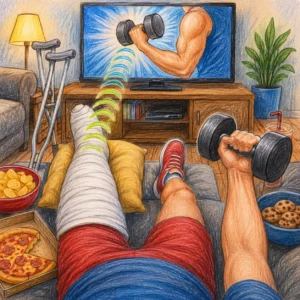
Imagine you’re finally getting into a great workout routine.
You’re showing up consistently, lifting heavier, walking more, eating reasonably well, and beginning to feel like the person who actually has their life together.
Then, one completely ordinary Tuesday, your foot catches on a curb.
Or you drop something heavy.
Or your dog decides that lying directly in the middle of the hallway is an excellent life choice.
Suddenly:
Trip. Twist. Ouch.
And just like that, you’re sitting in a doctor’s office listening to words such as fracture, immobilization, cast, or several weeks of rest.
Your workout schedule has officially been cancelled by the human body.
And while you’re probably more concerned about healing your injury, another thought may creep in:
“What is going to happen to all the strength I worked so hard to build?”
Unfortunately, immobilization can cause strength and muscle losses surprisingly quickly. When a limb isn’t being used normally, your body has little reason to keep investing energy in maintaining its previous capacity.
But here’s the interesting part.
Your body isn’t made up of completely independent pieces. Your nervous system connects the two sides of your body in remarkably complicated ways. Training your healthy limb can sometimes produce beneficial effects in the immobilized limb.
This phenomenon is known as cross-education.
In simple terms, motor training on one side of your body may help your untrained or immobilized side hold on to some strength.
It sounds almost like science fiction.
But research suggests there’s something real behind it.
And if you’re stuck wearing a cast, recovering from surgery, or temporarily unable to use one limb normally, this strange neurological trick may give you another tool to discuss with your doctor or physical therapist.
Let’s break it down without turning your brain into a medical textbook.
What Exactly Is Motor Training?
Before we get into the fascinating part, let’s make one thing clear.
Motor training isn’t about somehow magically moving a broken limb from across the room.
You’re not going to sit on the couch, stare dramatically at your cast, and make your toes wiggle through telepathy.
Instead, the concept we’re talking about is unilateral training—training one side of your body while the other side remains inactive or restricted.
Researchers often call the resulting effect cross-education.
Here’s an easy example.
Suppose your left arm is immobilized after an injury.
Your doctor says you shouldn’t move it.
You obviously don’t start doing left-arm biceps curls because you watched a motivational video at 2 a.m.
Instead, under appropriate medical guidance, you train your right arm.
Over time, some of the strength adaptations associated with that training can transfer to the opposite side.
That’s the fascinating bit.
Your right arm does the physical work, but your nervous system may help the left side maintain some of its functional capacity.
Recent research supports this phenomenon. A 2026 systematic review and meta-analysis of eight studies involving 189 participants found that unilateral resistance training reduced strength loss in an immobilized upper limb compared with immobilization alone. The researchers also found a smaller preservation effect for muscle size.
So, no, your injured arm isn’t secretly doing push-ups inside the cast.
But your nervous system may be doing considerably more work than you realize.
Why Does Training One Side Affect the Other?
This is where your brain becomes the star of the show.
Your muscles don’t operate independently.
Every deliberate movement involves communication between your brain, spinal cord, nerves, and muscles.
When you decide to pick up a dumbbell, your nervous system coordinates the movement by sending signals through a complex network.
And because the two sides of your body are neurologically connected, the command isn’t always as isolated as you might imagine.
When you repeatedly train one limb, your nervous system adapts.
Those adaptations can include improvements in how effectively the brain recruits and coordinates muscles.
Some of those changes can influence the opposite limb.
Researchers don’t believe there’s just one simple mechanism responsible for cross-education. Several neural processes may be involved, including changes in motor areas of the brain and communication between the two sides of the nervous system.
In other words, your brain doesn’t simply say:
“Right arm only. Everyone else, please leave.”
It’s more complicated than that.
And that’s exactly what makes the phenomenon so useful.
A review of the literature describes cross-education as a transfer of strength associated largely with neural adaptations, although the precise mechanisms are still being investigated.
The Big Problem: Muscles Don’t Like Being Ignored
Here’s the frustrating part about being injured.
Your muscles are expensive.
Your body needs energy and resources to maintain them.
If you stop using a muscle for an extended period, your body begins adapting to that reduced demand.
This can mean reduced muscle size, strength, coordination, and physical capacity.
And strength loss isn’t necessarily caused only by shrinking muscles.
Your nervous system also becomes less practiced at activating the immobilized limb.
That’s why the first few movements after prolonged immobilization can feel bizarre.
You might think:
“Why does my leg feel like it belongs to somebody else?”
Because your body has spent weeks operating under completely different conditions.
Immobilization can produce substantial declines in neuromuscular function, which is one reason rehabilitation after injury is so important.
This is where cross-education becomes particularly interesting.
If training your healthy limb can help preserve some strength in the immobilized limb, you may have an opportunity to reduce some of the consequences of inactivity.
Not eliminate them.
Not magically prevent all muscle loss.
But potentially reduce the damage.
And that’s still valuable.
How Motor Training May Help During Immobilization
Let’s imagine you have an injured leg.
Your left leg needs to remain protected.
Your right leg, however, is healthy.
Once your healthcare professional gives you permission to exercise, you may be able to train the healthy side.
For example, depending on your injury and rehabilitation plan, exercises might include unilateral movements such as:
- Single-leg resistance exercises
- Seated or supported strength exercises
- Calf work
- Leg extensions
- Controlled resistance movements
But there’s an important rule:
The exercise must be appropriate for your particular injury.
You shouldn’t copy an exercise routine from the internet simply because somebody called it “the secret hack.”
Your fracture, surgery, cast, joint, circulation, balance, and overall health all matter.
The goal isn’t to become a fitness superhero while injured.
The goal is to support recovery without interfering with healing.
Does Motor Training Actually Preserve Muscle?
This is where we need to separate exciting science from internet exaggeration.
The evidence is encouraging, but it isn’t magic.
A 2026 systematic review and meta-analysis found that cross-education significantly reduced strength loss during upper-limb immobilization. The effect on muscle size was smaller.
That distinction matters.
Strength preservation appears more consistent than muscle-size preservation.
Why?
Because much of the cross-education effect appears to be neural.
Your nervous system can become better at activating muscles even when the opposite limb isn’t physically training.
This doesn’t mean the immobilized muscle is receiving the same stimulus as if you were exercising it directly.
It isn’t.
A casted muscle can’t magically experience the mechanical tension of a normal resistance workout simply because its opposite partner is lifting weights.
Instead, cross-education may help preserve some of the nervous system’s ability to produce force.
Think of it as keeping some of the software updated while the hardware is temporarily unavailable.
That’s a much more accurate way to think about it.
Motor Training Isn’t a License to Go Crazy
This is probably the most important section of the entire article.
If you’re injured, don’t turn cross-education into an excuse to train recklessly.
The original idea that you need to lift extremely heavy weights to create a huge neurological signal is an oversimplification.
You don’t need to chase enormous weights.
You don’t need to train until you’re falling off the bench.
And you definitely don’t need to ignore pain because you think you’re “saving the other side.”
Your healthy limb still needs recovery.
Your cardiovascular system still matters.
Your balance may be affected.
And depending on the injury, excessive training could potentially create problems that have nothing to do with the immobilized limb.
Your doctor or physical therapist should determine what type, intensity, and frequency of exercise are appropriate.
The smartest workout during an injury is the one that helps rather than creates another injury.
A Safer Way to Think About Cross-Education
Instead of thinking:
“I’m going to hack my recovery.”
Think:
“I’m going to maintain as much useful capacity as my healthcare team says is safe.”
That’s a much healthier mindset.
Here are a few principles to discuss with your healthcare professional.
1. Get clearance first
If you’re in a cast, recovering from surgery, or dealing with a serious injury, ask your doctor or physical therapist whether unilateral exercise is appropriate.
This is not optional.
2. Train the healthy side
If permitted, exercises can focus on the uninjured limb rather than trying to force movement into the injured one.
3. Keep technique controlled
You don’t need to turn every workout into an action movie.
Controlled repetitions and good technique are generally more useful than showing off.
4. Don’t ignore pain
Pain in the healthy limb isn’t evidence that the workout is working.
It’s evidence that something may need attention.
5. Keep rehabilitation the priority
Cross-education is a potential addition to rehabilitation—not a replacement for rehabilitation.
Once your injured limb is cleared for movement, your physical therapist can progressively reintroduce appropriate exercises.
What About Visualizing the Injured Limb?
Here’s another fascinating piece of the puzzle.
Mental imagery involves imagining yourself performing a movement without physically performing it.
For example, you might picture your injured arm completing a controlled curl while actually training the opposite arm.
Mental practice has been studied in rehabilitation and sports settings, and motor imagery may influence neural activity involved in movement.
But again, let’s avoid turning this into a superhero story.
Visualization isn’t a substitute for physical rehabilitation.
And we shouldn’t promise that imagining a movement will preserve a specific percentage of muscle.
Think of it as a possible supporting technique, not a magical treatment.
If your therapist recommends motor imagery, however, it can be an interesting addition to your recovery routine.
The Mental Side of Being Injured
There’s another reason motor training can be useful that doesn’t show up neatly on a muscle chart.
It can make you feel less helpless.
Being injured is frustrating.
You suddenly lose access to activities that may have become part of your identity.
Maybe you were training for a race.
Maybe you loved lifting weights.
Maybe exercise was your stress relief.
Now you’re sitting around waiting for your body to cooperate again.
And watching your strength decline can be discouraging.
Cross-training gives you something productive to focus on.
Instead of thinking:
“I can’t train.”
You can potentially shift toward:
“I can’t train that part yet, but there are things I may still be able to do.”
That mental shift can be surprisingly powerful.
Recovery becomes something you’re participating in rather than something you’re simply waiting for.
What Happens When the Cast Finally Comes Off?
This is the moment everyone looks forward to.
The cast comes off.
You stare at your limb.
And…
Well…
It probably doesn’t look exactly like the limb you remember.
That’s normal.
You may notice weakness, stiffness, reduced muscle size, poor coordination, or simply a strange feeling when you try to use it again.
Don’t panic.
Your body has been adapting to weeks of reduced movement.
This is where rehabilitation becomes extremely important.
The good news is that cross-education may help preserve some strength during the immobilization period.
A 2022 systematic review and meta-analysis involving people recovering from ACL reconstruction found that unilateral training of the uninjured limb improved quadriceps strength when added to standard rehabilitation.
And research on lower-limb cross-education has also found meaningful improvements in strength measures in the untrained limb following unilateral resistance training.
But don’t expect to walk out of the clinic with a completely untouched limb.
You will still need rehabilitation.
You will still need patience.
And you will still need to rebuild movement gradually.
The Real “Secret” Isn’t a Hack
There’s a temptation to call cross-education a biological loophole.
And honestly, it’s a pretty fun way to describe it.
But the real lesson is more useful than the headline.
Your body is interconnected.
When one part temporarily can’t participate, other systems can sometimes help maintain function.
That’s why motor training can be interesting during periods of immobilization.
You’re not secretly exercising through the cast.
You’re not bypassing biology.
You’re working with the nervous system’s ability to adapt.
And science increasingly supports the idea that unilateral training can produce beneficial effects in the opposite limb, particularly for strength.
The effect isn’t perfect.
It doesn’t eliminate muscle loss.
It doesn’t replace physical therapy.
And it certainly doesn’t mean every injured person should grab the heaviest dumbbell they can find.
But it does give rehabilitation professionals another tool to consider.
Final Thoughts: Your Injured Side Isn’t Forgotten
Getting injured can feel like pressing the pause button on your entire life.
Suddenly, your normal workout disappears.
Your favorite activities are restricted.
Your muscles become weaker.
And the couch starts looking suspiciously comfortable.
But your body is still working behind the scenes.
Your nervous system continues adapting.
Your healthy side can potentially remain active.
And, with appropriate medical guidance, unilateral motor training may help preserve some of the strength you worked so hard to build.
The key word is may.
That’s important.
Cross-education isn’t a miracle cure or a replacement for proper medical care. It’s a strategy supported by growing evidence that may help reduce strength loss while one limb is immobilized.
So if injury temporarily puts one side of your body on the bench, don’t assume your entire body has to stop participating.
Ask your healthcare professional what you can safely train.
Keep moving where you’re allowed to move.
Keep your expectations realistic.
And remember that recovery isn’t about proving how tough you are.
It’s about giving your body the right conditions to come back stronger.
Sometimes the smartest workout isn’t the one where you move more.
Sometimes it’s the one where you understand how your nervous system can keep working—even when one part of your body has to rest.