
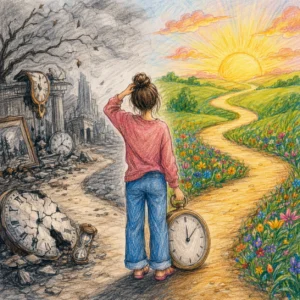
There is a strange little habit most of us share: we keep treating time as if it were something we could put on hold.
We replay the past as though watching it enough times might magically produce a different ending. Then we spend the tomorrow we haven’t received yet planning how happy, successful, relaxed, productive, or fulfilled we’re finally going to be.
Meanwhile, today is standing quietly in the corner like:
“Hello? Am I invisible?”
Let’s imagine something painfully ordinary.
You walk into your kitchen on Monday morning determined to become a completely new person. This is it. The healthy era begins now.
You open the refrigerator and spot a beautiful container of fresh organic raspberries. They’re plump, bright, and suspiciously photogenic.
You think, “I’m going to save these. On Thursday, I’ll make a gorgeous oatmeal bowl with them.”
Excellent plan.
Thursday arrives.
You open the refrigerator, reach for the berries, and discover that your beautiful fruit has transformed into something that looks like it belongs in a laboratory horror documentary.
You stare at it in disbelief.
“But I had plans for you!”
The raspberries, unfortunately, refuse to participate in the conversation.
Time has moved on.
The berries didn’t care about your intentions.
And honestly, neither does time.
That’s the uncomfortable lesson.
We often do the same thing with our lives. We save our happiness for later, while spending enormous amounts of emotional energy arguing with what has already happened.
We tell ourselves:
“I’ll enjoy life when things settle down.”
“I’ll wear that outfit when I lose weight.”
“I’ll take the trip when I have more money.”
“I’ll start painting again when I have more time.”
“I’ll forgive myself when I finally understand why I made that mistake.”
But there is one problem with this strategy:
The past won’t negotiate, and tomorrow isn’t guaranteed.
That doesn’t mean you should stop planning, stop learning, or stop having goals. It simply means you shouldn’t sacrifice the life you’re actually living for a version of life that exists only in your imagination.
And that realization can be surprisingly freeing.
The Past Has No Undo Button
Let’s start with the past, because this is where many of us become professional time travelers.
You lie in bed at 2 a.m. and suddenly remember something embarrassing you said five years ago.
Congratulations.
Your brain has apparently decided that sleep is optional and that the world’s most important emergency is something you said at a dinner party in 2021.
You replay the conversation.
“Why did I say that?”
“Why didn’t I just stay quiet?”
“What did they think of me?”
“What if I had answered differently?”
And round and round you go.
The problem is that thinking about the past isn’t always the same thing as learning from it.
There is a huge difference between reflection and rumination.
Reflection asks:
“What can I learn from this?”
Rumination asks:
“How many different ways can I make myself feel terrible about this?”
The American Psychological Association describes rumination as repetitive, excessive thinking that can interfere with other mental activity.
In other words, your brain can sometimes keep reopening a file that has already been closed.
And here’s the frustrating part:
You can’t edit the original document.
You can understand it.
You can apologize if necessary.
You can repair what can reasonably be repaired.
You can learn.
You can grow.
But you cannot travel backward and become the person you wish you had been.
And that’s okay.
Because the person you were back then didn’t have the knowledge, perspective, or experience you have today.
Imagine the past as a vending machine
Suppose you put money into a vending machine expecting chips.
The machine makes a terrifying mechanical noise and drops pretzels instead.
You stare at the pretzels.
You complain.
You shake the machine.
You explain that you specifically wanted chips.
You spend three hours standing there arguing with it.
Meanwhile, lunch is over.
You’re hungry.
And the pretzels are still sitting there.
That is what obsessing over the past can feel like.
You are demanding a refund from something that has already happened.
Eventually, you have to pick up the lesson and walk away.
The past has already delivered its package.
You don’t have to keep signing for it.
Learning From the Past Without Living There
None of this means the past is useless.
Quite the opposite.
Your past can be an excellent teacher.
It can show you what happens when you ignore red flags, refuse to set boundaries, spend money recklessly, neglect your health, trust the wrong person, or repeatedly make decisions that don’t align with your values.
The trick is to take the lesson without carrying the punishment forever.
Imagine touching a hot stove.
You learn something.
“Okay. Don’t touch that again.”
You don’t need to spend the next ten years standing beside the stove screaming:
“WHY DID I TOUCH THE STOVE?”
You learned.
Move on.
Ask yourself three simple questions:
- What happened?
- What did it teach me?
- What can I do differently now?
That’s productive reflection.
Once you’ve answered those questions, you have permission to close the file.
You don’t need to turn your entire life into a courtroom where you’re permanently both the defendant and the prosecutor.
Tomorrow Is a Terrible Place to Store Your Happiness
Now let’s talk about tomorrow.
Tomorrow sounds wonderful.
Tomorrow is when everything will finally happen.
Tomorrow you’ll wake up early.
Tomorrow you’ll exercise.
Tomorrow you’ll organize the house.
Tomorrow you’ll start the business.
Tomorrow you’ll call your friend.
Tomorrow you’ll eat healthier.
Tomorrow you’ll finally become the person you’ve been planning to become since approximately 2017.
The problem?
Tomorrow keeps moving.
Once it arrives, it becomes today.
Then another tomorrow appears.
And suddenly you’ve spent years living in a waiting room.
This is why phrases like “when things get better” can be so dangerous.
When I get promoted, I’ll relax.
When I lose weight, I’ll wear that dress.
When I have more money, I’ll travel.
When the children are older, I’ll focus on myself.
When work calms down, I’ll spend more time with my family.
There is nothing wrong with having goals.
The problem begins when you make your happiness conditional on achieving them.
Stop Saving Everything for a Special Occasion
Here’s another everyday example.
You buy an expensive candle.
It smells incredible.
You place it somewhere beautiful.
But you don’t light it.
Why?
Because you’re saving it.
For what?
A special evening.
A perfect dinner.
A clean house.
A rainy night.
A romantic mood.
A day when you somehow become the kind of person who casually enjoys expensive candles while wearing linen clothing and listening to jazz.
Weeks pass.
The candle gathers dust.
Eventually, you realize you’ve owned something beautiful for six months without actually enjoying it.
This happens with far more than candles.
We save clothes.
We save dishes.
We save vacations.
We save compliments.
We save hobbies.
We save conversations.
We save joy.
And sometimes, we save entire versions of ourselves.
But tomorrow doesn’t owe us an opportunity to use any of them.
That doesn’t mean you need to spend irresponsibly or behave as if consequences don’t exist.
It means you should stop confusing waiting with living.
Light the candle.
Wear the outfit.
Use the nice plates.
Take the photograph.
Call the person.
Eat the good dessert occasionally.
Start the sketch.
Read the book.
Sit outside.
Enjoy the ordinary Tuesday.
Your life is not a rehearsal.
The Present Is the Only Place You Can Actually Act
Here’s the most important part of the entire conversation:
You cannot act in the past.
You cannot act in tomorrow.
You can only act now.
That’s why the present is so powerful.
If you regret not exercising yesterday, you can walk today.
If you wish you had called someone last week, you can call today.
If you wasted money last month, you can make a better financial decision today.
If you abandoned your creativity five years ago, you can pick up a pencil today.
You don’t need permission from the calendar.
You don’t need a perfect Monday.
You don’t need a dramatic transformation.
You need one small action.
Mindfulness research focuses heavily on bringing attention back to the present rather than becoming trapped in thoughts about the past or worries about the future. NIH notes that practicing present-moment awareness may support stress management and overall well-being.
And here’s the beautiful thing:
Being present doesn’t require sitting cross-legged on a mountain while whispering ancient wisdom to a goat.
You can practice it while drinking coffee.
While washing dishes.
While walking.
While talking to someone.
While eating lunch.
While drawing.
You simply pay attention to what is actually happening instead of mentally living somewhere else.
Step One: Make Peace With What You Cannot Change
Take a few minutes and think about something from the past that still bothers you.
Don’t pretend it didn’t hurt.
Don’t force yourself to say, “Everything happens for a reason.”
Sometimes things simply hurt.
Instead, ask:
“Is there anything I can actually do about this now?”
If yes, do it.
Apologize.
Repair something.
Have the conversation.
Change the behavior.
Learn the lesson.
If no, then recognize that continuing to punish yourself won’t change the outcome.
You are allowed to stop carrying something simply because you’ve carried it for a long time.
Forgiveness doesn’t necessarily mean saying what happened was okay.
Sometimes forgiveness simply means:
“I’m not allowing this event to consume any more of my life.”
That’s a powerful distinction.
Step Two: Stop Making Happiness a Future Appointment
Look at the things you’ve been postponing.
Maybe it’s a hobby.
Maybe it’s wearing clothes you love.
Maybe it’s visiting someone.
Maybe it’s taking yourself out for coffee.
Maybe it’s finally hanging that artwork you’ve had sitting against the wall for eight months.
Pick one.
Do it now.
Not because tomorrow doesn’t matter.
Because today matters too.
Your future deserves planning, but your present deserves participation.
You can save money for a vacation while still enjoying a walk in your neighborhood.
You can work toward a healthier body while appreciating what your body can do today.
You can pursue a promotion while still enjoying dinner with your family tonight.
Life doesn’t have to begin after the next achievement.
Step Three: Turn Intentions Into Tiny Actions
We love intentions.
They’re comfortable.
“I want to write a book.”
Wonderful.
But have you written anything?
“I want to start drawing again.”
Fantastic.
Where is the pencil?
“I want to reconnect with my friend.”
Beautiful.
Have you sent the message?
Intentions become meaningful when they turn into action.
And the action doesn’t have to be enormous.
Write one paragraph.
Draw for ten minutes.
Walk around the block.
Send one text.
Read five pages.
Clean one drawer.
Drink some water.
Make one phone call.
Tiny actions matter because they turn an imaginary future into a real present.
You don’t have to transform your entire life before lunch.
You just have to move it one inch in the right direction.
Step Four: Practice the Art of Actually Being Here
Try this today.
Stop whatever you’re doing for thirty seconds.
Look around.
Notice five things you can see.
Notice what you can hear.
Notice the temperature of the air.
Notice your breathing.
Notice what your body feels like sitting or standing where you are.
Then ask yourself:
“What is happening right now?”
Not what happened yesterday.
Not what might happen next week.
Right now.
Maybe you’re drinking tea.
Maybe your child is talking.
Maybe traffic is making an awful noise outside.
Maybe you’re sitting at your desk.
Maybe nothing particularly exciting is happening.
That’s okay.
Life isn’t supposed to be a nonstop highlight reel.
Sometimes the most meaningful moments are completely ordinary.
Research on mindfulness suggests that deliberately returning attention to the present can help people manage stress and become more aware of their thoughts and experiences.
You don’t have to make the moment extraordinary.
You simply have to notice that you’re in it.
You Don’t Need to Choose Between Planning and Living
There is an important clarification here.
Living in the present does not mean becoming reckless.
It doesn’t mean spending every penny because “tomorrow isn’t guaranteed.”
It doesn’t mean ignoring responsibilities.
It doesn’t mean refusing to plan.
It doesn’t mean abandoning your ambitions.
Planning for the future is sensible.
Saving money is sensible.
Building a career is sensible.
Taking care of your health is sensible.
Preparing for tomorrow is part of living well.
The problem is when preparing for tomorrow consumes all of today.
Think of your life like a road trip.
You need a destination.
You need enough fuel.
You might even need a map.
But if you spend the entire journey staring at the map instead of looking through the windshield, you’re going to miss the scenery.
The future should be your direction—not your permanent residence.
The Real Time-Traveler’s Dilemma
Maybe the strangest thing about being human is that our minds can visit places our bodies cannot.
We can spend breakfast in yesterday.
We can spend lunch worrying about next year.
We can lie in bed tonight replaying something from ten years ago.
And the entire time, our actual life is happening somewhere between those two imaginary destinations.
That’s the tragedy.
But it is also the opportunity.
Because once you notice it, you can come back.
Come back to the coffee.
Come back to the conversation.
Come back to the walk.
Come back to the music.
Come back to the person sitting beside you.
Come back to yourself.
The past has already happened.
Tomorrow will arrive when it arrives.
But this moment?
This one is yours.
Eat the Raspberries While They’re Fresh
Remember those raspberries?
The lesson wasn’t really about fruit.
It was about postponement.
We keep telling ourselves we’ll enjoy things later, when conditions are perfect.
But perfect conditions are remarkably unreliable.
The house may never stay perfectly clean.
Your schedule may never magically become empty.
Your bank account may take longer to grow.
Your children may never stop needing you.
Your work may always be busy.
Your mind may always find something else to worry about.
So don’t wait for a flawless life before allowing yourself to experience it.
Eat the raspberries.
Light the candle.
Wear the outfit.
Call your friend.
Take the picture.
Draw the picture.
Say “I love you.”
Forgive yourself.
Go outside.
Laugh at something ridiculous.
Sit quietly for five minutes.
Do the small thing you’ve been postponing.
Because the point isn’t to stop caring about tomorrow.
The point is to stop sacrificing today for it.
And the point isn’t to erase the past.
The point is to stop letting it write every sentence of your present.
Time will continue moving whether we are ready or not.
The clock doesn’t stop because we’re regretting yesterday.
It doesn’t slow down because we’re waiting for the perfect tomorrow.
So perhaps the best thing we can do is stop fighting the clock and start using the time we’ve actually been given.
Yesterday is finished.
Tomorrow is uncertain.
But right now, you’re here.
And that’s not a small thing.
That’s your life happening.
So go ahead.
Eat the raspberries before they become a science experiment.
References
American Psychological Association — Rumination