
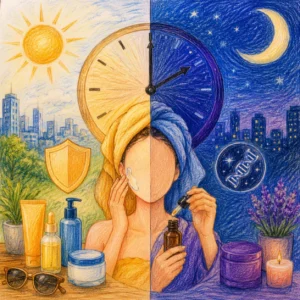
Have you ever spent a small fortune on a fancy serum, applied it religiously before bed, and then woken up looking as though you had personally lost a fight with your pillow?
You followed the instructions. You watched the skincare videos. You even resisted the temptation to buy another product because you were convinced this bottle was finally going to transform your skin.
And yet, the mirror says:
“Nice try.”
Before you banish that expensive serum to the dark, mysterious corner of your bathroom cabinet, there’s another factor worth considering: timing.
We often obsess over what we put on our skin—retinol, vitamin C, peptides, hyaluronic acid, exfoliating acids, moisturizers, oils—but we don’t always think about when we use them.
That’s where Chrono-Cosmetics comes in.
The idea sounds futuristic, but the basic concept is surprisingly simple: your skin doesn’t behave exactly the same way all day and all night. Like the rest of your body, it follows biological rhythms that influence things such as barrier function, temperature, blood flow, hydration, and permeability.
So instead of throwing every skincare product at your face whenever you remember, why not work with your skin’s schedule?
Think of it as giving your skincare routine a calendar.
Your skin has meetings. Your serum needs an appointment.
What Exactly Is Chrono-Cosmetics?
Chrono-Cosmetics refers to the idea of timing cosmetic or skincare interventions according to biological rhythms.
In plain English?
It means understanding that your skin has different priorities at different times of the day and choosing your routine accordingly.
Your skin is constantly responding to its environment. During daylight hours, it has to deal with ultraviolet radiation, pollution, temperature changes, wind, dryness, and other environmental stressors.
At night, the situation changes.
Your body enters a different physiological state, and several properties of the skin—including permeability, temperature, blood flow, and water loss—show daily variations. Research has also identified circadian clock mechanisms within skin cells themselves.
This doesn’t mean your skin suddenly flips a giant sign from OPEN to CLOSED at sunset.
It means your skin’s behavior changes over the course of the day.
And that’s an important distinction.
Chrono-Cosmetics isn’t about following a magical skincare timetable down to the exact minute. It’s about understanding your skin’s natural rhythms and building a routine that makes sense around them.
Your Skin Has Its Own Biological Clock
You’ve probably heard about your circadian rhythm.
It’s the roughly 24-hour biological system that helps regulate sleep, wakefulness, hormones, body temperature, and many other processes.
But here’s the interesting part: your skin isn’t simply waiting for instructions from your brain.
Skin contains its own molecular clock mechanisms.
Studies have found that various skin functions—including cell proliferation, blood flow, temperature, barrier behavior, and transepidermal water loss—can vary throughout the day.
Imagine your skin as a tiny office.
During the day, the security team is busy dealing with incoming threats.
At night, the maintenance department gets more involved.
Of course, biology isn’t quite that neat. Your skin doesn’t completely stop repairing itself at sunrise or suddenly become a repair factory at midnight. These processes overlap.
But the differences are real enough to make timing an interesting part of skincare.
And you don’t need to memorize complicated biological charts to take advantage of them.
You simply need to give your skin the right jobs at the right parts of the day.
Morning Skincare: Think Protection First
When you wake up, your skin is about to face the outside world.
Maybe you’re walking to work.
Maybe you’re sitting beside a sunny window.
Maybe you’re driving, exercising outdoors, or spending the afternoon running errands.
Whatever your day looks like, your skin is going to encounter environmental stressors.
That makes your morning routine less about throwing every anti-aging ingredient you own onto your face and more about protection and hydration.
1. Start With Gentle Cleansing
You don’t necessarily need to attack your face with a powerful cleanser first thing in the morning.
If your skin feels comfortable after waking, a gentle cleanser—or even a water rinse for some people—may be enough.
The goal is to remove excess oil, sweat, and nighttime skincare without leaving your skin feeling tight and squeaky.
And remember: squeaky-clean skin isn’t necessarily happy skin.
Sometimes it is simply screaming, “Why did you do this to me?”
2. Add an Antioxidant
Morning can be a useful time for antioxidant products such as vitamin C.
Vitamin C is widely used in skincare because of its antioxidant properties and its role in supporting collagen production and helping address uneven pigmentation.
You don’t need a serum containing seventeen different antioxidants and the tears of a mythical unicorn.
One well-formulated product is enough.
Consistency matters more than having a bathroom counter that looks like a chemistry laboratory.
3. Hydrate Your Skin
Next comes moisturizer.
If your skin is dry, tight, or easily irritated, a moisturizer can help support the skin barrier and reduce water loss.
If you’re oily, that doesn’t mean you should skip moisturizer completely.
Instead, look for a lightweight formulation that feels comfortable on your skin.
The perfect moisturizer isn’t the one with the fanciest packaging.
It’s the one you actually enjoy using consistently.
4. Never Negotiate With Sunscreen
If there is one part of your daytime skincare routine worth treating as non-negotiable, it’s sun protection.
The American Academy of Dermatology recommends choosing a broad-spectrum, water-resistant sunscreen with SPF 30 or higher. Sunscreen helps protect against sunburn, premature skin aging, and skin cancer.
And yes, this still matters when the weather is cloudy.
UVA radiation can contribute to premature skin aging, while UVB is a major contributor to sunburn.
So if your morning routine contains five serums but no sunscreen, your skincare priorities may need a little rearranging.
It’s like spending money renovating your house while leaving the front door permanently open during a storm.
Afternoon Skin: Why Your Face Can Suddenly Get Weird
Ever looked in the mirror around 3 PM and thought:
“Who is this shiny person?”
Your skin can feel different as the day progresses.
Oiliness, dryness, sweat, makeup buildup, environmental exposure, and changing hydration can all influence how your complexion looks and feels.
But don’t panic and start adding six more products.
If your skin feels dry, you can refresh it with a suitable moisturizer or hydrating product.
If you’re oily, gently blotting excess oil may be more useful than repeatedly washing your face.
And if you’ve been outdoors, remember that sunscreen protection doesn’t last forever.
When you’re spending extended time outdoors, the AAD recommends reapplying sunscreen approximately every two hours and after swimming or sweating, according to the product’s directions.
Your afternoon face doesn’t need a dramatic intervention.
Sometimes it just needs sunscreen, hydration, and for you to stop staring at it under fluorescent lighting.
Nighttime Skincare: Give Your Skin a Different Kind of Care
Now we reach the part most people associate with beauty sleep.
And yes, sleep genuinely matters.
Your nighttime routine is a good opportunity to use targeted products because you’re no longer preparing your skin for direct daytime UV exposure.
But let’s clear up one common misconception.
There isn’t a magical moment at exactly 11:00 PM when your skin suddenly whispers:
“Release the retinol.”
The biology is more complicated than that.
Skin functions change across the day and night, and research suggests that evening and nighttime can involve changes in permeability and water loss.
So rather than obsessing over a specific clock time, focus on having a consistent nighttime routine.
Step 1: Remove the Day
If you’ve worn makeup or sunscreen, cleanse your skin properly.
Some people prefer double cleansing, especially when removing makeup or water-resistant sunscreen.
That can mean:
First: an oil-based or balm cleanser.
Second: a gentle water-based cleanser.
But double cleansing isn’t mandatory for everyone.
If one gentle cleanser gets everything off without irritating your skin, congratulations.
You’ve just saved yourself an entire step.
Step 2: Choose Your Targeted Treatment
Nighttime can be a practical opportunity for ingredients such as retinoids, depending on your skin and the product you’re using.
Retinoids are among the better-known ingredients for addressing concerns such as fine lines, acne, and uneven skin texture.
However, they can irritate the skin and increase sun sensitivity, which is why dermatologists generally recommend using them at night and protecting your skin from the sun during the day.
If you’re new to retinol, don’t start by applying it every night and hoping for a miracle.
Your skin may respond with:
“Absolutely not.”
Start slowly and follow the instructions for your particular product.
Step 3: Don’t Turn Your Face Into a Chemical Experiment
Another mistake people make with nighttime skincare is stacking too many powerful ingredients.
Retinol.
Glycolic acid.
Salicylic acid.
Vitamin C.
Peptides.
Exfoliating toner.
And possibly one product that promises to make you look like a completely different person by breakfast.
More isn’t automatically better.
The American Academy of Dermatology recommends focusing on your primary skin concern and avoiding the use of too many anti-aging products at once because irritation can make the skin look worse.
Your face is not a science fair.
Give it one job at a time.
Where Do Peptides Fit Into Chrono-Cosmetics?
Peptides are another popular category in nighttime skincare.
They’re short chains of amino acids used in many cosmetic formulations and are often marketed for supporting the appearance of firmness and smoother-looking skin.
You don’t necessarily need to use peptides at night specifically.
Unlike retinoids, their use isn’t defined by the same strong reason to avoid daytime exposure.
But adding a peptide product to your evening routine can be a simple way to keep your routine organized.
Again, consistency beats complexity.
What About Exfoliating Acids?
Ingredients such as glycolic acid and lactic acid can help remove dead surface skin cells and improve the appearance of texture and brightness.
They can be useful—but they don’t need to be used every night.
Over-exfoliation is one of the easiest ways to turn a perfectly reasonable skincare routine into a skin-barrier disaster.
If your skin becomes burning, unusually tight, peeling, or persistently irritated, that’s not necessarily evidence that your skincare is “working.”
It may be evidence that you’ve gone too far.
Chrono-Cosmetics isn’t about doing more.
It’s about doing the right things thoughtfully.
The Sleep Connection: Your Skincare Routine Isn’t the Whole Story
Here’s something worth remembering:
You can own the world’s most sophisticated skincare routine and still sabotage yourself with terrible sleep.
Your circadian system doesn’t operate independently of your lifestyle.
Late nights, inconsistent sleep schedules, stress, and excessive nighttime light exposure can interfere with normal circadian biology.
And while that doesn’t mean one late-night Netflix marathon will destroy your complexion, consistently poor sleep isn’t exactly a beauty strategy.
You know that classic morning face after sleeping for four hours?
The dull eyes.
The tired expression.
The “I have made several questionable decisions” energy?
Exactly.
So if you’re serious about Chrono-Cosmetics, don’t think only about the products in your bathroom.
Think about your biological clock as a whole.
A Simple Chrono-Cosmetics Routine You Can Actually Follow
Forget complicated 14-step schedules.
Here’s a practical approach.
Morning
1. Cleanse gently
Remove sweat, excess oil, and leftover products.
2. Use an antioxidant if desired
Vitamin C is a popular choice.
3. Moisturize
Choose a texture suited to your skin.
4. Apply broad-spectrum SPF 30+
This is the most important daytime protection step.
During the Day
1. Reapply sunscreen when needed
Especially when you’re outdoors.
2. Hydrate when your skin feels dry
Use a suitable moisturizer or hydrating product.
3. Don’t constantly touch or scrub your face
Your skin isn’t a dusty bookshelf.
Evening
1. Remove makeup and sunscreen
2. Cleanse gently
3. Apply your chosen treatment. For example, a retinoid, peptide product, or exfoliating acid depending on your routine.
4. Moisturize
5. Go to bed
That final step may be the hardest one.
Common Chrono-Cosmetics Mistakes
Mistake 1: Thinking Timing Can Replace Good Skincare
It can’t.
Putting a mediocre product on at the “perfect” time doesn’t magically turn it into a miracle treatment.
Product quality, formulation, skin type, consistency, and proper use still matter.
Mistake 2: Believing There’s One Perfect Skincare Time
Your skin isn’t a microwave.
You don’t have to apply your moisturizer at exactly 9:07 PM.
Your schedule, climate, lifestyle, and skincare products all matter.
Think of circadian timing as a helpful framework—not a rigid appointment calendar.
Mistake 3: Using Retinol Whenever You Remember
Retinoids are generally best used at night, and daytime sun protection is essential.
So if your retinol has been sitting beside your toothbrush because you keep forgetting to use it, move it somewhere that reminds you to use it in your evening routine.
Mistake 4: Skipping Moisturizer Because You’re Oily
Oily skin still needs hydration.
Instead of abandoning moisturizer altogether, choose a lightweight, non-comedogenic formulation that works for your skin.
Mistake 5: Changing Everything at Once
This is perhaps the biggest skincare mistake of all.
You buy four new products.
You start all of them Monday.
By Thursday, your face is angry.
Now you have no idea which product caused the problem.
Introduce new products gradually whenever possible.
It makes your routine easier to understand and your skin much easier to manage.
Does Chrono-Cosmetics Really Work?
Here’s the honest answer:
The science behind biological rhythms in skin is real, but Chrono-Cosmetics should not be treated as a magical skincare hack.
Research clearly shows that skin physiology changes according to circadian rhythms. Skin barrier behavior, permeability, temperature, blood flow, and water loss can vary throughout the day.
However, claims that applying a particular product at one exact hour will dramatically multiply its effectiveness are much stronger than the evidence supports.
That’s why the smartest approach is surprisingly simple:
Use ingredients appropriately, protect your skin during the day, use targeted treatments thoughtfully at night, and maintain a consistent sleep-wake routine.
You don’t need a stopwatch.
You need consistency.
The Bigger Beauty Lesson
Perhaps the most useful thing about Chrono-Cosmetics isn’t a specific product or magical hour.
It’s the reminder that your skin is living tissue.
It isn’t an empty canvas waiting for you to dump another serum onto it.
It responds to light, temperature, hormones, environmental exposure, sleep, stress, hydration, and countless other signals.
Once you understand that, skincare becomes less about chasing trends and more about supporting your body’s natural processes.
Morning is your opportunity to protect.
Daytime is about maintaining.
Evening is your opportunity to cleanse, treat, and moisturize.
And nighttime sleep gives your entire body—including your skin—the chance to follow its natural rhythms.
So the next time you find yourself standing in front of the bathroom mirror at midnight, surrounded by twelve bottles and wondering why your skin isn’t cooperating, take a breath.
You probably don’t need another serum.
You might just need a better routine—and maybe, honestly, a little more sleep.
Because beautiful skin isn’t always about doing more.
Sometimes it’s about doing the right things at the right time, consistently.
References
Circadian Rhythm and the Skin — PMC