
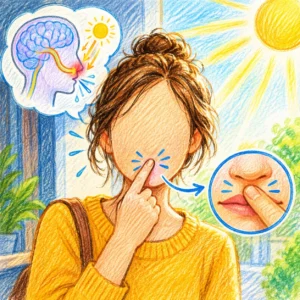
Picture this.
You walk out of a dim restaurant into brilliant afternoon sunshine. You blink once. Twice.
Then your nose starts tingling.
You know what’s coming.
Your eyes narrow, your nostrils twitch, and your entire face suddenly prepares for a dramatic “Achoo!” at exactly the moment you don’t want it.
Maybe you’re stepping onto a stage. Maybe you’re trying to apply eyeliner without poking yourself in the eye. Maybe you’re sitting quietly in a meeting. Or perhaps you’re driving out of a dark tunnel and into bright daylight.
And then—boom.
One innocent burst of sunlight appears to press a mysterious button inside your nose.
If this happens to you regularly, congratulations: you may have what scientists call the photic sneeze reflex.
It’s one of those wonderfully strange things the human body does that sounds made up until you realize there is actual research behind it. Bright light, particularly a sudden change from darkness to intense light, can trigger sneezing in some people. Researchers estimate that roughly one in four people may experience this phenomenon, although estimates vary between studies and populations.
And yes, there is a popular trick involving pressure around the upper lip that people claim can interrupt the sensation.
But before you start treating your face like a remote control, there’s an important distinction: the photic sneeze is real; the idea that pressing your upper lip is a scientifically proven “cancel button” is not.
So let’s separate the fascinating science from the internet folklore—and figure out what you can actually do when sunlight suddenly makes your nose decide it’s party time.
What Exactly Is a Photic Sneeze?
A photic sneeze is sneezing triggered by exposure to bright light.
The classic situation is almost comically predictable.
You’re sitting in a dark room. Everything is calm. Your nose is behaving itself.
Then you step outside.
The sunlight hits your eyes.
Your face freezes.
And suddenly:
ACHOO!
Some people sneeze once. Others sneeze several times in rapid succession.
The phenomenon is also known as ACHOO syndrome, which stands for the wonderfully elaborate phrase Autosomal Dominant Compelling Helio-Ophthalmic Outburst. The name is much more intimidating than the condition itself.
The important point is that photic sneezing isn’t the same thing as having a pollen allergy.
You don’t necessarily have something irritating your nose.
Instead, the trigger appears to be light itself—or more specifically, a sudden change in light intensity.
Research has found that bright-light exposure can reliably provoke sneezing in susceptible people, although scientists still don’t have one universally accepted explanation for exactly why it happens.
And that’s where things get interesting.
Why Does Bright Light Make You Sneeze?
Your brain is constantly receiving information from different parts of your body.
Your eyes report changes in light.
Your nose reports smells, irritation and sensations.
Your skin reports touch and pressure.
Your ears report sound.
Most of the time, these signals stay nicely organized.
But the nervous system is an enormous communication network, and researchers have proposed several explanations for why intense visual stimulation can sometimes be associated with a sneeze.
One leading idea involves interactions between visual processing and pathways involving the trigeminal system, a major sensory network responsible for much of the sensation in your face.
However, here’s where the original version of this story needs a scientific reality check.
It’s tempting to describe the phenomenon as if the optic nerve simply “short-circuits” into the trigeminal nerve and accidentally tells your nose to sneeze.
That’s a fantastic metaphor.
It’s just not established science.
Studies suggest that photic sneezing may involve increased sensitivity to visual stimulation and activity in areas of the brain involved in processing sensory information. One EEG study found differences in visual-cortex responsiveness among people who experience photic sneezing, along with activity in sensory-processing regions associated with the nasal prickling sensation.
More recent reviews emphasize that the precise mechanism remains unresolved. Several theories—including optic-trigeminal interactions and autonomic nervous-system mechanisms—have been proposed, but none has been conclusively demonstrated as the explanation.
In other words, your brain isn’t necessarily “confused.”
It may simply have a particularly sensitive way of responding to sudden changes in visual stimulation.
So Why Does It Feel Like Your Nose Is Being Hijacked?
Because sneezing is powerful.
A sneeze isn’t just your nose deciding to make an annoying sound.
It’s a coordinated reflex involving your respiratory muscles, throat, face and nasal passages.
Your body is essentially preparing a rapid expulsion of air.
Once the sensation starts building, trying to mentally negotiate with it can feel completely useless.
You can tell yourself:
Don’t sneeze.
Your brain responds:
Interesting suggestion.
ACHOO.
That’s because conscious thought doesn’t have complete control over involuntary reflexes.
And that’s also why the idea of physically interrupting the sensation is so appealing.
Which brings us to the famous upper-lip trick.
Can Pressing Your Upper Lip Stop a Photic Sneeze?
This is where we need to separate popular technique from proven medical treatment.
You may have heard that pressing firmly on the area between your nose and upper lip—the small vertical groove called the philtrum—can stop a sneeze.
The technique is easy.
Place a finger horizontally beneath your nose.
Apply gentle, noticeable pressure to the upper lip.
Hold it briefly.
Some people report that this interrupts the urge to sneeze.
But there is currently no strong clinical evidence showing that upper-lip pressure reliably cancels a photic sneeze through a proven “sensory-gating override.”
So rather than calling it a neurological emergency brake, it’s more accurate to describe it as a commonly suggested trick that may help some people but isn’t guaranteed.
And that’s actually more interesting than pretending we have solved the mystery.
Your face contains a dense network of sensory nerves. Applying pressure around the nose and upper lip certainly creates a new sensory signal. It’s plausible that changing what you’re paying attention to may alter the sensation of an impending sneeze.
But that doesn’t mean we’ve discovered a secret button that switches off the sneeze reflex.
Your nervous system is considerably more complicated than that.
If You Want to Try the Upper-Lip Trick
If you’ve noticed that pressure around your upper lip seems to reduce the urge for you, there’s nothing particularly mysterious about trying a gentle version of it.
Here’s the sensible approach.
Step 1: Notice the Early Warning
The earlier you notice the familiar nasal tickle, the better.
Don’t wait until you’re already in the middle of a powerful sneeze.
Step 2: Place Your Finger Under Your Nose
Use a clean finger and gently position it across the upper-lip area beneath your nose.
Step 3: Apply Gentle Pressure
Use steady, comfortable pressure.
There is absolutely no reason to press hard enough to cause pain, numbness or discomfort.
Step 4: Give Yourself a Moment
Take a calm breath and see whether the sensation passes.
If the sneeze disappears, great.
If it doesn’t, don’t fight it.
Step 5: Let the Sneeze Happen Safely
This is the important part.
If your body is going to sneeze, don’t forcefully clamp your nose and mouth shut to prevent it.
Let the reflex happen safely.
Cover your nose and mouth with a tissue or sneeze into your elbow according to standard respiratory-hygiene advice.
The goal isn’t to defeat your biology at all costs.
The goal is simply to remain comfortable and safe.
Why You Shouldn’t Forcefully Hold a Sneeze
There’s a big difference between trying a gentle distraction technique when you first feel a sneeze coming and forcibly stopping a sneeze that is already happening.
The second one isn’t a great idea.
Sneezing produces a rapid pressure change. When you aggressively block the nose and mouth, that pressure has fewer places to escape.
Medical experts have reported potential complications from forcefully suppressing sneezes, including problems involving the ears, sinuses and blood vessels. Serious injuries are uncommon, but they’re exactly why “just pinch your nose shut” isn’t sensible advice.
So if the upper-lip trick doesn’t work?
Don’t escalate.
Don’t squeeze your nose harder.
Don’t hold your breath until your face turns purple.
And definitely don’t try to win a wrestling match against your respiratory system.
Sometimes the healthiest response is simply:
Achoo!
When a Photic Sneeze Can Actually Be a Problem
For most people, photic sneezing is simply weird.
It happens.
You sneeze.
You continue with your day.
But there are situations where it deserves more attention.
Imagine driving a car out of a dark tunnel.
Suddenly, sunlight hits your windshield.
Your eyes react.
Your nose reacts.
You sneeze repeatedly.
Even a brief involuntary reaction can be distracting when you’re controlling a vehicle.
Researchers have specifically noted that photic sneezing can create safety concerns for drivers and pilots because sudden sneezing can occur during visually demanding situations.
A 2026 case report also described a motor-vehicle accident associated with recurrent light-triggered sneezing, highlighting why people who experience frequent photic sneezing should take extra care during driving and other safety-sensitive activities.
If sunlight reliably triggers sneezing while you’re driving, don’t experiment with finger tricks behind the wheel.
Instead, prioritize safe driving habits.
Wear appropriate sunglasses when conditions allow.
Keep your windshield clean.
Avoid staring toward bright light.
And if your sneezing is frequent, severe or difficult to control, talk with a healthcare professional.
How to Reduce Your Chances of a Sun-Induced Sneeze
You can’t necessarily switch off a photic sneeze reflex.
But you can sometimes reduce the intensity of the trigger.
Wear Sunglasses
Good-quality sunglasses can reduce the amount of intense light reaching your eyes.
They’re especially useful when moving from shade into bright sunlight.
Give Your Eyes a Transition
If you’re leaving a dark building, don’t immediately stare toward the brightest part of the sky.
Let your eyes adjust naturally.
Use Your Car’s Sun Visor
If you experience photic sneezing while driving, use your vehicle’s sun visor appropriately and keep your attention on the road.
Avoid Looking Directly at Bright Lights
This sounds obvious, but people often instinctively look toward the source of sudden brightness.
You don’t need to stare at the sun to experience photic sneezing.
Your eyes can react to substantial changes in illumination without direct sun-gazing.
And, of course, never deliberately look directly at the sun.
Is Photic Sneezing Genetic?
Possibly—and genetics appear to play a role.
The phenomenon has historically been described as having an autosomal-dominant inheritance pattern, meaning that it can run in families.
Modern genetic research has also identified genetic variants associated with photic sneeze reflex susceptibility. A large study in a Chinese population found genetic associations with the trait and supported the idea that its biological basis is complex rather than being explained by a single simple switch.
But here’s another reason not to oversimplify the story.
Not everyone who experiences photic sneezing has a parent who does it.
And not everyone who has a family member with it will necessarily experience it themselves.
So if your father sneezes every time he walks outside and you do too, you aren’t imagining the family resemblance.
Your genes may genuinely be contributing.
You’re Not Broken—Your Nervous System Is Just Weird
Human biology is full of bizarre little features.
Some people sneeze in bright sunlight.
Some people get goosebumps when they hear music.
Some people can wiggle their ears.
Others can fall asleep almost instantly while their partner lies awake contemplating every embarrassing thing they’ve done since 2008.
The human nervous system is complicated.
The photic sneeze is simply one of those quirks that reminds us how interconnected our senses really are.
Light enters your eyes.
Your brain processes it.
Your autonomic and sensory systems respond.
And somehow your nose gets involved.
We don’t yet have every answer about exactly why that happens.
And that’s okay.
Science is often most interesting precisely where the explanation isn’t finished.
The Real “Trick” Is Understanding Your Trigger
So, can pressing your upper lip stop a photic sneeze in five seconds?
Maybe for some people.
But it shouldn’t be presented as a guaranteed medical technique.
The more useful discovery is understanding your own trigger pattern.
Does it happen when you leave a dark room?
When you step outside at noon?
When sunlight suddenly hits your face?
When you look toward a bright window?
Once you know your pattern, you can plan around it.
And that’s much more powerful than relying on a supposedly magical pressure point.
If you’re walking outside and feel that familiar tickle, you can slow down, avoid staring toward the brightest light, put on your sunglasses and let your eyes adjust.
If you want to gently try the upper-lip technique, you can.
If it doesn’t work, don’t force it.
And if the sneeze arrives anyway?
Let your body do what it was designed to do.
Final Thoughts: Sometimes “Achoo” Is Just Biology
The photic sneeze reflex is a perfect example of how wonderfully strange the human body can be.
Bright light can trigger sneezing in a significant minority of people, and scientists are still investigating exactly how visual and sensory pathways interact to create this response.
The upper-lip trick is an interesting piece of practical folklore, but it isn’t a proven neurological “cancel button.”
And honestly, that’s worth knowing.
You don’t need exaggerated internet claims to make the phenomenon fascinating.
Your brain already does something extraordinary: it can take a sudden environmental change—something as ordinary as stepping into sunlight—and produce a completely involuntary sneeze.
So the next time you walk outside and your nose suddenly starts preparing for an unexpected explosion, don’t panic.
Take a breath.
Let your eyes adjust.
If you want, try gentle pressure around your upper lip and see whether it helps you.
But don’t forcefully suppress the sneeze.
And if it still happens?
Well…
Achoo.
Consider it your nervous system’s slightly ridiculous way of saying:
“Congratulations. We have detected sunlight.”
References
Stimulus conditions eliciting sneezing in response to bright light
When the sun prickles your nose: an EEG study identifying neural bases of photic sneezing
ACHOO Syndrome — Medical Genetics Summaries, NCBI Bookshelf.