
Imagine driving a beautiful sports car down a winding road.
The engine is powerful, the suspension is sophisticated, and every part of the car has been designed to work together. But now imagine covering the windshield with a thick, blurry sheet of plastic. You can still drive, but your ability to read the road has suddenly become much worse.
You might miss a small pothole. You might react too late to a sharp turn. You might have trouble judging exactly how the tires are interacting with the road.
Your body has its own version of this communication system.
And surprisingly, a big part of that conversation starts at your feet.
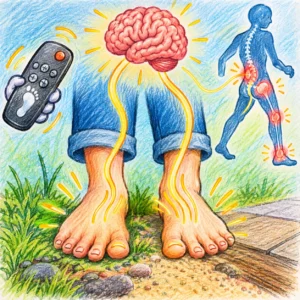
Every time your feet touch the ground, thousands of sensory receptors detect pressure, movement, stretch, and changes in the surface beneath you. That information travels through your nervous system and helps your brain coordinate balance and movement.
This sensory relationship is often discussed alongside Plantar Proprioception.
Now, before we blame your favorite sneakers for every ache in your lower back, there is an important reality check: your shoes are not automatically the hidden villain behind chronic pain. Back, hip, knee, and foot pain can have many causes, including muscle weakness, injuries, joint conditions, activity levels, posture, training errors, and medical conditions.
However, your feet really do matter.
They are your body’s foundation, and the sensory information coming from them can influence how you stand, walk, balance, and move.
So let’s take a closer look at this fascinating foot-to-brain connection—and how you can safely give your feet more opportunities to move, sense, and work.
What Exactly Is Plantar Proprioception?
Let’s start with the simplest explanation.
Proprioception is your body’s ability to sense where different parts of you are positioned and how they are moving without having to consciously stare at them.
Close your eyes and lift one foot.
You probably know where that foot is even though you cannot see it.
That’s proprioception at work.
Your nervous system gathers information from muscles, tendons, joints, skin, and other sensory structures. Your brain combines all of those signals to create an ongoing picture of where your body is and how it is moving.
The soles of your feet are particularly interesting because they are constantly interacting with the environment.
The skin of the foot contains different types of low-threshold mechanoreceptors that respond to things such as pressure and deformation. Research shows that sensory information from the soles contributes to the control of standing balance and walking.
Think about walking across different surfaces.
A smooth kitchen floor feels completely different from grass.
Grass feels different from sand.
Sand feels different from a firm sidewalk.
Your feet detect those differences, and your nervous system uses the incoming information to help coordinate your movements.
You don’t have to consciously announce:
“Attention, brain. We have encountered grass. Please adjust ankle strategy accordingly.“
Thankfully, your nervous system handles that conversation automatically.
Your Feet Are More Than Just Things Inside Your Shoes
Most of us think about our feet in surprisingly boring ways.
They get us from the bedroom to the kitchen.
They help us squeeze into our favorite shoes.
They complain when we stand in line too long.
And occasionally, they become the victims of the dreaded furniture corner.
But mechanically and neurologically, your feet are much more impressive.
The foot contains numerous bones, joints, muscles, tendons, ligaments, and sensory structures. Together, they help absorb and redirect forces while allowing you to adapt to different surfaces.
When you walk, your foot doesn’t behave like a solid block.
It changes shape.
It loads.
It unloads.
It adjusts.
Your ankle moves.
Your toes contribute to stability and propulsion.
Your calf muscles respond.
Your knee and hip coordinate with the movement.
And your brain continuously receives information about what is happening.
That means your foot isn’t simply a platform underneath your body.
It is an active participant in movement.
Can Your Shoes Really “Turn Off” Your Feet?
This is where the conversation needs a little nuance.
It’s tempting to say that thick, cushioned shoes completely block sensory information from the ground.
They don’t.
Your feet can still sense pressure and movement while you’re wearing shoes. The amount and type of sensory information may change depending on the shoe’s construction, stiffness, thickness, fit, and sole.
So your sneakers aren’t necessarily putting your feet into a neurological blackout.
However, different footwear can change the mechanical and sensory experience of walking.
A very stiff shoe behaves differently from a flexible shoe.
A narrow toe box feels different from a wide one.
A thick sole creates a different relationship with the ground than a thin sole.
And a highly supportive shoe may alter how certain parts of the foot move.
That doesn’t automatically make one option “good” and the other “bad.”
It simply means footwear is part of the movement equation.
The bigger lesson is that your feet benefit from being allowed to move and function appropriately—not that everyone needs to abandon supportive footwear.
Why Foot Sensation Matters for Balance
Here’s a simple experiment.
Stand normally with your feet about hip-width apart.
Now close your eyes.
Did you suddenly become more aware of every tiny wobble?
That’s because your brain normally receives information from several systems that help maintain balance.
Your vision gives you information about your surroundings.
Your inner ear contributes information about head movement and orientation.
Your muscles and joints provide information about body position.
And sensory information from the feet tells your nervous system about your contact with the ground.
When one source of information becomes less reliable, your brain can increase its reliance on other sources.
This is one reason foot sensation becomes especially important for balance as people age or when certain neurological or musculoskeletal problems affect movement.
Research on the sensory receptors of the foot sole shows that altering this feedback can change gait and standing balance.
So yes, your feet are sending valuable information upward.
But that doesn’t mean every ache in your back is secretly a foot problem.
The Foot-to-Knee-to-Hip Connection
Here’s where things get really interesting.
Your body works as a kinetic chain.
When one joint moves, neighboring joints often respond.
Your foot interacts with the ground.
Your ankle responds to that interaction.
Your shin and knee coordinate with the movement.
Your thigh rotates.
Your pelvis responds.
Your spine helps maintain your overall position.
This doesn’t mean that a small change in your foot automatically throws your entire skeleton “out of alignment.”
Human movement is much more adaptable than that.
Instead, think of your body as a team.
If one player changes how they move, the other players may adjust their strategies.
Sometimes those adjustments are completely normal.
Sometimes they become inefficient or painful, particularly when combined with weakness, injury, excessive training, poor recovery, or another underlying problem.
That’s why looking at the entire movement system can be more useful than obsessing over one body part.
Could Your Feet Be Contributing to Your Back Pain?
Possibly—but don’t jump to conclusions.
There are studies exploring relationships between foot mechanics, lower-limb movement, and musculoskeletal pain. However, the relationship between footwear, foot posture, and back pain is complicated.
There is no reliable rule saying:
“Bad feet = bad back.”
Likewise, there isn’t a universal rule saying:
“Bare feet = pain-free spine.”
If you have persistent lower-back pain, the sensible approach is to investigate the problem rather than automatically blaming your shoes.
Your pain could involve muscles.
It could involve joints.
It could be related to training or activity.
It could involve an old injury.
It could have nothing to do with your feet at all.
And occasionally, back pain can be associated with medical conditions that require professional evaluation.
Your feet are worth considering, but they shouldn’t become the scapegoat for every unexplained ache.
How to Wake Up Your Feet Safely
The good news is that you don’t need to spend thousands on gadgets to give your feet more movement and sensory variety.
You can start with simple habits.
1. Spend Some Time Barefoot at Home
If your environment is safe, try spending some time barefoot indoors.
Walk around your home.
Stand while brushing your teeth.
Move your toes.
Feel the difference between carpet, tile, wood, and other safe surfaces.
This isn’t a magical cure.
You’re simply giving your feet an opportunity to experience different sensory and mechanical conditions.
If you’re at increased risk of foot injury or have reduced sensation in your feet, however, barefoot walking may not be appropriate. In that situation, ask a healthcare professional what is safe for you.
2. Try Gentle Foot Mobility
Sit comfortably and slowly move your ankles through their comfortable range of motion.
Then practice spreading and relaxing your toes.
Try lifting your big toe while keeping the other toes down.
Then reverse it if you can.
Don’t worry if your toes initially behave like five stubborn toddlers refusing to cooperate.
Coordination takes practice.
The goal isn’t to force extreme movement.
It’s to gradually improve your awareness and control.
3. Practice the “Tripod Foot”
Here’s a useful exercise.
Imagine your foot has three important contact points:
- The heel
- The base of the big toe
- The base of the little toe
While standing, gently feel those three areas contacting the floor.
Don’t grip your toes.
Don’t force your arch upward.
Simply notice how your weight is distributed.
This can be a simple way to increase awareness of your foot position while standing.
4. Explore Safe Natural Surfaces
If you have a safe area available, try walking slowly on grass or another comfortable surface.
You don’t need to walk over sharp rocks like you’re auditioning for a survival documentary.
Start with something gentle.
Notice how your feet respond to small changes in the surface.
The objective is sensory variety and movement—not suffering.
5. Strengthen the Muscles Around Your Feet
Foot strength can be trained.
Simple exercises such as controlled calf raises, toe movements, balance exercises, and other foot-strengthening activities may be useful depending on your goals and physical condition.
If you have existing pain, an injury, or a medical condition, a physical therapist can help choose exercises appropriate for you.
This is especially important because “more movement” isn’t automatically better.
Your body needs an appropriate dose.
What About Minimalist or Barefoot Shoes?
This is where you should slow down.
Minimalist footwear has become popular because it allows greater foot movement and provides a different sensory and mechanical experience.
Some research suggests minimalist footwear may influence foot muscle strength, gait mechanics, and lower-limb loading. But the evidence is mixed, and minimalist footwear isn’t automatically superior for everyone.
Most importantly, don’t suddenly go from thick supportive shoes to running barefoot five miles on Monday morning.
Your feet and lower legs need time to adapt.
Recent research published in 2026 found that transitioning to minimalist footwear was associated with increased injury risk, particularly involving the forefoot, Achilles tendon, and calf, when people made the transition.
Previous research has also emphasized gradual transitions rather than abruptly changing footwear.
In other words:
Your feet may enjoy freedom.
Your tendons may prefer a notice period.
Listen to both.
If you want to experiment with minimalist footwear, begin with short, low-intensity periods and increase gradually if your body responds well.
And if pain develops, don’t treat it as a motivational challenge.
Pain is information.
Don’t Throw Away Your Orthotics Just Yet
Another popular claim is that orthotics are inherently bad because they make your feet “lazy.”
That’s far too simplistic.
Orthotics can be useful for some people, particularly when prescribed or selected appropriately for a specific problem. They can alter pressure distribution and provide support while someone recovers or manages a condition.
The goal isn’t to prove that supportive footwear is evil.
The goal is to understand that support and movement aren’t opposites.
Sometimes your body needs support.
Sometimes it benefits from strengthening.
Sometimes it needs both.
A person with significant foot pain should not automatically remove their insoles because an internet article told them their feet need to “wake up.”
That’s how a harmless experiment can turn into a very annoying injury.
The Bigger Lesson: Your Body Is a Conversation
Perhaps the most useful thing to take away from Plantar Proprioception isn’t that your feet contain a secret button that cures back pain.
They don’t.
The more interesting truth is that your body is constantly communicating with itself.
Your feet talk to your nervous system.
Your muscles talk to your brain.
Your joints provide information.
Your eyes contribute to balance.
Your inner ear contributes information about movement and orientation.
Your brain combines all of these signals and uses them to coordinate movement.
It’s a remarkably complicated conversation—and most of it happens without you thinking about it.
You don’t consciously calculate every ankle angle while walking to the refrigerator.
You simply walk.
That automatic ability is one of the things that makes the human body so fascinating.
When Foot Awareness Isn’t Enough
If you’re experiencing persistent or worsening back, hip, knee, ankle, or foot pain, don’t assume the problem is simply “weak feet.”
A professional evaluation may be appropriate, especially if pain is severe, follows an injury, interferes with daily activities, or is accompanied by symptoms such as significant weakness, numbness, or other concerning changes.
And if you have diabetes, reduced sensation, circulation problems, or another condition affecting your feet, speak with a healthcare professional before spending extended periods barefoot.
The goal isn’t to follow a trendy foot hack.
It’s to understand your body well enough to make sensible choices.
Final Step: Give Your Feet Some Attention
Your feet might be the most overlooked part of your body.
They spend their entire lives carrying you around, yet most of us only think about them when they hurt.
Maybe it’s time to pay a little more attention.
Take your shoes off when it’s safe.
Move your toes.
Walk slowly.
Notice different surfaces.
Practice balance.
Strengthen your feet gradually.
Choose footwear that fits comfortably and suits your activities.
And most importantly, don’t expect one change to magically cure years of pain.
Your feet aren’t a secret remote control for your spine.
They’re something more interesting: an important sensory and mechanical part of a whole-body movement system.
When you understand that connection, you stop looking at your feet as two things attached to the bottom of your legs.
You start seeing them as active participants in how you balance, move, adapt, and interact with the world.
And sometimes, simply becoming more aware of that connection is a pretty good place to start.
References
Foot-sole sensory feedback and balance