
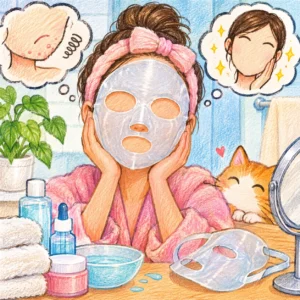
Have you ever covered your face in the richest moisturizer you could find, gone to bed feeling like a beautifully hydrated skincare goddess, and then woken up looking like your face had been dipped in cooking oil?
And, naturally, there is usually a surprise waiting on your chin.
One new bump.
Then another.
Suddenly you’re standing in front of the mirror wondering how skin that felt desperately thirsty last night somehow managed to become both dry and oily at the same time.
It is one of skincare’s most annoying little contradictions.
Your skin feels tight, flaky, dull, or uncomfortable, so your instinct is to pile on thicker creams and oils. But if your skin is acne-prone or simply dislikes heavy products, that strategy can leave you feeling greasy without necessarily solving the dehydration underneath.
This is where Epidermal Water Wrapping enters the conversation.
The basic idea is wonderfully simple: instead of relying entirely on increasingly heavy products, focus on applying hydrating ingredients to damp skin and then temporarily reducing water evaporation with an occlusive layer.
Think of it less like “forcing water deep into your face” and more like giving your skin a temporary hydration tent.
And honestly, your face might appreciate the vacation.
What Exactly Is Epidermal Water Wrapping?
Despite the dramatic name, the basic principle behind Epidermal Water Wrapping isn’t mysterious.
Your outermost skin layer contains water, and your skin naturally loses some of that water to the environment. This process is known as transepidermal water loss, or TEWL.
Moisturizers work partly by helping maintain water in the outer layers of the skin. Different ingredients have different jobs: humectants attract and hold water, emollients soften the skin, and occlusives help reduce water loss.
The American Academy of Dermatology recommends applying moisturizer while skin is still damp because this helps trap water in the skin. Ingredients such as glycerin and hyaluronic acid can also help hydrate the outer skin layer.
Epidermal Water Wrapping takes that general concept one step further by temporarily covering hydrated skin with an occlusive or semi-occlusive layer, such as a suitable silicone facial mask.
The goal isn’t to literally force water through your entire skin.
Instead, the goal is to slow evaporation and keep the outer layer of skin hydrated for longer.
That distinction matters.
Your skin isn’t a dry sponge sitting there waiting for you to pour a bucket of water into it. It is a living protective barrier with carefully controlled movement of water and substances.
Dry Skin vs. Dehydrated Skin: They’re Not the Same
Before attempting any hydration technique, it helps to understand the difference between dryness and dehydration.
Dry skin generally describes a skin type or condition associated with insufficient oils or lipids.
Dehydrated skin describes skin that has insufficient water.
And yes, you can experience both.
Imagine your skin barrier as a brick wall.
The skin cells are the bricks, while lipids help fill the spaces between them. When the barrier isn’t functioning properly, water can escape more easily and the skin may become rough, tight, flaky, or irritated.
This is why someone with oily skin can still have dehydrated skin.
You can have a shiny forehead and still feel like your cheeks are desperately asking for a glass of water.
That is also why throwing more oil at the problem isn’t always the answer.
Why Does Water Escape From Your Skin?
Your skin is not supposed to hold onto every molecule of water forever.
Some water naturally evaporates from the surface. Environmental conditions such as low humidity can increase dryness, which is one reason skin may become particularly uncomfortable in dry climates or during certain seasons.
This is where moisturizers become useful.
A good moisturizer doesn’t simply “add water.” It can help hydrate the outer skin and reduce the amount of water escaping afterward.
Modern moisturizers often combine several types of ingredients:
Humectants
Humectants include ingredients such as:
- Hyaluronic acid
- Glycerin
- Urea
- Sorbitol
- Some forms of lactic acid
They help attract and retain water in the outer layers of skin.
Emollients
Emollients help soften and smooth the skin by filling gaps and improving the feel of rough skin.
Occlusives
Occlusives form a barrier that helps reduce water loss.
Petrolatum is a classic example, although there are many other occlusive ingredients and formulations.
So rather than thinking:
“I need more water!”
think:
“I need water + something that helps my skin hold onto it.”
That’s the real hydration strategy.
So Where Does the “Wrapping” Part Come In?
Here’s where the technique gets interesting.
Imagine applying a lightweight hydrating serum to damp skin and then placing a clean silicone facial mask over it.
The silicone layer can act as an occlusive covering.
Instead of allowing moisture to evaporate freely into the surrounding air, the covering creates a more humid microenvironment against the skin.
This is essentially the skincare equivalent of putting a tiny blanket over your hydration routine.
And unlike a traditional sheet mask, silicone itself doesn’t dry out in the same way a wet cotton or paper mask can.
However, that doesn’t mean silicone magically pumps water into your skin.
The biggest realistic benefit is reducing evaporation and maintaining hydration at the skin surface.
Occlusion can also increase penetration of topical ingredients. That’s useful when a product is specifically designed for occlusive use, but it is also why you shouldn’t trap powerful active ingredients underneath an occlusive covering without understanding the risks.
Epidermal Water Wrapping vs. Sheet Masks
Sheet masks aren’t bad.
In fact, the American Academy of Dermatology notes that ingredients such as hyaluronic acid and glycerin can be useful in masks designed for dry skin.
The difference is mainly in the experience.
A traditional sheet mask is soaked in a liquid essence. As time passes, the sheet can gradually dry.
A reusable silicone mask, by contrast, can sit over skincare and reduce evaporation without becoming a dried-out piece of fabric.
That can make it useful as an occlusive finishing layer.
But don’t fall into the skincare-influencer trap of thinking:
“More occlusion = more hydration = better skin.”
Not necessarily.
Your skin doesn’t need to be marinated.
How to Try Epidermal Water Wrapping
If you want to experiment with the technique, keep it simple.
You don’t need twelve serums, three essences, an expensive mist, and a skincare routine that requires its own spreadsheet.
Step 1: Cleanse Gently
Start with a gentle cleanser.
Avoid aggressively scrubbing your face because you’re trying to create the perfect canvas. Over-cleansing can leave the skin feeling tight and irritated.
Rinse thoroughly.
Step 2: Leave Skin Slightly Damp
Instead of completely drying your face with a towel, leave it slightly damp.
This is consistent with dermatologists’ advice to apply moisturizer soon after washing while the skin is still damp.
You don’t need water literally dripping down your cheeks.
Slightly damp is enough.
Step 3: Apply a Simple Hydrating Product
Choose a lightweight, fragrance-free hydrating serum or essence.
Look for ingredients such as:
- Glycerin
- Hyaluronic acid
- Panthenol
- Beta-glucan
You don’t need every ingredient on the list.
One or two well-tolerated hydrating ingredients can be perfectly reasonable.
If you’re acne-prone, choose a formulation labeled non-comedogenic when possible. The AAD notes that people with oily or acne-prone skin can still moisturize and may prefer lighter gel-type formulations.
Step 4: Apply Your Clean Silicone Mask
Place a clean, reusable silicone facial mask over the product.
Make sure the mask is intended for facial use and fits comfortably.
It should not be painfully tight.
And please don’t treat your face like a leftover sandwich.
The goal is gentle occlusion, not suffocation.
Step 5: Keep the Session Short
Start with a short session, perhaps around 10–20 minutes, following the instructions provided with your particular mask.
You don’t need to wear it for hours.
More time isn’t automatically more beneficial.
If you notice burning, itching, significant redness, discomfort, or irritation, remove the mask and rinse your skin.
Step 6: Finish With Moisturizer
After removing the mask, gently pat in any remaining product.
Then apply your normal moisturizer.
This final step is important because hydration isn’t only about putting water onto the skin. You also want to help reduce subsequent water loss.
For oily or acne-prone skin, a lightweight gel or lotion may feel better.
For very dry skin, a cream may be more appropriate.
There is no universal winner.
Your skin gets a vote.
What About Acne-Prone Skin?
This is where we need to kill one particularly attractive skincare myth.
Epidermal Water Wrapping cannot guarantee breakout-free skin.
A technique involving occlusion may feel wonderfully hydrating for one person and uncomfortable or congestion-prone for another.
The product underneath the mask matters.
The mask’s cleanliness matters.
Your skin type matters.
And your existing acne treatment matters.
The AAD specifically notes that moisturizer selection should take skin type into account and that people prone to breakouts can consider lighter, non-comedogenic products.
So if your skin is acne-prone, don’t turn the process into a chemistry experiment.
Start with one simple hydrating product.
Don’t add five new products at the same time.
That way, if your skin suddenly decides to stage a rebellion, you’ll have a much better idea of what caused it.
Don’t Trap Strong Actives Under Occlusion
This is perhaps the most important safety rule.
Don’t assume that because a product is safe when used normally, it is automatically safe underneath an occlusive covering.
Occlusion can increase absorption of topical substances. DermNet specifically notes that absorption can be greater under occlusion.
That means you should be especially cautious with strong active ingredients.
Avoid experimenting with things such as:
- Strong exfoliating acids
- Prescription medications
- Retinoids
- Irritating acne treatments
- Products that already cause stinging or burning
If a dermatologist has prescribed a topical medication, follow the instructions you’ve been given rather than improvising an occlusive treatment around it.
Your skincare routine should make your skin happier, not turn your bathroom into a chemistry laboratory.
How Often Should You Do It?
You don’t necessarily need to perform Epidermal Water Wrapping several times a week.
Start conservatively.
Try it occasionally and observe how your skin responds.
If your skin becomes irritated, excessively warm, itchy, congested, or uncomfortable, stop.
Also remember that you don’t need a silicone mask to maintain healthy hydration.
A simple routine of gentle cleansing, appropriate moisturizer, and daily sun protection can do far more for your skin than chasing every viral skincare technique on the internet.
The “Glass Skin” Effect: What Can You Really Expect?
Now for the fun part.
Why can hydrated skin look so dramatically better?
When the outer layer of skin is well hydrated, it can look smoother and more supple. Fine dehydration lines may appear less noticeable, and the surface can reflect light more evenly.
That’s part of why people describe hydrated skin as:
plump.
bouncy.
dewy.
glowy.
glass-like.
But “glass skin” is mostly a visual description, not a medical condition.
And no mask can permanently erase wrinkles, transform your pores, or rewrite your genetics overnight.
Think of the result as a temporary hydration boost, not a permanent facial renovation.
Your skin isn’t a phone that needs a software update.
The Funniest Part: You May Look Ridiculous
Let’s be honest.
This is probably not going to be your most glamorous beauty moment.
You may have a shiny silicone mask stretched across your face.
Your cheeks may look slightly squished.
Your ears may be doing suspicious amounts of work.
And if someone walks into the bathroom unexpectedly, you may have approximately three seconds to explain yourself.
“Don’t worry. I’m hydrating.”
They will probably remain unconvinced.
But that’s okay.
Some of the best skincare rituals look absolutely ridiculous halfway through.
The goal isn’t to look beautiful while wearing the mask.
The goal is to take it off and enjoy skin that feels comfortable, soft, and hydrated.
A Few Final Rules for Your Hydration Experiment
Keep these simple principles in mind:
Clean your reusable mask properly. Follow the manufacturer’s cleaning instructions and allow it to dry completely before storage.
Don’t share your mask. Your skincare equipment doesn’t need a roommate.
Don’t use occlusion over irritated or broken skin unless a healthcare professional has advised you to.
Patch-test unfamiliar products.
Avoid combining strong actives with experimental occlusion.
Stop if your skin burns, swells, becomes intensely red, or develops a rash.
And remember: if your skin is persistently dry, painful, cracked, itchy, or inflamed, don’t keep throwing new beauty hacks at it. Persistent dryness can sometimes be associated with underlying skin conditions and may need professional evaluation.
Your Skin Doesn’t Need to Be Drowned
The biggest lesson behind Epidermal Water Wrapping isn’t actually about silicone.
It’s about understanding that hydration and moisturization are connected but not identical ideas.
Your skin needs water.
It also needs a healthy barrier capable of keeping that water from escaping too quickly.
Humectants can help hydrate. Emollients can soften. Occlusives can reduce water loss. And the right moisturizer can combine several of these functions.
That’s why the smartest approach isn’t necessarily the thickest cream you can find.
It’s about choosing products that match your skin.
If your face loves lightweight hydration, give it lightweight hydration.
If your skin needs a richer cream, don’t be afraid of cream simply because social media says oil equals breakouts.
And if you want to experiment with Epidermal Water Wrapping, treat it as a gentle hydration technique rather than a miracle treatment.
Start simple.
Keep everything clean.
Use mild, well-tolerated products.
Don’t trap aggressive actives underneath an occlusive layer.
And listen to your skin.
Because at the end of the day, the goal isn’t to wake up looking like a walking skincare advertisement.
It’s much simpler than that.
You want skin that feels comfortable, soft, hydrated, and healthy.
And sometimes, that starts with something as wonderfully unglamorous as putting a little hydration on damp skin and giving it a chance to stay there.
References
American Academy of Dermatology — Dermatologists’ tips for relieving dry skin
American Academy of Dermatology — How to pick the right moisturizer