
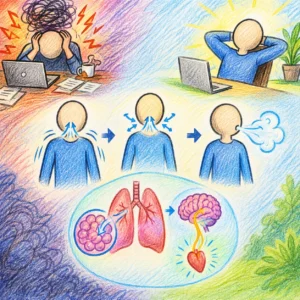
You’re sitting at your desk, minding your own business, answering emails or staring at a screen, when suddenly your body decides there is an emergency.
Your chest feels tight. Your breathing becomes shallow. Your shoulders creep toward your ears as if they are trying to disappear into your neck. Your heart starts beating faster, and your brain suddenly begins producing an impressive collection of worst-case scenarios.
The funny thing?
Nothing has actually happened.
There is no tiger. No fire. No collapsing building. Maybe there isn’t even a particularly terrible email.
Yet your nervous system has already hit the panic button.
At that moment, advice like “just meditate for 30 minutes” can feel almost comically unrealistic. When you’re already stressed, you probably don’t want to find a quiet room, light a candle, sit cross-legged, and begin a spiritual journey.
Sometimes you just want something simple.
Something you can do right now.
That is where Sigh Neuromodulation, more commonly discussed as the physiological sigh or cyclic sighing, becomes interesting.
It involves a surprisingly simple breathing pattern: a deep inhale, a second smaller inhale to top it off, and then a long, slow exhale.
It sounds almost too basic to matter.
But your respiratory system is closely connected to the systems that regulate arousal, stress, and emotional state. Researchers have been studying how controlled breathing can influence these systems, and a 2023 randomized controlled study found that daily cyclic sighing was associated with improvements in mood and reductions in physiological arousal.
So, could a couple of deliberate breaths really help when stress suddenly hits?
Let’s take a closer look.
Your Lungs Are Doing More Than Moving Oxygen
Most of us learn a very simple version of breathing in school:
You inhale oxygen.
You exhale carbon dioxide.
Done.
But breathing is considerably more sophisticated than that.
Every breath influences oxygen and carbon dioxide levels, blood chemistry, lung mechanics, heart activity, and signals traveling between the body and brain.
Your lungs contain millions of tiny air sacs called alveoli. These microscopic structures are where gas exchange occurs. They need to remain adequately expanded so that oxygen and carbon dioxide can be exchanged efficiently.
This is one reason your body naturally produces occasional sighs.
A physiological sigh isn’t simply an emotional expression of frustration. It has an important respiratory function. Research reviews describe sighs as large breaths that help reopen partially collapsed alveoli and restore normal lung mechanics.
Think of it like occasionally stretching after sitting in the same position for too long.
Your lungs need their own version of a stretch.
A sigh provides one.
So Where Does Carbon Dioxide Fit In?
Here’s where the original explanation often gets a little too dramatic.
Carbon dioxide isn’t some evil gas secretly controlling your mood.
It’s actually an essential part of normal physiology.
Your brain continuously monitors changes in carbon dioxide and acidity because these signals help regulate breathing. When CO₂ rises, the body responds by adjusting ventilation to bring the system back toward its normal range.
This is incredibly useful.
Your brain doesn’t sit around waiting for you to remember to breathe.
It is constantly monitoring your internal environment and adjusting your breathing automatically.
And this is one reason breathing can influence how you feel.
Your respiratory system isn’t isolated from your nervous system. The two communicate constantly.
When you’re stressed, breathing often changes.
And when you deliberately change your breathing, you can send different signals back to your nervous system.
That doesn’t mean a single breath magically “turns off anxiety.”
It means breathing gives you one practical way to influence the physical side of a stress response.
And that’s much more realistic—and still pretty fascinating.
The Double-Inhale: Why Does It Feel So Different?
Here’s the technique.
Take a comfortable inhale through your nose.
Before exhaling, take another smaller inhale through your nose.
Then slowly exhale through your mouth.
That’s it.
The second inhale is sometimes described as a “top-off” breath.
Why?
Because the first inhale expands the lungs, while the second inhale can further increase lung volume and help reinflate smaller or partially collapsed air spaces.
Physiological sighs naturally involve large inspiratory breaths and play a role in maintaining effective gas exchange and preventing alveolar collapse.
Then comes the important part:
the long exhale.
That slow exhalation is particularly relevant to cyclic sighing research.
In the Stanford-led randomized study, cyclic sighing emphasized prolonged exhalation, and participants practicing it for five minutes daily showed improvements in mood and reductions in respiratory rate.
So the magic isn’t really a mysterious loophole.
It’s your respiratory system doing what it was designed to do—with a little conscious direction from you.
How to Try a Physiological Sigh
The technique doesn’t need to be complicated.
Try this:
Step 1: Take a Comfortable Inhale
Breathe in through your nose.
Don’t try to suck in the biggest breath your lungs have ever experienced.
A comfortable, deep breath is enough.
Step 2: Add the Top-Off Breath
Without exhaling, take a second, smaller inhale through your nose.
Think of it as topping up the breath rather than taking another huge breath.
Step 3: Slowly Exhale
Open your mouth and slowly release the breath.
Make the exhale longer and gentler than the inhale.
You don’t need to force it.
Imagine letting the air escape rather than pushing it out.
Step 4: Return to Normal Breathing
After the exhale, simply breathe normally.
You can repeat the pattern several times if it feels comfortable.
A five-minute daily practice was the format used in the Stanford study, rather than a claim that one breath permanently switches off stress.
And that’s an important distinction.
This is a breathing exercise—not a magic button.
Why the Long Exhale Matters
Here’s where things get particularly interesting.
Breathing affects more than your lungs.
Your cardiovascular and autonomic systems are closely linked to your respiratory rhythm. Changes in breathing can influence heart-rate patterns and other measures of physiological arousal.
The 2023 Stanford study compared several structured breathing exercises with mindfulness meditation. The cyclic-sighing group, which emphasized longer exhalations, showed particularly promising changes in mood and respiratory rate.
That doesn’t mean cyclic sighing is guaranteed to work identically for everybody.
Human beings aren’t identical breathing machines.
Stress levels, health conditions, breathing habits, expectations, and individual nervous-system responses can all vary.
Still, the research provides an interesting reason to take this simple technique seriously.
The Sigh Is Actually a Built-In Biological Reset
One of the coolest things about physiological sighing is that your body already does it automatically.
You probably sigh without thinking about it.
You might sigh after finishing a difficult task.
You might sigh when you finally sit down after a long day.
You might sigh after an argument.
You might even sigh when something that has been bothering you finally resolves.
Scientists studying sighs have proposed that they have both physiological and psychological functions. Reviews describe sighing as potentially helping regulate respiratory state and contributing to transitions between different psychophysiological states.
In other words, the dramatic sigh you’ve been giving after opening your 47th email may actually be doing something useful.
Your body has been practicing this for you all along.
When Could You Use It?
You don’t need to wait until you’re completely overwhelmed.
A physiological sigh can be used as a brief pause whenever you notice yourself becoming tense or overstimulated.
Before a Difficult Conversation
Your heart is racing because you have to make an uncomfortable phone call.
Instead of immediately pressing “call” while your nervous system is screaming, take a couple of slow sighing breaths first.
You’re giving yourself a moment to settle physically before responding.
During a Stressful Workday
You’ve been staring at your laptop for three hours.
Your jaw is tight.
Your shoulders are tense.
Your brain feels like it has been microwaved.
Take a brief breathing break.
You don’t need an elaborate wellness ritual.
Just step away from the screen for a moment and breathe.
Before a Presentation
Public speaking can trigger a powerful physical stress response.
A few deliberate breaths before you begin may help you slow down and become more aware of your breathing.
You still have to give the presentation.
Unfortunately, the lungs haven’t invented a way to write your PowerPoint slides for you.
But they can at least help you pause.
When You Feel Overwhelmed
Sometimes the problem isn’t one huge crisis.
It’s twenty tiny problems arriving at the same time.
Your inbox.
Your messages.
Your unfinished work.
Tomorrow’s schedule.
That one thing you forgot three days ago.
When everything starts piling up, controlled breathing gives you something immediate and physical to focus on.
What About Panic Attacks?
This is where we need to be careful.
A physiological sigh may be a useful calming technique, but it should not be presented as a guaranteed treatment for panic attacks, anxiety disorders, or other mental-health conditions.
If you’re experiencing recurrent panic attacks, severe anxiety, difficulty breathing, chest pain, fainting, or other concerning symptoms, it’s important to speak with an appropriate healthcare professional.
Breathing exercises can be supportive.
They aren’t a substitute for medical evaluation or evidence-based treatment when that’s needed.
And if a particular breathing technique makes you dizzy, uncomfortable, or more anxious, stop and return to normal breathing.
More breathing isn’t automatically better breathing.
Don’t Turn the Technique Into a Competition
This is another common mistake.
You don’t need to inhale until your lungs feel like they’re about to explode.
You don’t need to hold your breath for an extreme amount of time.
You don’t need to perform twenty dramatic sighs because the internet told you that more is better.
It isn’t.
The goal is comfortable controlled breathing.
Think gentle, not heroic.
If you find yourself straining, gasping, becoming light-headed, or feeling uncomfortable, stop.
Your goal is to calm your system, not win the Olympic gold medal in breathing.
Sigh Neuromodulation Isn’t Really a “Hack”
The word “hack” makes it sound as though you’ve discovered a secret loophole in human biology.
You haven’t.
And honestly, that’s even more impressive.
You’re simply using a normal biological system deliberately.
Your brain controls breathing.
Breathing influences your body’s internal environment.
Your lungs respond mechanically to changes in pressure and volume.
Your cardiovascular and autonomic systems interact with respiration.
And your emotional state can influence your breathing in return.
It’s a two-way conversation.
Stress changes breathing.
Breathing can influence the physical experience of stress.
That’s the real story.
What the Research Actually Says
One of the most useful pieces of evidence comes from a randomized controlled study published in Cell Reports Medicine in 2023.
Researchers compared three structured breathing practices with mindfulness meditation over a month. The breathing groups practiced for five minutes each day.
The cyclic-sighing method emphasized prolonged exhalation.
Researchers found that breathwork—particularly cyclic sighing—was associated with improvements in mood and reductions in respiratory rate compared with the mindfulness control.
That’s encouraging.
But it doesn’t prove that a single physiological sigh will instantly erase anxiety.
It also doesn’t mean cyclic sighing is the only useful breathing technique.
The researchers themselves described daily cyclic sighing as having promise for stress management rather than presenting it as a universal cure.
That’s the healthier way to look at the science.
Promising?
Yes.
Interesting?
Absolutely.
A magical five-second cure for every stressful situation?
That’s a claim the evidence doesn’t justify.
The Five-Second Mental Pause
Perhaps the biggest benefit isn’t even the complicated science.
It’s the pause.
Think about what normally happens when stress arrives.
You feel something.
Your brain interprets it.
You react.
You send the message.
You answer the email.
You snap back.
You make the decision.
And five minutes later you wonder:
“Why did I do that?”
A deliberate sigh creates a tiny interruption.
You stop.
You breathe.
You exhale.
And for a few seconds, you aren’t reacting.
You’re simply noticing what is happening.
That small gap can be valuable.
Sometimes you don’t need to solve your entire life.
You just need enough space to avoid making the next ten minutes worse.
Your Body Isn’t Working Against You
Sudden stress can feel frustrating.
You may wonder why your heart is racing when nothing terrible is happening.
You may become annoyed by your tight chest or shallow breathing.
But these sensations aren’t evidence that your body has betrayed you.
Your nervous system is designed to protect you.
Sometimes it reacts strongly.
Sometimes it reacts to an actual danger.
Sometimes it reacts to an email titled “Quick Question.”
Your body doesn’t always know the difference immediately.
Learning to work with your physiology rather than fighting against it can be surprisingly empowering.
And breathing is one of the simplest places to start.
A Simple Sighing Routine to Remember
If you want to keep this technique in your mental toolbox, forget the complicated terminology.
Remember:
Inhale.
Top off.
Slowly exhale.
Then breathe normally.
That’s the basic idea behind the physiological or cyclic sigh.
You can use it as a brief reset during a stressful moment or practice a structured version for several minutes as studied in research.
The goal isn’t to force yourself into instant bliss.
The goal is to give your body a calmer breathing pattern and give your mind a moment to catch up.
Final Thoughts: Take the Breath Before You Take the Bait
Stress doesn’t always announce itself politely.
Sometimes it arrives as a racing heart.
Sometimes it’s a clenched jaw.
Sometimes it’s the sudden urge to throw your laptop out the window because one spreadsheet cell refuses to cooperate.
And sometimes it arrives for no obvious reason at all.
When that happens, you don’t necessarily need an elaborate ritual.
You can start with one breath.
A comfortable inhale.
A second small inhale.
Then a long, relaxed exhale.
That’s Sigh Neuromodulation in its simplest form—not a magical loophole and not a guaranteed cure, but a fascinating example of how closely breathing and the nervous system are connected.
Your lungs aren’t just oxygen delivery bags.
They’re part of a sophisticated biological communication system that constantly talks with your brain and body.
So the next time stress suddenly knocks on the door, pause before opening it.
Take a breath.
Top it off.
Let it out slowly.
And give yourself a few seconds before deciding what comes next.
Sometimes the most useful reset button you have is the one you’ve been carrying around in your chest all day.
References
Stanford Medicine — Cyclic Sighing and Stress Relief
Severs, Vlemincx & Ramirez — The psychophysiology of the sigh: physiological perspective