
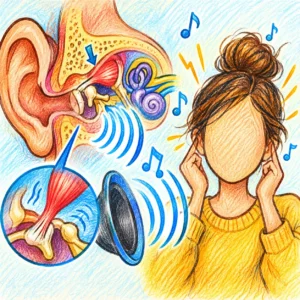
Have you ever discovered that you can make a strange, deep rumbling sound inside your own ears without anyone else hearing it?
It can sound like distant thunder, a tiny engine starting up, or a bass speaker suddenly switching on somewhere inside your skull.
And the strangest part?
You may be doing it deliberately.
This unusual ability is connected to a tiny muscle hidden inside the middle ear called the tensor tympani. Some people can voluntarily contract this muscle and create what is commonly called an ear rumble. Researchers have even documented people using voluntary tensor tympani contraction as a form of discreet physical control.
That makes the phenomenon fascinating enough without adding exaggerated claims.
The internet sometimes describes this as a secret pressure-release switch for headaches, sinus pressure, eye strain, or blocked ears. That’s where we need to slow down a little. Although the tensor tympani is involved in middle-ear mechanics and can affect how sounds are transmitted, there is currently not enough evidence to say that voluntarily contracting it instantly eliminates headaches or pressure throughout the skull.
Still, learning what this tiny muscle does—and discovering whether you can control it yourself—is genuinely fascinating.
So, let’s take a tour inside the ear, find the mysterious internal “bass speaker,” and explore what Tonal Tensor Tympani Control really means.
Meet the Tiny Muscle Hiding Inside Your Ear
When most of us picture the ear, we imagine the part we can see: the outer ear, ear canal, and perhaps the eardrum.
But behind the eardrum is a surprisingly complicated little mechanical system.
The middle ear contains three tiny bones called the malleus, incus, and stapes. Together, they transfer vibrations from the eardrum toward the inner ear.
And attached to this system are two tiny muscles:
- The tensor tympani
- The stapedius
The tensor tympani is particularly interesting because it attaches to the malleus. When it contracts, it pulls on the malleus and increases tension in the eardrum and middle-ear system. This changes the way vibrations are transmitted through the ear.
Think of it as a microscopic mechanical adjustment system.
It isn’t literally a speaker, of course. But if you can voluntarily contract it, you may perceive the resulting internal vibration as a deep rumble.
And that’s where things get weird—in the best possible way.
What Is the Famous Ear Rumble?
The sound is usually described as a low-frequency rumble, roar, buzz, or vibration.
It isn’t coming from the room around you.
You’re generating the sensation internally by changing the mechanical state of structures in your middle ear.
Researchers have documented people who can voluntarily contract the tensor tympani. During contraction, measurable changes occur in the ear, including changes in tympanometry and sound transmission.
In one study involving five people who could voluntarily contract their tensor tympani muscles, researchers observed temporary changes in hearing thresholds while the muscles were contracted. The effects disappeared after the contraction stopped.
So if you can create that strange internal rumbling sound, you’re not necessarily imagining it.
Your ear really can produce a measurable mechanical response.
That doesn’t mean you’ve discovered a magical headache cure.
But it does mean your body contains a remarkably unusual piece of controllable anatomy.
Why Does the Tensor Tympani Contract?
This is where the science gets especially interesting.
The tensor tympani doesn’t exist simply so humans can make amusing thunder noises in their heads.
It participates in the complex mechanics of the middle ear.
It is connected to the mandibular division of the trigeminal nerve, also known as cranial nerve V. The muscle can become active during several everyday activities, including chewing, swallowing, speaking, yawning, facial movements, and certain reflex responses.
Its precise function is still debated.
Researchers have proposed that tensor tympani activity may help modify sound transmission, particularly for sounds generated by our own bodies. It may also contribute to the protective and mechanical behavior of the middle ear.
However, the tensor tympani isn’t the only muscle involved in protecting the ear from loud sounds. The stapedius plays a major role in the acoustic reflex as well.
In other words, your ear is less like a simple microphone and more like a tiny self-adjusting sound system.
And the tensor tympani is one of its microscopic adjustment mechanisms.
Can Everyone Control Their Tensor Tympani?
Apparently not.
Some people discover completely by accident that they can create the internal rumbling sensation.
Others can’t seem to do it no matter how hard they try.
Voluntary tensor tympani control has been documented in research, but it appears to be an unusual ability rather than something everybody can consciously perform.
That’s why you may have mentioned your ear rumbling to someone and received the classic:
“What on earth are you talking about?”
Meanwhile, you’re sitting there thinking:
“Wait…you DON’T hear thunder inside your head?”
It’s one of those wonderfully strange differences in human perception.
How to Explore Your Own Ear Rumble
If you’ve never tried it, you can experiment gently.
The goal isn’t to force anything. You’re simply trying to notice whether you can voluntarily reproduce the sensation.
1. Start With a Natural Yawn
Take a slow, comfortable yawn.
Don’t force your jaw open as far as possible. Just allow the movement to happen naturally.
Pay attention to what you hear.
Some people notice a temporary rushing, popping, crackling, or rumbling sensation during yawning.
The tensor tympani is known to become active during yawning and other facial movements, although the sensation you experience isn’t necessarily proof that you’re consciously controlling the muscle.
2. Pay Attention During Eye Closure
Some studies have found tensor tympani activity associated with non-auditory stimulation around the eye and with forceful eye closure.
So gently close your eyes and listen carefully.
Do you notice a faint internal vibration?
Don’t worry if you don’t.
This isn’t a flexibility test for your ears, and there is no prize for producing the loudest internal thunderstorm.
3. Experiment With a Gentle Jaw Movement
Try opening your mouth slightly.
Then relax your jaw.
You can experiment with very small movements while paying attention to the sensation around your ears.
Some people discover that certain combinations of jaw, facial, or throat movements help them reproduce the rumble.
The important word here is gentle.
Don’t repeatedly clench your teeth, shove your jaw backward, or strain your face trying to force the muscle to activate.
4. See If You Can Repeat the Rumble
If you suddenly hear a low internal roar, stop and notice it.
Can you reproduce it?
Can you make it disappear?
Can you hold it briefly?
If yes, congratulations—you may have discovered voluntary tensor tympani control.
You don’t need to hold the contraction for long periods.
In fact, research involving voluntary contraction has found that sustained contraction can fatigue, so this isn’t something you need to turn into an endurance competition.
What Happens Inside Your Ear When You Rumble?
Here’s the really cool part.
When the tensor tympani contracts, it pulls on the malleus and changes the tension of the tympanic membrane.
That alters the mechanical behavior of the middle-ear system.
Researchers have measured changes in sound transmission during voluntary contraction, including temporary changes in low-frequency hearing thresholds.
That’s probably why the sensation sounds so deep and unusual.
You’re not hearing an ordinary external sound.
You’re experiencing a change in the mechanical system that normally transfers sound toward your inner ear.
Imagine lightly tightening a guitar string.
The instrument hasn’t disappeared.
You have simply changed its mechanical behavior.
Your middle ear can do something surprisingly similar—on a microscopic scale.
Does Ear Rumbling Relieve Headaches?
This is where it’s important to separate fascinating anatomy from internet wellness claims.
There is not enough scientific evidence to say that voluntarily contracting the tensor tympani is a proven treatment for tension headaches.
The original idea that activating this muscle automatically relaxes the jaw, releases pressure behind the eyes, increases circulation, and breaks a headache cycle goes far beyond what current evidence demonstrates.
Yes, the tensor tympani is anatomically connected to structures involved in chewing and is innervated by the trigeminal nerve. Yes, the muscle affects middle-ear mechanics. And yes, some people experience the rumbling sensation as interesting or even soothing.
But those facts don’t establish that the technique treats headache pain.
Headaches can have many causes, including muscle tension, migraine, dehydration, sleep problems, medication overuse, visual strain, illness, and other conditions.
A strange sound inside your ear isn’t a universal solution.
And honestly, the real anatomy is interesting enough without turning it into a miracle cure.
What About Blocked Ears and Eustachian Tube Pressure?
This is another area where online explanations can become misleading.
The Eustachian tube helps connect the middle ear with the back of the nose and throat and plays an important role in middle-ear pressure regulation.
Swallowing and yawning can help equalize pressure.
However, the tensor tympani should not be confused with the tensor veli palatini, which is an important muscle involved in actively opening the Eustachian tube. Current anatomical references identify the tensor veli palatini as the primary muscle responsible for active Eustachian tube opening.
So if your ears pop when you swallow during an airplane descent, don’t assume you’ve simply “flexed your tensor tympani.”
The ear is coordinating several muscles and structures at once.
That’s one reason the system is so fascinating—and so difficult to reduce to a single secret pressure valve.
Why Does the Rumble Sometimes Feel Relaxing?
Even if the rumble isn’t a scientifically established headache treatment, some people may find the sensation interesting or calming.
Part of that may simply come from attention.
When you deliberately focus on an unusual internal sensation, you’re temporarily shifting your attention away from everything happening around you.
Instead of thinking about your overflowing inbox, your noisy phone, tomorrow’s deadline, and the seventeen things you forgot to do, you’re suddenly thinking:
“Whoa. I can make my ear sound like a tiny thunderstorm.”
That change in attention can feel surprisingly absorbing.
But it’s better to describe this as a possible personal relaxation experience rather than claiming that the tensor tympani itself has been proven to calm the nervous system.
The Connection Between the Ear, Jaw, and Trigeminal Nerve
There is still a fascinating connection worth exploring.
The tensor tympani is innervated by the mandibular division of the trigeminal nerve. That same division is heavily involved with sensation and motor control related to the jaw.
This helps explain why researchers and clinicians are interested in the relationship between the middle ear, jaw movement, facial sensations, and conditions involving ear discomfort or unusual sounds.
But anatomical connections don’t automatically mean that exercising one structure will therapeutically relax another.
That’s an important distinction.
The human body is full of interconnected systems, but “connected” doesn’t always mean “one can directly fix the other.”
When Should You Avoid Experimenting?
Ear rumbling should remain a gentle curiosity rather than something you force.
Stop if you experience:
- Ear pain
- Sudden hearing changes
- Significant dizziness
- New or worsening ringing
- A feeling of pressure that doesn’t settle
- Jaw pain
- Severe headache
- Unusual neurological symptoms
If you’re experiencing persistent ear pressure, hearing loss, tinnitus, recurrent headaches, or significant pain, it’s better to have the underlying problem assessed by an appropriate healthcare professional rather than trying to repeatedly contract the muscle.
And don’t insert anything into your ear to try to trigger the sensation.
Your tensor tympani is already hidden safely inside your middle ear.
It doesn’t need DIY assistance.
The Strange Little Superpower You May Already Have
The human body contains countless abilities we rarely think about.
We can control our breathing.
We can wiggle our ears.
Some people can move individual toes independently.
Some can voluntarily contract the tensor tympani and create a deep rumbling sound inside their ears.
None of these abilities need to be mystical to be fascinating.
And perhaps that’s the best way to think about Tonal Tensor Tympani Control.
It isn’t a magical pressure-release button.
It isn’t a guaranteed headache cure.
It isn’t evidence that you’ve unlocked some secret neurological superpower.
It’s something much more interesting: a glimpse into how surprisingly sophisticated the human body really is.
That tiny muscle inside your ear can alter the mechanics of your eardrum and change the way sound is transmitted. Some people can consciously activate it, producing a strange internal rumble that most people never experience.
So the next time you’re sitting quietly and suddenly notice that familiar “rrrrrrrr” inside your ears, don’t panic.
You may simply be hearing one of your body’s tiniest muscles doing its job.
And if you can make it happen intentionally?
Well, congratulations.
You may officially own the world’s least useful—and possibly most entertaining—built-in bass speaker.
Just remember: if you’re dealing with persistent head or ear pressure, treat the symptom as a reason to investigate the cause rather than assuming that an internal rumble will fix it.
Sometimes the most fascinating body hacks aren’t the ones that cure everything.
They’re the ones that make you stop and realize:
“Wait…my body can actually do THAT?”
References
National Library of Medicine — Audiometric Findings With Voluntary Tensor Tympani Contraction
National Library of Medicine — The Function of the Tensor Tympani Muscle: A Comprehensive Review
National Library of Medicine — Exploring the “EarSwitch” Concept