
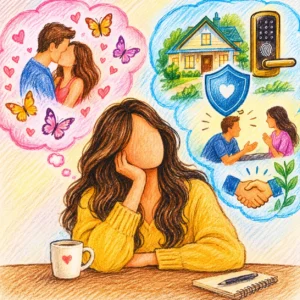
Let’s start with a painfully relatable Friday-night scenario.
Imagine you spend a small fortune on a gorgeous smart lock for your front door. It has fingerprint recognition, voice activation, a sleek brushed-gold finish, and enough futuristic features to make you feel like you accidentally moved into a luxury hotel.
You install it. You admire it. You tell everyone about it.
Then a storm arrives.
The wind starts howling. Rain is hammering against the windows. Suddenly, the smart lock begins glitching. The screen flashes red. The alarm starts making noises that sound suspiciously like a robot having an existential crisis.
And then the door pops open.
At that moment, you probably aren’t standing there admiring the beautiful gold finish.
You aren’t whispering, “But you’re so attractive.”
You’re grabbing something heavy, securing the door, and wondering why you trusted a piece of technology that couldn’t actually do the one job you needed it to do.
Relationships can work in a surprisingly similar way.
Chemistry can be beautiful. Attraction can be exciting. Romantic gestures can make your heart race. But when life becomes difficult, people eventually discover whether the relationship has an actual foundation underneath all that sparkle.
For many women—and, importantly, for many people in relationships generally—love becomes much more meaningful when it is accompanied by emotional security, respect, consistency, and trust.
Butterflies are wonderful.
But butterflies aren’t structural engineers.
They cannot hold up a relationship when life gets windy.
The Spark Is Not the Same as the Foundation
New love can feel almost ridiculously exciting.
You text until 2 a.m. You replay conversations in your head. A simple “good morning” message suddenly feels like a national holiday. You start noticing songs that remind you of the person, and somehow even standing in line at the grocery store becomes romantic because they happened to send you a funny meme.
That’s chemistry.
And chemistry matters.
But chemistry alone doesn’t tell you how a relationship will function six months, two years, or ten years later.
Infatuation is excellent at making an introduction. It is much less qualified to manage a mortgage, family disagreement, career crisis, illness, disappointment, or a Tuesday evening when both people are exhausted and nobody wants to decide what to eat.
Research on relationship quality consistently points toward factors beyond simple attraction. Large-scale research has found that relationship-specific factors such as perceived commitment, appreciation, satisfaction, and conflict are strongly associated with relationship quality.
In other words, the exciting beginning is only part of the story.
A relationship eventually has to answer much less glamorous questions:
Can I trust you?
Can I talk to you?
Will you respect my boundaries?
Will your behavior match your promises?
Can we disagree without destroying each other?
Will you still treat me with dignity when you’re angry?
Those questions aren’t nearly as cinematic as a candlelit dinner.
But they are far more important when the lights go out.
What Security Really Means
The word security sometimes gets misunderstood.
People hear “a woman wants security” and immediately assume someone is talking about money, expensive gifts, a high-paying job, or a luxurious lifestyle.
Financial stability can certainly matter in a relationship, especially when two people are building a life together. But emotional security is much bigger than a bank balance.
Security is largely about knowing where you stand.
It’s consistency.
It’s predictability.
It’s being able to believe someone’s words because their actions repeatedly support them.
Think about a traffic light.
You don’t spend your entire commute wondering whether red will mean stop today.
You trust the system because the rules are predictable.
Now imagine a traffic light that changes its rules depending on its mood.
Monday: green means go.
Tuesday: green means maybe.
Wednesday: red means “I’m processing.”
Thursday: all the lights disappear because the traffic signal “needs some space.”
You would be terrified.
You wouldn’t calmly cruise through the intersection. You’d approach every light cautiously, constantly expecting something unexpected to happen.
That’s what emotional inconsistency can feel like in a relationship.
Someone is affectionate one day, distant the next, intensely committed on Saturday, mysteriously unavailable on Monday, and completely silent whenever conflict appears.
The other person eventually stops relaxing.
They start analyzing.
“Did I say something wrong?”
“Why has his behavior changed?”
“Are we okay?”
“Does he still care?”
That constant uncertainty can make emotional closeness extremely difficult.
Security doesn’t mean a partner has to be available every second of every day. Nobody is that emotionally polished. People get busy. People become stressed. People need alone time.
Security simply means that changes in availability don’t constantly threaten the foundation of the relationship.
A secure relationship can say:
“I’m busy today, but we’re okay.”
“I need some time to cool down, but I’ll come back and talk about this.”
“I can’t solve this problem tonight, but we’ll work through it together.”
Those sentences may not sound romantic.
They’re actually incredibly romantic.
Because they reduce uncertainty.
Respect Is Where Love Becomes Real
Security without respect isn’t enough.
A person can be dependable, financially stable, and extremely consistent while still making their partner feel small.
That’s where the second pillar comes in: respect.
Respect isn’t simply opening doors, buying flowers, or remembering anniversaries.
Those things can be lovely.
But genuine respect goes deeper.
It means recognizing that your partner is a complete human being—not an accessory, employee, possession, therapist, or supporting character in your personal movie.
Respect sounds like:
“I hear what you’re saying.”
“I don’t agree, but I understand why you feel that way.”
“I’ll respect your boundary.”
“Your career matters to you, so it matters to me.”
“You don’t have to become a smaller version of yourself to make me comfortable.”
It also appears in disagreements.
Anyone can be affectionate when everything is going perfectly.
The real test often arrives when two people want completely different things.
Imagine two people arguing about a major decision.
One person wants to win.
The other wants to understand.
Those are two very different approaches.
The first asks:
“How can I prove I’m right?”
The second asks:
“How can we solve this without hurting each other?”
Research supports the importance of perspective-taking and understanding in relationships. A meta-analysis covering 20 samples and more than 4,600 participants found a significant association between perspective-taking and romantic relationship satisfaction.
That doesn’t mean couples must agree on everything.
Healthy couples absolutely disagree.
The difference is that disagreement doesn’t have to become disrespect.
Boundaries Are Part of Respect
One of the clearest forms of respect is what happens when someone says no.
No should not automatically become a negotiation.
No should not trigger guilt.
No should not become an invitation to pressure someone until they surrender.
A boundary is information about where another person’s comfort begins and ends.
Respecting it doesn’t mean you have to love every boundary. It means you acknowledge that your partner has autonomy.
The same principle works in both directions.
A healthy relationship isn’t built around one person having unlimited freedom while the other constantly adjusts.
Both people need room to have preferences, friendships, goals, interests, privacy, and individuality.
Love should create closeness without requiring the disappearance of identity.
Security Without Respect Becomes a Cage
Now we can see why security and respect work best together.
Imagine a relationship where everything is financially comfortable.
The bills are paid.
The house is beautiful.
There is stability.
But one partner constantly dismisses the other’s opinions, controls their choices, mocks their ambitions, or treats them like they are incapable of making decisions.
Is that truly emotional security?
Not necessarily.
It may provide practical stability while creating emotional confinement.
That’s the difference between a safe home and a beautiful cage.
A person doesn’t only need somewhere to live.
They need somewhere they are allowed to be themselves.
Respect Without Security Can Become Exhausting
Now reverse the situation.
Imagine someone who listens beautifully.
They admire your intelligence.
They respect your career.
They communicate wonderfully.
But they repeatedly break promises.
They disappear during difficult conversations.
They change their mind constantly.
They make commitments they rarely keep.
They love talking about the future but struggle to show up consistently in the present.
That relationship may contain genuine affection and respect, but the instability can make it difficult to relax inside the connection.
It’s like building a beautiful sandcastle directly beside the ocean.
The architecture is impressive.
The location is the problem.
When life gets rough, the foundation matters.
When Both Pillars Exist, Something Changes
When people experience both security and respect, they often have more room to become emotionally vulnerable.
They don’t have to spend every conversation defending themselves.
They don’t have to constantly investigate whether the relationship is still intact.
They don’t have to decode every text message like they’re solving a government conspiracy.
They can simply participate in the relationship.
That distinction matters.
Emotional safety creates room for honesty.
Respect creates room for individuality.
Trust creates room for vulnerability.
Together, these qualities can make intimacy feel less like a high-stakes audition and more like a place where two people can actually breathe.
Recent research involving cohabiting romantic couples also found that emotional closeness and positive communication were each associated with higher daily relationship satisfaction.
The important takeaway isn’t that there is a magical formula for love.
There isn’t.
Relationships are complicated.
People have different histories, attachment patterns, expectations, cultures, personalities, and needs.
But healthy connection generally requires more than attraction.
The Three Everyday Tests of a Strong Relationship
You don’t need a relationship laboratory to understand whether your connection is becoming healthier.
Try these three simple tests.
1. The Consistency Test
Ask yourself:
Do actions generally match words?
If someone says they’ll call, do they usually follow through?
If plans change, do they communicate?
If they make a mistake, do they acknowledge it?
Nobody will be perfect.
The goal isn’t robotic perfection.
It’s reliability.
A person who occasionally forgets something is human.
A person who repeatedly makes promises they have no intention of keeping creates a very different environment.
Trust is built through hundreds of ordinary moments.
Not one spectacular declaration.
2. The Respect Test
Ask:
Can both people express disagreement without being humiliated?
Can you say, “I don’t like that,” without being mocked?
Can you have a different opinion?
Can you say no?
Can you discuss your ambitions without being made to feel selfish?
Can you bring up a problem without immediately becoming the enemy?
Respect isn’t proven during the easy conversations.
It’s revealed during uncomfortable ones.
3. The Storm Test
Every relationship eventually gets a storm.
Maybe it’s financial stress.
Maybe it’s family conflict.
Maybe it’s work pressure.
Maybe it’s a major move.
Maybe it’s simply two exhausted people having the worst Tuesday imaginable.
When that happens, ask:
Do we become opponents, or do we become a team?
Being a team doesn’t mean avoiding responsibility or pretending everything is fine.
It means approaching the problem as something to solve rather than using the problem as an excuse to attack each other.
“We’ll figure this out” can be one of the most powerful sentences in a relationship.
What “Woman You” Really Means in Love
The phrase woman you may sound unusual as a keyword, but behind it is a much more universal idea: the woman you are, the person you are becoming, and the person you should be able to remain inside a healthy relationship.
A relationship shouldn’t require someone to abandon herself in exchange for affection.
Love should not demand that a woman become quieter, smaller, less ambitious, less intelligent, less independent, or endlessly accommodating just to keep a partner happy.
And the same principle applies to men.
Healthy love makes room for two complete people.
You don’t have to disappear into someone else’s life to prove that you love them.
In fact, genuine intimacy often becomes stronger when both people can remain individuals while choosing each other.
True Love Is Often Surprisingly Quiet
We have been trained to think love should be dramatic.
Grand gestures.
Unexpected flights.
Thousands of roses.
Long messages at midnight.
Jealous declarations.
Movie-worthy reunions.
And yes, those things can be wonderful.
But the deeper version of love is often much quieter.
It’s someone remembering what makes you anxious and responding gently.
It’s someone keeping their word.
It’s someone asking how your day actually went—and listening to the answer.
It’s someone respecting your “no.”
It’s someone apologizing without turning the apology into an argument.
It’s someone who can disagree with you without trying to destroy your confidence.
It’s someone who doesn’t make you constantly wonder whether you’re loved.
That kind of love may not look dramatic from the outside.
It may actually be much more valuable.
The Real Emotional Blueprint
The healthiest relationships aren’t necessarily the ones with the most fireworks.
They’re often the ones where two people gradually develop a sense that they can rely on each other while still being fully themselves.
Security says:
“You don’t have to live in fear of where you stand.”
Respect says:
“You don’t have to become someone else to deserve love.”
Trust says:
“My actions will give my words somewhere solid to stand.”
And affection says:
“I genuinely enjoy having you in my life.”
Put those qualities together and romance becomes more than chemistry.
It becomes partnership.
So if you’re wondering what makes love feel real, don’t only look at the butterflies.
Look at what happens after the butterflies calm down.
Look at the conversations nobody posts online.
Look at how disagreements are handled.
Look at whether boundaries are respected.
Look at whether promises become actions.
Look at whether both people feel heard.
Look at whether the relationship gives each person room to grow rather than forcing either person to shrink.
Because in the end, love isn’t simply about finding someone who makes your heart race.
It’s about finding—or building—a relationship where your heart doesn’t constantly have to run for its life.
That is where security matters.
That is where respect matters.
And that is where love can finally stop being a beautiful promise and start becoming a beautiful reality.