
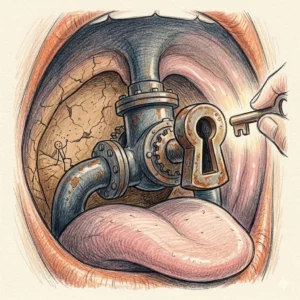
If someone says “pharyngeal palatal seal” at the dinner table, there is a good chance everyone will suddenly become very interested in their food.
It sounds less like something inside your body and more like a piece of industrial equipment.
But the phrase actually relates to something much more familiar: the way structures in the back of your mouth and throat work together during swallowing, speaking, and breathing.
And while it isn’t a secret switch that you can flip tonight to magically cure snoring, understanding your throat, tongue, soft palate, and breathing habits can give you a much better idea of why you sometimes wake up with a dry mouth, irritated throat, or the feeling that your sleep wasn’t nearly as refreshing as it should have been.
Let’s be honest. We’ve all experienced that miserable morning.
The alarm goes off.
You open your eyes.
Your mouth feels like someone left a bag of flour inside it overnight. Your lips are dry. Your throat feels scratchy. Your tongue is practically glued to the roof of your mouth.
And then someone sleeping nearby gives you that look.
The look that says:
“Did you seriously snore like a lawn mower all night?”
You may immediately blame your pillow, your mattress, the weather, your bedroom humidity, or the fact that you ate something salty before bed.
Sometimes those things can matter.
But breathing deserves some attention too.
Your nose, mouth, tongue, soft palate, and throat are part of a surprisingly sophisticated airway system. The way these structures are positioned can influence how easily air moves while you’re awake and asleep.
So instead of thinking about your throat as some mysterious passageway that simply carries food and air, let’s take a closer look at what is actually happening.
Your Nose Was Built for Breathing
Your body gives you two obvious routes for air: your nose and your mouth.
That doesn’t mean they are interchangeable in every situation.
Your nose performs several useful jobs before air reaches your lungs. It helps warm and humidify incoming air and traps particles through mucus and the tiny hairs and structures lining the nasal passages.
Your mouth doesn’t provide the same kind of conditioning.
That’s one reason you may notice a huge difference after sleeping with your mouth open.
You wake up thirsty.
Your mouth feels sticky.
Your throat feels irritated.
Your breath probably isn’t exactly fresh either.
Mouth breathing isn’t automatically dangerous, and there are plenty of situations where people naturally breathe through their mouths, especially during exercise or when their nose is blocked.
The problem is when mouth breathing becomes persistent, particularly during sleep.
And that brings us to the back of the mouth.
What Is the Pharyngeal Palatal Area?
The term pharyngeal palatal essentially points us toward the relationship between the soft palate and the pharynx—the upper part of the throat behind your mouth and nose.
Your soft palate is the soft tissue toward the back of the roof of your mouth.
It isn’t just hanging around doing nothing.
It moves.
When you swallow, structures in this region help separate the nasal passages from the throat so food and liquid are directed toward the esophagus rather than traveling into your nose.
When you speak, your soft palate also contributes to controlling how sound resonates through your mouth and nose.
And when you breathe, the position and movement of tissues around the upper airway matter.
So, rather than thinking of the “throat lock” as a magical valve, think of this area as a coordinated muscular system.
Your body constantly adjusts it without you consciously telling it what to do.
Pretty impressive for something you usually don’t even think about.
Why Does Your Throat Get So Dry at Night?
Here’s where things get extremely relatable.
Imagine your bedroom is perfectly comfortable.
You have your favorite blanket.
Your pillow is finally behaving.
You’ve achieved the rare luxury of getting into bed without checking your phone for another forty-five minutes.
Then you fall asleep.
At some point, your mouth opens.
You continue breathing through it for hours.
By morning, your mouth and throat may have lost a considerable amount of moisture.
That’s because the constant movement of air through the mouth can dry the tissues.
This is especially noticeable if the air in your bedroom is already dry.
And suddenly your peaceful morning begins with:
“Why does my throat feel like sandpaper?”
Persistent nighttime mouth breathing can also be associated with unpleasant breath and increased oral dryness.
But here’s an important distinction:
Dry mouth doesn’t automatically mean you have a problem with your throat structure.
Medications, dehydration, nasal congestion, allergies, alcohol, certain medical conditions, and other factors can contribute too.
So if dry mouth happens regularly, it’s worth looking at the bigger picture rather than blaming one anatomical feature.
And Then There Is Snoring
Snoring is another reason your throat deserves attention.
When you’re awake, the muscles and tissues supporting your upper airway generally maintain enough tone to keep the passage open.
During sleep, muscle tone decreases.
For some people, the airway becomes narrower.
As air moves through a narrowed passage, surrounding soft tissues can vibrate.
That vibration creates the familiar sound of snoring.
In other words, snoring isn’t simply your body making random nighttime noises for entertainment.
It’s airflow interacting with relaxed tissues.
The tricky part is that ordinary snoring and obstructive sleep apnea aren’t the same thing.
Someone can snore without having sleep apnea.
But loud, persistent snoring—especially when accompanied by gasping, choking, witnessed pauses in breathing, morning headaches, excessive daytime sleepiness, or difficulty concentrating—deserves medical attention.
That’s not the moment to simply buy a more expensive pillow and hope for the best.
Your Tongue Has a Bigger Role Than You Think
Now we get to the fun part.
Your tongue is not merely the hardworking organ responsible for helping you taste food and complain about restaurant portions.
It’s a powerful muscular structure involved in speaking, swallowing, chewing, and maintaining the shape of the oral cavity.
Its resting position can change depending on what you’re doing.
When you’re swallowing, your tongue presses against the palate in a coordinated movement.
When you’re speaking, it constantly changes shape and position.
And when you’re relaxed, it has a natural resting posture.
This is why tongue posture has become such a popular topic online.
You’ll often hear people say:
“Just push your entire tongue against the roof of your mouth and everything will change.”
Unfortunately, human anatomy isn’t quite that simple.
Tongue posture can be important, but deliberately forcing your tongue upward doesn’t guarantee that you’ll keep your mouth closed while sleeping or prevent airway obstruction.
And you certainly shouldn’t feel as though you’re performing an Olympic tongue-pressing competition every night.
The “NG” Sound Can Help You Find Your Tongue
There is, however, a simple way to become more aware of your tongue position.
Say:
“Sing.”
Now notice what happens when you make the final “ng” sound.
The back portion of your tongue rises toward the palate.
That sensation can help you understand where the rear part of your tongue is positioned during certain movements.
You can use this as a gentle awareness exercise.
Don’t aggressively push.
Don’t clench your jaw.
Don’t force your tongue backward.
Simply notice the movement.
Then relax.
That’s the key.
The goal is awareness, not muscular warfare.
What About the Famous “Swallow and Seal” Trick?
You’ve probably seen advice online suggesting that you can press your tongue against your palate, swallow, create a vacuum, and then maintain a permanent seal.
There is some genuine physiology behind the sensation.
Swallowing involves coordinated movements of the tongue, soft palate, pharynx, and other muscles. Your tongue can temporarily create suction against the palate.
But the internet often takes a small piece of anatomy and turns it into a superhero origin story.
A swallow doesn’t create a permanent airtight seal that guarantees your mouth will remain closed for eight hours.
Your body continues adjusting muscle tone and airway position throughout sleep.
That’s why it’s more useful to think of tongue posture as one piece of the breathing puzzle, rather than a guaranteed nighttime cure.
A Better Three-Second Awareness Exercise
If you want to practice healthy oral posture during the day, try this gentle sequence.
Step 1: Relax Your Jaw
Let your teeth separate slightly.
Your jaw shouldn’t be clenched.
Your facial muscles should feel relaxed.
Step 2: Rest Your Tongue Comfortably
Let the tongue rest gently against the palate rather than pushing it upward with maximum force.
The tip should rest comfortably behind the upper front teeth without pressing directly against them.
Step 3: Breathe Through Your Nose
If your nose is clear, breathe quietly through it.
Don’t force nasal breathing if you’re congested or struggling to get enough air.
That’s your body’s signal that something needs attention.
This little exercise isn’t a treatment for sleep apnea.
It isn’t guaranteed to stop snoring.
But it can help you become more aware of what relaxed oral posture feels like.
And awareness is often where useful habits begin.
Why Nasal Breathing Feels Different
When your nasal passages are open, nasal breathing can feel smoother and quieter than mouth breathing.
The nose provides resistance to airflow, and the nasal passages help condition incoming air.
Your nasal tissues also participate in respiratory functions beyond simply acting as an empty tunnel.
One important example is nitric oxide production within the nasal passages, although it’s important not to turn that fact into another exaggerated internet wellness claim.
Your body already has an impressively complicated respiratory system.
It doesn’t need us to make it sound like a miracle product.
What About the Jawline Claims?
Here’s another claim you’ll frequently encounter online:
“Keep your tongue on the roof of your mouth and you’ll sculpt your jawline.”
It sounds fantastic.
Unfortunately, facial structure doesn’t work like a gym membership.
Tongue posture alone isn’t a reliable method for dramatically reshaping an adult jawline.
Bone structure, genetics, body composition, age, muscle development, and many other factors influence facial appearance.
Good oral posture can be part of healthy oral function, but don’t expect three seconds of tongue positioning to transform your face overnight.
Your jaw deserves better than internet clickbait.
What You Can Actually Do Before Bed
If your goal is better nighttime breathing, start with the basics.
Keep your bedroom comfortable.
Stay adequately hydrated throughout the day.
Address persistent nasal congestion instead of simply forcing yourself to breathe through a blocked nose.
If allergies are bothering you, discuss appropriate treatment with a healthcare professional.
And pay attention to your sleep patterns.
If you consistently wake up with a dry mouth, sore throat, headaches, or extreme tiredness—or if someone tells you that you regularly gasp, choke, or stop breathing during sleep—talk to a healthcare professional.
Those symptoms can sometimes point toward sleep-disordered breathing, including obstructive sleep apnea.
That requires proper evaluation, not a tongue hack from social media.
Should You Tape Your Mouth Shut?
This deserves a special mention because mouth taping has become extremely popular online.
The idea sounds simple:
“Close your mouth and force yourself to breathe through your nose.”
But breathing isn’t something you should casually obstruct.
If your nose is blocked, you have significant nasal congestion, you may rely on mouth breathing for a reason.
People with certain respiratory or sleep conditions also need to be particularly cautious.
So don’t treat mouth tape like skincare patches.
Before experimenting with anything that physically restricts your breathing during sleep, especially if you snore heavily or suspect sleep apnea, talk to a qualified healthcare professional.
Your airway is not the place for a DIY challenge.
A Better Way to Think About Your Throat
Your throat isn’t a simple pipe.
It’s a moving, muscular, highly coordinated part of your body that participates in breathing, swallowing, speaking, and airway protection.
Your tongue, soft palate, jaw, nasal passages, and throat all work together.
Sometimes that system runs beautifully.
Sometimes congestion, anatomy, sleep position, muscle relaxation, medications, or other factors interfere with it.
And that’s why there isn’t one magical posture that fixes every nighttime breathing problem.
The more useful approach is to understand the system and pay attention to warning signs.
Your Three-Second Nighttime Check
Before going to sleep tonight, take three seconds.
Relax your jaw.
Let your tongue rest comfortably against your palate.
Close your lips naturally if nasal breathing feels easy.
Take a quiet breath through your nose.
Then let your body do what it normally does.
Don’t force anything.
Don’t clench.
Don’t obsessively monitor your tongue.
And don’t expect this tiny routine to guarantee perfect sleep.
Think of it as a gentle reminder rather than a secret switch.
Because sometimes the smartest thing you can do for your body isn’t to control every tiny movement.
It’s to give your body the conditions it needs to work naturally.
When Your Throat Is Trying to Tell You Something
A dry mouth once in a while isn’t necessarily a big deal.
A snore after an unusually exhausting day isn’t automatically a medical emergency.
But persistent symptoms deserve attention.
If your throat is regularly dry or sore when you wake up, if you snore loudly most nights, or if you feel exhausted despite spending enough time in bed, don’t simply assume you need a better sleep gadget.
Look for the cause.
Your nose may be congested.
Your bedroom air may be dry.
Your medication may be contributing to dry mouth.
Your sleep position may be affecting airflow.
Or there may be an underlying sleep-related breathing disorder that needs evaluation.
The important thing is not to blame yourself.
And definitely don’t blame your tongue.
Your body isn’t failing you.
It’s communicating with you.
Final Thoughts
The phrase pharyngeal palatal seal may sound intimidating, but the basic idea brings us back to something wonderfully ordinary: your body is constantly coordinating tiny muscles and structures to keep you breathing, swallowing, speaking, and protecting your airway.
Your tongue doesn’t need to become a nighttime superhero.
Your throat doesn’t need a secret “unlock code.”
And you don’t need to believe every dramatic promise made by the wellness corner of the internet.
Instead, learn what normal feels like.
Relax your jaw.
Allow your tongue to find a comfortable resting position.
Breathe through your nose when it is comfortable and unobstructed.
Pay attention to persistent dryness, snoring, choking, gasping, or daytime exhaustion.
And if those problems keep happening, investigate them rather than simply covering them up.
Sometimes better sleep doesn’t begin with another gadget.
Sometimes it begins with understanding what’s happening inside your own body.
References
Cleveland Clinic — Mouth Breathing