
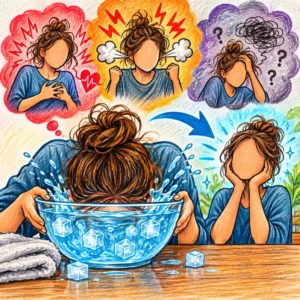
Have you ever been so angry that you could practically feel steam coming out of your ears? Or so anxious that your heart started racing, your thoughts went into overdrive, and even the simplest decision felt like solving a complicated mathematical equation?
Perhaps you’ve experienced brain fog so thick that you stared at your computer screen for ten minutes, forgot what you were doing, and somehow ended up watching videos of cats falling off sofas.
Welcome to being human!
Panic, anger, and mental overwhelm are part of life. They can show up during a stressful conversation, after an unexpected email, while juggling household responsibilities, or for reasons that seem impossible to explain. One minute, everything is fine. The next, your body behaves as though you’ve just received an emergency evacuation notice.
Your heart races. Your muscles tighten. Your breathing changes. Your thoughts become louder, faster, and considerably less helpful.
And then somebody tells you to relax.
Oh, brilliant. Why didn’t you think of that?
The truth is that calming yourself down can be difficult when your body is already in a heightened state of stress. Sometimes, you need something practical that helps you pause before you react.
One surprisingly accessible option is cold water.
A brief application of cool water to the face may help some people feel calmer by engaging parts of an automatic physiological response known as the mammalian diving reflex. It isn’t a magical off-switch for every emotional problem, but understanding how it works may give you another useful tool for difficult moments.
Let’s explore the science, the safest ways to try a cold-water reset, and how to use it when panic, anger, or brain fog threatens to take over your day.
1. When Your Body Sounds the Alarm
Imagine you’re sitting at your desk, minding your own business, when a message arrives that immediately irritates you.
Perhaps someone has misunderstood your work, blamed you for something you didn’t do, or sent an email that deserves its own award for unnecessary drama.
Your shoulders tense. Your jaw tightens. Your heartbeat speeds up, and suddenly you’re composing a reply that could end three professional relationships before lunchtime.
What happened?
Your body activated its stress response.
When your brain interprets a situation as threatening, the sympathetic nervous system helps prepare you to respond. Stress hormones and other chemical messengers contribute to changes in heart rate, breathing, muscle tension, and attention.
This response can be useful when you need to react quickly to genuine danger. However, it can also activate during arguments, uncertainty, embarrassment, and overwhelming workloads.
Your body doesn’t always distinguish between a physical threat and an emotionally stressful situation as neatly as you might expect.
During intense stress, the brain’s threat-detection systems become highly active, while the complex thinking involved in planning, flexible decision-making, and controlling impulses can become more difficult.
That’s why a perfectly reasonable person can suddenly struggle to find the right words, make a simple decision, or resist sending an angry message.
The problem isn’t necessarily that you’ve lost your ability to think. Your attention and mental resources may simply be caught up in the stress response.
The first step toward regaining control is understanding that you don’t have to solve the entire problem while your emotions are at their loudest.
Sometimes, you need to help your body settle before you decide what to do next.
2. The Curious Science Behind the Cold-Water Reset
Humans have an interesting physiological response that we share with other mammals.
It’s called the mammalian diving reflex, a collection of automatic responses that can occur when the face is exposed to cold water, particularly when the face is submerged and breathing is briefly held.
The response helps the body conserve oxygen during diving. Its strength varies from person to person and depends on factors such as water temperature, the extent of facial immersion, and individual physiology.
Two important changes can occur.
Your heart rate may slow
Cold-water stimulation of the face can activate sensory pathways that communicate with the brainstem. This can increase parasympathetic influence on the heart through the vagus nerve, producing a slowing of the heart rate known as bradycardia.
In simple terms, your body has an automatic mechanism that can slow your heartbeat under certain conditions.
This is one reason facial cooling is sometimes used as a distress-tolerance technique in psychological skills training.
However, the effect isn’t identical for everyone. It doesn’t guarantee a particular reduction in heart rate, and it shouldn’t be described as an instant cure for emotional distress.
Your body also responds to cold as a stimulus
Cold water doesn’t simply tell your body to relax. Cold exposure can activate other responses as well, including changes in blood vessel constriction and sympathetic nervous system activity.
The overall response depends on how the cold is applied and how your body reacts.
This matters because the diving reflex is not a universal relaxation button. A gentle, brief cooling technique may feel soothing to one person but unpleasant or startling to another.
The practical takeaway? You can experiment with a mild, controlled cold-water technique if it’s appropriate for you, but you don’t need to force yourself into freezing water to prove anything.
Your bathroom sink is not an Olympic swimming pool. Let’s keep it that way.
3. Can Cold Water Interrupt Panic and Anger?
Cold water may help interrupt an escalating emotional episode by shifting your attention toward a physical sensation and engaging an automatic bodily response.
There are two useful ideas here.
First, intense emotions often involve a feedback loop. You notice a racing heartbeat, interpret it as evidence that something is terribly wrong, become more frightened, and experience even more physical arousal.
Second, deliberately focusing on a simple physical sensation can give you a momentary break from repetitive thoughts.
Imagine you’re furious after an argument. Your mind keeps replaying the other person’s words, inventing better comebacks, and preparing for a second round of the conversation.
A brief pause to cool your face and notice your breathing can create a little distance between the feeling and your next action.
That pause matters.
You may still be angry afterward. The disagreement may still need resolving. But you might find it easier to choose a response rather than immediately reacting.
The same principle can apply to anxiety. A cooling sensation may help some people redirect their attention when their thoughts are spiraling.
However, research on the diving reflex should not be confused with strong evidence that a 15-second cold-water treatment reliably stops panic attacks. Individual responses vary, and cold water can sometimes increase discomfort.
Think of cold water as a possible coping tool, not a biological kill-switch.
If panic attacks are recurring, frightening, or interfering with everyday life, professional support can help you understand their triggers and learn effective treatments.
4. The Simple Cold-Water Reset: A Safer Step-by-Step Guide
You don’t need a bucket of ice, a dramatic soundtrack, or the determination of someone training for an Arctic expedition.
Start gently.
Step 1: Pause before reacting
If you’re angry, put down your phone, step away from the argument if possible, and give yourself permission not to respond immediately.
If you’re anxious, find a safe place where you can sit or stand comfortably.
The goal isn’t to force your emotions away. It’s to create enough space to respond thoughtfully.
Step 2: Use cool water on your face
Splash cool tap water gently onto your face or place a cool, damp washcloth against your cheeks and forehead.
You don’t need ice-cold water. Start with a temperature that feels comfortable rather than painful.
A brief facial-cooling technique may be more manageable than full facial submersion, especially if you’re unfamiliar with cold exposure.
Step 3: Breathe normally
Keep breathing comfortably. Try not to gasp, hyperventilate, or hold your breath for an extended period.
You can allow your exhalation to be slightly slower than your inhalation if that feels comfortable. Avoid forcing deep breaths, particularly if doing so makes you feel dizzy or more anxious.
Never use underwater breath-holding as a test of willpower.
Step 4: Pay attention to the sensation
Notice the coolness on your skin, the feeling of your feet against the floor, and the objects around you.
You might silently identify three things you can see and two physical sensations you can feel.
This gives your attention something concrete to focus on instead of allowing your mind to replay the same upsetting thought.
Step 5: Wait before making decisions
Dry your face and sit quietly for a moment.
Ask yourself three simple questions:
- What am I feeling right now?
- What actually happened, rather than what am I afraid might happen?
- What would be the most helpful next step?
You don’t have to feel completely calm to answer these questions. Even a small reduction in emotional intensity can make it easier to think clearly.
If cold water makes you feel worse, stop and try another grounding technique.
The point is to help yourself, not to win a staring contest with your own nervous system.
5. When This Technique May Be Useful
A cold-water reset may be worth trying during certain everyday situations, provided it feels comfortable and is medically appropriate for you.
When anger is building
You know that moment when somebody says something so irritating that your brain begins writing a speech you never intended to deliver?
Before responding, take a break. Cool your face, relax your jaw, and let the immediate urge to retaliate pass.
You can return to the conversation later with a clearer idea of what you actually want to communicate.
When anxiety starts spiraling
Sometimes, a small uncertainty becomes an entire imaginary disaster movie.
You send a message and receive no reply. Suddenly, your mind has invented twelve explanations, all of them terrible.
A brief grounding exercise combined with gentle facial cooling may help you redirect your attention toward the present moment.
Remind yourself that a frightening possibility isn’t automatically a fact.
When you feel emotionally overwhelmed
Stress can make ordinary tasks feel unusually demanding. You might struggle to prioritize, find yourself switching between unfinished tasks, or feel close to tears over something relatively small.
Take a short break, drink some water if you’re thirsty, and use a grounding exercise to regain perspective.
If you’re exhausted, remember that you may need rest rather than another trick to push through the day.
When your mind feels foggy
Brain fog is a general description of symptoms such as difficulty concentrating, mental sluggishness, or trouble remembering information. It isn’t a single diagnosis.
Stress, poor sleep, dehydration, medication effects, and numerous medical conditions can contribute to these symptoms.
Cool water might make you feel more alert temporarily, but there is no good reason to assume it will treat the underlying cause of persistent brain fog.
If your concentration problems continue, worsen, or affect your daily life, consider speaking with a healthcare professional.
Sudden confusion or an abrupt change in mental function requires urgent medical assessment, particularly if accompanied by weakness, difficulty speaking, severe headache, or other new neurological symptoms.
6. Why You Shouldn’t Try to Freeze Your Feelings Away
Cold water can be useful for some people, but it isn’t the only way to regulate an emotional response.
In fact, making cold exposure your only coping strategy can leave you unprepared when you don’t have access to a sink or when the sensation makes you uncomfortable.
Try building a small collection of practical techniques.
Use grounding. Notice the room around you, feel your feet on the floor, and name a few objects you can see.
Slow your breathing gently. Breathe at a comfortable pace without forcing unusually deep breaths or holding your breath.
Move your body. A short walk or gentle stretching can help you step away from an emotionally charged situation.
Write down your thoughts. Separating what happened from what you fear it means can make a problem feel more manageable.
Protect your sleep. Poor sleep can affect attention, emotional regulation, and concentration. No cold-water trick can consistently replace adequate rest.
Seek support when needed. Therapy, particularly approaches that teach emotional regulation and coping skills, can be helpful for persistent anxiety, panic, or difficulty managing anger.
These techniques work in different ways, and you don’t have to use all of them at once. Choose what feels appropriate for the situation.
7. Important Safety Precautions Before Using Cold Water
A useful coping technique should not introduce unnecessary risks.
Avoid plunging your face into ice water or holding your breath underwater if you have a heart rhythm disorder, significant cardiovascular disease, a history of fainting, or another condition that could make cold exposure risky, unless a qualified healthcare professional has advised you that it is appropriate.
Cold exposure can affect heart rate and blood vessels, and abrupt physiological changes may be dangerous for some people.
Don’t combine facial immersion with prolonged breath-holding, especially if you are alone. Never use a cold-water technique while driving or in any situation where distraction could put you or someone else at risk.
If you’re experiencing chest pain, severe shortness of breath, fainting, or symptoms that could indicate a medical emergency, don’t assume anxiety is the cause or delay seeking medical help to try a cold-water reset.
Likewise, if you’re repeatedly experiencing panic, persistent anger that affects your relationships, or ongoing brain fog, consider getting professional guidance.
The goal is to develop safer ways to cope, not to ignore symptoms that deserve attention.
8. The Real Secret to Taking Back Control
One of the most frustrating things about intense emotions is how quickly they can convince you that you have no choice.
Anger says you must respond immediately.
Anxiety says you must solve every possible problem right now.
Mental overwhelm says you’re incapable of handling anything.
But emotions, even powerful ones, are not instructions you must automatically follow.
A brief pause can help you recognize what is happening without immediately acting on it. Cool water may provide a helpful physical cue for some people, while grounding, comfortable breathing, movement, and supportive conversations offer other ways to regain perspective.
The real victory isn’t making yourself feel absolutely nothing. It’s learning that you can experience a powerful emotion without allowing it to make every decision for you.
You can be angry and still choose your words carefully.
You can feel anxious and still take one manageable step forward.
You can experience brain fog and recognize that you may need rest, support, or medical advice rather than blaming yourself for not concentrating.
And you can learn to treat your nervous system with patience instead of frustration.
The next time your internal alarm system starts ringing, you don’t need to fight yourself or demand instant calm. Pause, find a safe way to ground yourself, and give your body and mind a little room to settle.
Cold water might be one useful tool in that process. It isn’t magic, and it doesn’t need to be.
Sometimes, the most powerful thing you can do is create a small space between what you feel and what you do next.
That’s where better decisions begin.
References
The diving response and cardiac vagal activity: A systematic review and meta-analysis