
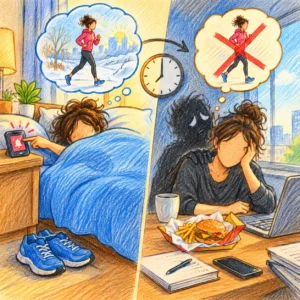
Have you ever turned off your morning alarm, snuggled deeper into your blanket, and convinced yourself that skipping your workout was the smartest decision of your life? Of course you have. Most of us have negotiated with our alarm clocks at least once, and some of us could probably win an award for creative excuses.
Picture this: It’s 6:30 AM. Outside, the weather is cold, the sky is gloomy, and your running shoes are sitting by the door, looking far too enthusiastic for this hour. Your bed is warm, your pillow is comfortable, and your brain suddenly becomes a motivational speaker for the wrong team.
“You worked hard yesterday,” it whispers. “You deserve a little rest. One missed workout won’t change anything!”
It sounds reasonable, doesn’t it? So you close your eyes, pull the blanket over your head, and return to dreamland.
Now fast-forward to 1 PM. You’re sitting at your desk, struggling to concentrate after lunch. Your back feels stiff, your energy is disappearing, and your mood is somewhere between grumpy and completely fed up. You glance outside and realize the weather has improved.
Suddenly, you remember those running shoes.
“Why didn’t I just get up and go?”
Welcome to the wonderfully frustrating world of regret.
Regret has a strange habit of arriving after the opportunity to make a different choice has disappeared. It rarely interrupts us when we’re enjoying a comfortable shortcut. Instead, it shows up later, carrying a list of everything we could have done differently.
But here’s the good news: you don’t have to spend your life cleaning up after decisions you could have approached more thoughtfully. By understanding why we make short-sighted choices and learning a few practical habits, you can reduce unnecessary regret and make life easier for your future self.
Why Your Present Self Keeps Creating Problems for Your Future Self
Let’s be honest. Most of us care about our future. We want to feel healthier, save more money, build meaningful relationships, and accomplish the goals we keep writing in our notebooks.
The problem is that our present desires often shout louder than our future plans.
You might want to save money, but that limited-time online sale looks irresistible. You might want to sleep earlier, but one more episode somehow becomes three. You might want to eat healthier, but the chocolate cake in the refrigerator appears to have a personal mission to ruin your good intentions.
Psychologists and behavioral economists study this tendency through concepts such as present bias. In simple terms, we often give immediate rewards more importance than benefits that will arrive later.
A comfortable bed offers an immediate reward. The benefits of exercise require effort before you experience them. Buying something exciting feels good right now, while the credit card bill belongs to a future date.
Our brains can understand long-term consequences perfectly well and still struggle to prioritize them in the moment.
Think of your present self as a shopper who enjoys spending money but leaves the bill for someone else. Unfortunately, that unfortunate someone is you, just a few hours, days, or months later.
This pattern appears in almost every area of life.
You postpone an important task and spend tomorrow working under unnecessary pressure.
You avoid an uncomfortable conversation and allow a small misunderstanding to become a serious problem.
You ignore your budget because you want something immediately, then feel anxious when your savings shrink.
You skip simple maintenance and eventually face an expensive repair.
The solution isn’t to stop enjoying life. It’s to recognize that your future self deserves consideration, too.
Before making a decision, ask yourself whether you’re genuinely choosing something enjoyable or simply transferring an inconvenience to tomorrow.
That small distinction can change more than you might expect.
Why Regret Always Seems to Arrive Too Late
Imagine reversing your car out of a crowded garage. You notice a stack of storage boxes near the bumper. You could get out, move them, and return to the driver’s seat, but it’s cold outside.
“There’s enough space,” you tell yourself.
You adjust the steering wheel, press the accelerator, and hear a horrible scraping sound.
Congratulations! You’ve just turned a ten-second task into a potentially expensive afternoon.
Before the collision, you were optimistic. Afterward, the consequences became impossible to ignore. You could suddenly see exactly why moving those boxes would have been worthwhile.
That’s one reason regret can feel so powerful. It involves comparing what actually happened with what might have happened if you’d chosen differently.
Psychological research describes regret as an emotion associated with evaluating alternative outcomes and sometimes blaming ourselves for a decision. We imagine the better result we could have achieved, and the contrast makes our actual situation feel worse.
The trouble is that we often underestimate consequences before they happen.
When you skip a workout, you may not immediately feel any different. When you delay saving money, your bank balance doesn’t necessarily collapse overnight. When you ignore a difficult conversation, the relationship might appear perfectly fine for another week.
Because the negative outcome isn’t immediately visible, the decision feels harmless.
Later, when the consequences become clearer, your perspective changes.
However, regret isn’t always a sign that you made a terrible decision. Sometimes you make a thoughtful choice and still experience an unfortunate outcome because circumstances change or information was missing.
The goal isn’t to predict every possible problem. Nobody can do that.
The goal is to notice foreseeable risks, consider realistic consequences, and take reasonable precautions before acting.
Being careful doesn’t mean becoming frightened of every decision. It means giving yourself a chance to avoid problems that don’t need to happen in the first place.
The Hidden Cost of Saying, “I’ll Fix It Later”
We live in a world that celebrates second chances, and rightly so. People make mistakes, relationships recover, and damaged things can sometimes be repaired.
But there’s a difference between forgiving yourself for a mistake and repeatedly creating problems because prevention feels inconvenient.
Imagine you’ve bought a beautiful wooden dining table. It’s your favorite piece of furniture, and it makes your dining room look like something straight out of a home-design magazine.
One afternoon, you decide to work on a craft project directly on the table.
A protective cloth is available in the cupboard, but retrieving it feels unnecessary. You’re careful, you tell yourself. What could possibly go wrong?
A few minutes later, a sharp tool slips. A scratch appears across the wood, and a drop of strong adhesive leaves another mark.
Now you’re researching repair products, watching tutorials, comparing stain colors, and spending your weekend trying to restore the surface.
Maybe you can repair it successfully. Maybe a faint mark will remain. Either way, you’ve spent time and money dealing with a problem that a simple protective covering could have prevented.
Everyday life works in much the same way.
Ignoring a small maintenance issue can lead to a bigger repair. Avoiding a conversation can create emotional distance. Missing a deadline can damage professional trust. Repeatedly overspending can turn an enjoyable purchase into months of financial pressure.
The real cost isn’t always money. Sometimes it’s your time, energy, confidence, or peace of mind.
Of course, you shouldn’t blame yourself for every difficulty. Unexpected events happen, other people make their own choices, and not every problem is preventable.
But when a situation is within your control, prevention is often easier than repair.
Instead of asking, “Can I get away with this?” try asking, “What would it take to handle this properly now?”
That question encourages responsibility without demanding perfection.
The Five-Minute Future Test
One of the simplest ways to reduce avoidable regret is to imagine how your decision might affect you later.
You don’t need a complicated planning system, an expensive journal, or a life coach standing beside your refrigerator. You simply need a brief pause before making choices that matter.
Call it the Five-Minute Future Test.
When you’re tempted to make an impulsive decision, imagine yourself five minutes, five hours, or five days from now.
Ask yourself three questions:
1. How will I probably feel about this choice later?
If you send an angry message right now, will you feel relieved tomorrow or embarrassed by the words you used?
If you purchase something you cannot comfortably afford, will the excitement outweigh the financial stress?
If you stay up late scrolling through videos, will you appreciate the extra entertainment when your alarm rings?
You won’t always know the answer, but considering it helps you look beyond the immediate reward.
2. Am I solving a problem or avoiding discomfort?
Sometimes we genuinely need rest. Sometimes we need to postpone a task because we’re overwhelmed, unwell, or dealing with an emergency.
But sometimes we label avoidance as self-care because it sounds kinder than admitting we don’t want to make an effort.
The distinction matters.
Rest can support your well-being. Avoidance can make a manageable problem more difficult when repeated indefinitely.
3. Is there a small action I can take now to make tomorrow easier?
Perhaps you can prepare breakfast, put your workout clothes beside your bed, schedule a bill payment, or write down the first step of an intimidating assignment.
You don’t need to solve your entire life before bedtime. You just need to make one sensible decision.
The Five-Minute Future Test works best when you use it without turning every little choice into a dramatic courtroom trial. Choose the moments that have meaningful consequences, pause briefly, and move forward.
Make Good Decisions Easier Than Bad Ones
Let’s discuss willpower.
We often imagine successful people waking up every morning overflowing with discipline. They leap out of bed, drink water, exercise, eat nutritious meals, complete their work, and somehow maintain immaculate homes.
Meanwhile, the rest of us are negotiating with a laundry basket that has apparently developed its own ecosystem.
The truth is that relying on motivation alone makes life unnecessarily difficult. Motivation changes with your mood, sleep, stress, and circumstances.
A better approach is to design your environment so that useful habits require less effort.
If you want to exercise in the morning, prepare your clothes, shoes, and water bottle before going to bed. Set a realistic alarm and decide what you’ll do before you wake up. If the weather is unpleasant, have an indoor alternative ready.
If online shopping repeatedly damages your budget, remove saved payment details, unsubscribe from promotional emails, and introduce a waiting period before nonessential purchases. You can still buy things you enjoy without allowing every passing impulse to become an order confirmation.
If you want to eat more balanced meals, keep convenient options available. Prepare ingredients in advance, place fruit where you can see it, and avoid buying large quantities of snacks you already know you struggle to portion comfortably.
If you tend to miss deadlines, break projects into smaller tasks and schedule the first step rather than waiting for the perfect burst of inspiration.
You can even use a simple if-then plan:
If my alarm rings, then I’ll sit up and put my feet on the floor.
If I feel tempted to make an unnecessary purchase, then I’ll wait 24 hours.
If I feel too overwhelmed to start a task, then I’ll work on it for five minutes.
If I receive an upsetting message, then I’ll pause before replying.
These plans connect a familiar situation with a specific response. Research on implementation intentions suggests that such if-then planning can help people translate their intentions into action.
The beauty of this approach is that you’re not constantly fighting yourself. You’re making the desired action easier to begin.
Protect Your Relationships From Avoidable Regret
Regret isn’t limited to exercise routines, shopping habits, or unfinished tasks. Some of our deepest regrets involve the people we care about.
Think about a disagreement with someone close to you. You’re frustrated, tired, and convinced that your perspective is the only reasonable one.
You say something unnecessarily harsh.
At that moment, winning the argument feels more important than protecting the relationship. Later, when the anger settles, you remember the expression on the other person’s face and wish you’d chosen your words differently.
Unfortunately, apologies cannot always erase the impact of what we say.
The answer isn’t to suppress every feeling or avoid difficult conversations. Healthy relationships need honesty, boundaries, and the ability to discuss uncomfortable subjects.
What matters is learning to respond rather than react.
When emotions are running high, give yourself permission to pause. Take a few breaths, collect your thoughts, and return to the conversation when you can speak more clearly.
Ask yourself whether your goal is to solve the problem or simply to make the other person feel as upset as you do.
Listen before preparing your next argument. Explain your feelings without turning them into accusations. If you’ve made a mistake, acknowledge it without adding a long list of excuses.
And don’t assume that the people you love will always have unlimited time, patience, or opportunities to reconnect.
Send the message. Make the call. Express appreciation. Address misunderstandings before resentment becomes a permanent resident in your relationship.
You cannot control how another person responds, but you can choose to communicate with care and integrity.
Build a Life That Requires Less Damage Control
There’s a particular kind of relief that comes from knowing you’ve handled the important things reasonably well.
Your bills are organized. Your schedule reflects your priorities. You’ve prepared for an upcoming deadline instead of hoping it magically disappears. You’ve addressed a misunderstanding rather than allowing it to grow.
Life still presents challenges, of course. Your plans will change, your car might break down, and sometimes even your best efforts won’t produce the results you wanted.
Being careful doesn’t guarantee a trouble-free life.
What it can do is reduce the number of difficulties created by preventable mistakes.
Start with one area where regret regularly appears.
If money is the problem, review your spending and create a realistic budget. If procrastination is the problem, identify the smallest useful next step. If your relationships are suffering, consider what conversation you’ve been avoiding. If your routine leaves you exhausted, examine your sleep habits and daily commitments.
Don’t attempt to redesign your entire life in one afternoon. Choose one recurring problem and introduce one practical change.
Then give that change time to become familiar.
When you make a mistake, learn from it without turning it into a permanent judgment about your character. Shame often keeps people stuck, while specific reflection can help them make better choices.
Instead of saying, “I’m hopeless with money,” ask, “What made that purchase so tempting, and what could I change next time?”
Instead of saying, “I never follow through,” ask, “Was my plan realistic, and how can I make starting easier?”
This is how you turn regret into useful information rather than an endless source of self-criticism.
What If You Have Already Made the Mistake?
Sometimes prevention comes too late. The money has been spent, the deadline has passed, the opportunity has disappeared, or the words have already been spoken.
What then?
First, acknowledge what happened without pretending it didn’t matter. If someone was hurt, take responsibility where appropriate. If you made a financial mistake, look honestly at the consequences. If you missed an opportunity, allow yourself to feel disappointed.
Next, separate what you can change from what you cannot.
You may not be able to reverse yesterday’s decision, but you can apologize, make a repayment plan, repair what is repairable, or prepare differently for a similar situation.
Finally, decide what the experience can teach you.
Regret can become useful when it helps you recognize your values, understand your behavior, and choose a different response in the future. It becomes less helpful when you replay the same event endlessly without taking any constructive action.
You don’t need to punish yourself forever to prove that you learned something.
Give yourself permission to move forward.
The purpose of looking back is not to live in the past. It’s to carry better judgment into the future.
Start Today, Not Someday
Here’s a little truth worth remembering: you will never make every decision perfectly.
Some mornings, you’ll choose extra sleep. Some days, you’ll spend more than you planned. Occasionally, you’ll procrastinate, lose your temper, or make a choice that looks questionable in hindsight.
You’re human, not a perfectly programmed productivity machine.
The goal is not to eliminate every mistake. It’s to become more thoughtful about the choices you can influence.
Before you go to bed tonight, choose one small thing your future self will appreciate. Prepare your clothes for tomorrow, organize your workspace, set aside money for a goal, or write down the task you’ve been avoiding.
Tomorrow, when the familiar temptation to take the easiest route appears, pause long enough to consider the consequences.
You don’t have to make the most difficult choice every time. You simply need to recognize when a small amount of effort now could save you considerable frustration later.
Regret may arrive late, but you don’t have to keep giving it reasons to visit.
Your future self is waiting for you, one ordinary decision at a time. Treat that person with a little more care, make room for sensible preparation, and remember that a better life is often built through small choices that nobody else notices.
Move the boxes before reversing the car. Protect the table before starting the project. Think before sending the message. Put on the shoes when exercise is a sensible choice, and rest when your body genuinely needs it.
Most importantly, stop waiting for tomorrow’s disappointment to explain what today’s wisdom could have prevented.
Your future deserves more than your leftovers. Give it a little thought today.
References
Frontiers in Psychology — Regret and Other Emotions Related to Decision-Making.
Understanding procrastination: Research on how prioritizing immediate rewards can influence long-term decisions. Saving Regret and Procrastination.
Making plans that lead to action: A meta-analysis examining the effectiveness of implementation intentions and practical if-then planning. The When and How of Planning.