
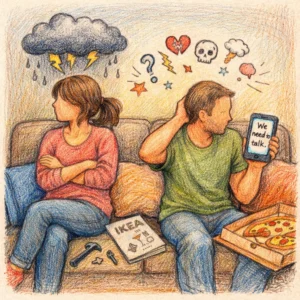
We’ve all lived this moment.
You walk into your home after a long day. Your partner, roommate, sibling, or mother-in-law is sitting there. Something feels… off. The air is thick, like a storm waiting to break. You sense it before a single word is spoken.
You take a deep breath and ask, carefully:
“Is everything okay?”
And then it lands.
The most dangerous word in the English language:
“Fine.”
Now technically—yes—that is communication. A word was spoken. Sound waves traveled. Language was exchanged. But in reality? That single word just detonated the entire evening.
The vibe died. The conversation died. And your motivation to speak again quietly crawled into a corner and gave up.
Welcome to the great irony of modern life:
Communication is the very thing that can either save a relationship—or destroy it completely.
It builds bridges.
It burns cities.
It heals wounds.
It creates them.
And in 2026, when we are more connected than ever, we are also more misunderstood than ever.
The Beautiful and Brutal Truth About Communication
We’ve been told since childhood that communication is the solution to everything.
“Just talk it out.”
“Say how you feel.”
“Communication is key.”
And while all of that is true… it’s also incomplete.
Because not all communication is good communication.
Some words soothe.
Some words scar.
Some words open doors.
Some words slam them shut so hard they never reopen.
This is why communication can feel so ironic—because the same tool that saves us can also silently sabotage us.
Let’s talk about how that happens.
When Words Become Weapons: How Communication Kills
1. The “Too Much Information” Trap
In 2026, honesty has been mistaken for total transparency. We believe that if we’re not saying everything we think, we’re being fake.
But that’s not honesty. That’s emotional dumping.
The situation:
Your friend proudly shows you their newly renovated neon-green living room. They’re glowing. They’re excited. They ask, “So… what do you think?”
You decide to practice “honest communication.”
You say:
“It looks like a radioactive lime had a mental breakdown.”
Result:
You communicated.
You were honest.
You also possibly ended a friendship.
Sometimes, communication kills not because it’s dishonest—but because it’s unfiltered, unnecessary, and unkind.
Good communication isn’t about saying everything.
It’s about saying the right thing, at the right time, in the right way.
2. The Digital Ghost Effect
Most of our communication now happens through screens. Messages. Emails. DMs. Voice notes. Typing bubbles that appear… and disappear… and reappear like emotional jump scares.
Text-based communication is efficient—but it’s also dangerous.
The message:
“We need to talk.”
What you meant:
“Let’s decide what to eat tonight.”
What they heard:
“I’m leaving.”
“You’re fired.”
“This relationship is over.”
“You’re about to be emotionally destroyed.”
Four hours later, they’ve mentally rewritten their entire life story, imagined every worst-case scenario, and emotionally pre-grieved a future that doesn’t even exist.
That’s how communication kills in the digital age—not through what’s said, but through what’s assumed.
3. The Over-Instruction Explosion
Ever tried helping someone parallel park?
Or assemble IKEA furniture without ending a relationship?
“Turn left!”
“No, my left!”
“YOUR OTHER LEFT!”
“Stop! Go! Why are you crying?!”
In moments like these, more communication doesn’t help—it overwhelms.
The human brain shuts down when flooded with instructions. What feels like “helping” often feels like criticism, pressure, or control.
Sometimes, silence is the most respectful form of communication.
When Words Become Lifeboats: How Communication Saves
Now for the magic—because when communication works, it really works.
It heals.
It reconnects.
It rescues relationships from the edge.
1. The Vulnerability Breakthrough
Nothing saves a relationship faster than replacing “Fine” with the truth.
Instead of:
“I’m fine.”
Try:
“I’m overwhelmed, and I don’t know how to say it without sounding dramatic.”
That one sentence can defuse days of tension.
Vulnerability is powerful because it invites connection instead of conflict. It turns your partner from an enemy into an ally.
It’s not weakness—it’s emotional courage.
2. Communication in the Workplace: The Silent Hero
Picture this:
A project is failing. Deadlines are slipping. Stress is high. Leadership is tense. Everyone is pretending they understand what’s happening.
Then someone says the bravest sentence in corporate life:
“I don’t fully understand the goal here. Can we clarify?”
That single moment of honest communication can save:
- Thousands of dollars
- Hundreds of wasted hours
- And everyone’s mental health
According to Harvard Business Review and Forbes, clarity is one of the most valuable communication skills in 2026.
Silence doesn’t make you professional.
Clear communication does.
3. The Stranger Effect
You’re standing in a long, miserable line. Everyone is tired. Irritated. Quietly suffering.
Then someone jokes:
“Does the air conditioner sound like it’s emotionally struggling… or is that just me?”
Laughter spreads. The mood shifts. Strangers soften.
That’s communication saving a moment—proving that words don’t just connect people we love, but people we don’t even know.
Why Communication Is So Ironic
Here’s the real issue:
Humans are powered by assumptions.
Communication kills when:
- We assume tone
- We assume intention
- We assume meaning
Communication saves when:
- We ask
- We clarify
- We listen
Think of communication like software.
If you don’t update it, the bugs take over:
- Resentment
- Sarcasm
- Passive aggression
- Emotional shutdown
Eventually, the entire system crashes.
3 Practical Ways to Make Communication Save More Than It Kills
1. The 10-Second Rule
When you’re angry, your brain is in survival mode. Anything you say will sound like a weapon—even if you don’t mean it that way.
Pause for 10 seconds.
Breathe.
Ask yourself:
“Will this solve the problem—or just make me feel powerful for three seconds?”
That pause can save relationships.
2. Upgrade to Active Listening
Most people don’t listen to understand.
They listen to reply.
Try reflective listening:
“So what I’m hearing is that you’re upset because I forgot the milk, and it made you feel unimportant. Is that right?”
It sounds simple. It feels awkward.
And it works.
The Gottman Institute consistently shows that feeling heard is more important than being right.
3. Choose the Right Medium
If it’s important—don’t text it.
If it’s emotional—don’t email it.
If it’s conflict—walk and talk.
Tone, body language, and timing carry more meaning than words alone.
Don’t let a blue message bubble destroy a ten-year relationship.
You Are the Architect
Communication is just a tool.
Like a hammer.
You can use it to build safety, trust, and understanding.
Or you can use it to shatter connection.
The irony isn’t that communication is dangerous.
The irony is that we stop trying because of that danger.
In 2026, let’s choose better communication.
Let’s explain instead of explode.
Listen instead of lecture.
And remember that “I’m sorry, I messed up” is one of the most powerful sentences a human can say.
Your words can change someone’s day—or their life.
Use them wisely.
Speak life, not damage.
References
Psychology Today – How couples’ communication influences relationship quality
Psychology Today – The art of listening (improve communication)
Harvard Business Online – How to communicate for impact
HelpGuide – Communication skills for healthy relationships
The Gottman Institute – Effective communication strategies
The Gottman Institute – 10 communication exercises for couples
Wikipedia – Active listening (communication technique)
Wikipedia – Nonverbal communication (importance in human interaction)