
We’ve all lived this moment.
It’s Sunday night. You just watched an inspiring documentary about someone who runs marathons before breakfast, drinks green juice like it’s magic, and somehow smiles through burpees. You feel fired up. Transformed. Reborn.
You order the $150 sneakers. You download three meditation apps. You promise yourself that tomorrow—tomorrow—you’ll wake up at 5:00 AM and finally become the disciplined, glowing, unstoppable version of yourself.
Then Monday morning shows up.
The alarm goes off. It’s raining. Your blanket feels like it was custom-designed by angels. And suddenly, the “future you” who was going to conquer life feels suspiciously like the “current you” who just wants five more minutes.
Welcome to the Great Motivation Trap.
Motivation is powerful—but it’s also temporary. And if you rely on it alone, you’ll keep starting over instead of moving forward.
The real secret? Consistency.
Consistency is what finishes what Motivation starts.
The Spark vs. The Engine
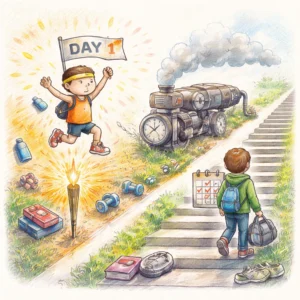
Think of Motivation as the spark that turns the ignition key. It gets you moving. It’s exciting. It’s emotional. It feels like possibility.
But Consistency? That’s the fuel in the tank.
Without fuel, even the most beautiful car goes nowhere.
Our culture loves the spark. We celebrate:
- “Day One” gym selfies
- New journals with perfectly written goals
- Announcements of fresh starts
- Vision boards and hype videos
But we rarely celebrate Day 47.
Day 47 is when you wake up tired and still go for a 15-minute walk.
Day 47 is when you write 300 words even though they’re not perfect.
Day 47 is when you practice a skill quietly, with no applause.
That’s where the magic happens.
Motivation is loud.
Consistency is quiet.
Motivation feels heroic.
Consistency feels boring.
But boring is what builds extraordinary lives.
Why Your Brain Loves Motivation but Hates Consistency
Your brain isn’t designed to help you “achieve your dreams.” It’s designed to keep you alive.
From an evolutionary standpoint, conserving energy was survival. Expending effort unnecessarily could be dangerous.
So when you suddenly decide to:
- Wake up earlier
- Exercise daily
- Eat differently
- Learn a new skill
- Build a business
Your brain reacts like you’ve suggested running into the wilderness.
Let’s break down what typically happens:
Week One: The Hype Phase
Motivation is high. Everything feels new. Your brain enjoys the novelty. Dopamine is flowing. You feel unstoppable.
Week Two: The Negotiation Phase
The excitement fades. Your brain starts asking questions:
“Are we still doing this?”
“Is this really necessary?”
“Wouldn’t the couch be better?”
Week Three: The Danger Zone
This is where most people quit.
They say, “I lost Motivation.”
But here’s the truth: Motivation did its job. It got you started.
Now Consistency is supposed to take over.
And Consistency doesn’t feel exciting. It feels like discipline. It feels repetitive. It feels… ordinary.
But ordinary actions, repeated daily, create extraordinary results.
The Myth of “Feeling Ready”
One of the biggest lies we tell ourselves is:
“I’ll do it when I feel like it.”
But feelings are weather.
Some days are sunny.
Some days are stormy.
Some days are foggy and confusing.
If a train only moved when the weather was perfect, it would rarely leave the station.
Consistency means you move anyway.
Not perfectly. Not intensely. Just steadily.
When you stop waiting for the perfect mood, you gain power.
Consistency Builds Identity
Here’s something powerful: every time you act consistently, you are voting for the kind of person you want to become.
- When you write daily, you become a writer.
- When you exercise regularly, you become someone who takes care of their body.
- When you save money consistently, you become financially responsible.
Identity isn’t built through big dramatic moments.
It’s built through repeated behavior.
Research from Stanford psychologist Carol Dweck shows that adopting a growth mindset—believing you can improve through effort—leads to greater achievement over time. And effort, by definition, requires consistency.
Small repeated effort compounds.
Just like money invested grows through compound interest, habits grow through compound behavior.
How to Build Consistency Without Burning Out
You don’t need iron willpower.
You need a system.
Here are practical ways to build Consistency even when Motivation disappears.
1. Lower the Bar Until It’s Almost Funny
Most people fail because they start too big.
Instead of:
“I’ll work out for 90 minutes every day”
Try:
“I’ll move for 5 minutes.”
Instead of:
“I’ll write 2,000 words daily”
Try:
“I’ll write one paragraph.”
The goal isn’t intensity. It’s repetition.
Five minutes daily beats one intense workout followed by two weeks of nothing.
Behavior scientist BJ Fogg, author of Tiny Habits, emphasizes starting ridiculously small. When habits feel easy, they stick.
Consistency thrives on simplicity.
2. Use Habit Stacking
Attach a new habit to something you already do.
For example:
- After brushing your teeth → meditate for 2 minutes.
- After pouring coffee → read one page.
- After lunch → take a 5-minute walk.
Your brain already knows how to brush teeth or drink coffee. You’re simply piggybacking a new behavior onto an existing one.
This reduces friction. And friction kills consistency.
3. Follow the “Never Miss Twice” Rule
Life will interrupt you.
You’ll get sick.
You’ll travel.
You’ll have a stressful day.
Missing once is human.
Missing twice starts a new pattern.
If you skip today, your only job is to show up tomorrow—even if it’s at 10% effort.
Consistency doesn’t mean perfection. It means returning.
4. Celebrate the Boring Wins
We celebrate milestones:
- Losing 20 pounds
- Publishing a book
- Hitting a revenue goal
But we rarely celebrate:
- Choosing water over soda
- Writing when tired
- Practicing when no one is watching
The real victory isn’t the milestone.
It’s the day you showed up without Motivation.
That’s strength.
The Compound Effect of Consistency
Success is rarely dramatic.
It’s gradual. Quiet. Almost invisible—until suddenly, it’s undeniable.
Author Darren Hardy wrote about this in The Compound Effect: small daily decisions shape your destiny more than occasional bursts of effort.
Imagine improving just 1% each day.
It doesn’t feel like much.
But over a year, that tiny improvement multiplies beyond what you can imagine.
Consistency compounds.
Motivation spikes.
Spikes fade.
Compounding grows.
Why Motivation Alone Keeps You Stuck
When you rely solely on Motivation:
- You only act when inspired.
- You stop when bored.
- You restart every few weeks.
- You feel guilty for “failing.”
This creates a cycle:
Inspiration → Intense Action → Burnout → Quit → Guilt → New Inspiration
Consistency breaks that cycle.
It replaces drama with stability.
And stability builds confidence.
When you keep promises to yourself—even tiny ones—you build self-trust.
And self-trust is powerful.
Consistency and Self-Respect
Every time you say you’ll do something and don’t, your brain notices.
Every time you follow through—even in small ways—your brain notices that too.
Consistency builds internal credibility.
You start believing yourself.
You stop saying:
“I’ll try.”
And start saying:
“I do.”
That shift changes everything.
The Lifestyle Shift
Motivation focuses on goals.
Consistency builds lifestyles.
Motivation says:
“I want to run a marathon.”
Consistency says:
“I run three times a week.”
Motivation says:
“I want to write a book.”
Consistency says:
“I write daily.”
One is event-based.
The other is identity-based.
And identity always wins long term.
What Consistency Really Looks Like
Let’s be honest.
Consistency doesn’t look glamorous.
It looks like:
- Repeating basics.
- Doing small things.
- Saying no to distractions.
- Choosing long-term progress over short-term comfort.
It’s not dramatic.
But it’s powerful.
When you become someone who acts regardless of mood, you become unstoppable.
Your feelings become weather—not commands.
Start With a Micro-Habit Today
If this all feels overwhelming, shrink it.
What is one action that takes less than two minutes?
- Two push-ups
- One page of reading
- One gratitude sentence
- One glass of water
Start there.
Do it tomorrow.
Then the next day.
Then the next.
Your future self isn’t built in one motivational moment.
It’s built in small, repeated decisions.
Consistency transforms “I wish” into “I did.”
Final Thoughts: The Real Secret Sauce
Motivation is beautiful.
It’s the spark. The excitement. The beginning.
But Consistency is the secret sauce.
It’s steady.
It’s reliable.
It’s sometimes boring.
And it works.
Stop chasing the next wave of inspiration.
Instead, choose the smallest action you can repeat daily.
Your future self is already at the finish line—grateful you didn’t quit when Motivation left the room.
References
Dweck, C. (2006). Mindset: The New Psychology of Success. Random House.
Fogg, B. J. (2019). Tiny Habits: The Small Changes That Change Everything.
Hardy, D. (2010). The Compound Effect. Vanguard Press.
Clear, J. (2018). Atomic Habits. Avery.