
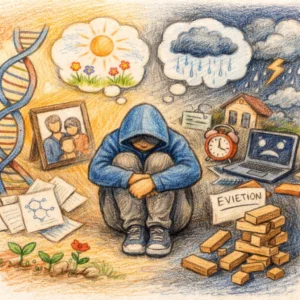
Let’s pause for a moment and have a real, honest, no-filter conversation.
Not the kind where someone says, “Just think positive!”
Not the kind where depression gets reduced to a bad mood or a bad attitude.
I’m talking about that heavy cloud—the one that doesn’t lift when the sun comes out. The kind of tired that sleep doesn’t fix. The kind of sadness that doesn’t need a reason. The kind that makes everyday tasks feel like climbing a mountain in flip-flops.
That’s Depression.
And if you’ve ever found yourself sitting alone—maybe late at night—wondering,
“Why do I feel like this?”
“Is something wrong with me?”
“Did I inherit this… or did life just wear me down?”
First of all: you’re not alone.
Second of all: you’re asking the right questions.
The debate around whether Depression is hereditary (genetic) or developed through life experiences has been going on for decades. And the answer isn’t simple—but it is reassuring.
So let’s break it down without scary medical terms, without judgment, and without pretending this is easy. We’ll use logic, science, relatable examples, and a little humor—because sometimes laughter is the only light in the fog.
Nature vs. Nurture: The Mental Health Showdown
Imagine your mental health as a garden.
Genetics is the soil you’re born with.
Some soil is nutrient-rich. Some is rocky. Some needs a little extra care.Environment is the weather.
Sunshine, storms, droughts, floods—none of these are under your control.
Even the best soil struggles in a hurricane.
Even difficult soil can grow something beautiful with the right care.
That’s Depression in a nutshell.
The truth? It’s rarely just one thing.
It’s not only your DNA, and it’s not only your circumstances.
It’s the interaction between the two.
Let’s look at the real evidence.
Proof #1: The Genetic Blueprint (The Family Factor)
If Depression seems to “run in your family,” that’s not your imagination.
What science tells us
Studies show that if a parent or sibling has experienced Depression, your own risk increases. Researchers have identified gene variations linked to how the brain manages chemicals like serotonin, dopamine, and norepinephrine—the messengers responsible for mood, motivation, and emotional balance.
Think of it this way:
You might be born with a slightly smaller emotional fuel tank. It’s not empty—it just runs out faster under stress.
What this does not mean
This does not mean Depression is guaranteed.
This does not mean you’re broken.
This does not mean you’re destined to suffer.
A genetic risk is a heads-up, not a life sentence.
Just like someone with a family history of diabetes pays closer attention to diet, someone with a family history of Depression benefits from paying closer attention to mental health.
Awareness is power—not doom.
Proof #2: The “Broken Thermostat” (Biology & Brain Chemistry)
Sometimes Depression develops without a clear external trigger. Life might look “fine” on paper—yet inside, everything feels off.
This is where biology steps in.
What’s happening in the brain
Your brain runs on chemical messengers called neurotransmitters. When they’re balanced, emotions flow. When they’re disrupted, messages get lost.
This imbalance can happen due to:
- Hormonal changes (postpartum, thyroid disorders, menopause)
- Chronic illness or inflammation
- Certain medications
- Aging and brain structure changes
The very human explanation
Your brain is a three-pound blob of electrified jelly doing a billion jobs at once.
Sometimes… it glitches.
No trauma. No bad childhood. No dramatic event.
Just a system error.
And that’s why Depression is a medical condition, not a character flaw.
Proof #3: Stress Jenga (Life Events & Emotional Overload)
Now let’s talk about life.
Real life.
Messy life.
The kind that doesn’t come with warning labels.
How Depression develops through experience
Chronic stress, trauma, grief, abuse, financial pressure, burnout, relationship loss—these experiences force the brain into constant survival mode.
When stress becomes nonstop, your nervous system says:
“Enough.”
And to conserve energy, it shuts down things like:
- Pleasure
- Motivation
- Emotional range
- Hope
That shutdown? That’s Depression.
An important reminder
You wouldn’t blame a phone for dying if it never got charged.
You wouldn’t blame a car for breaking if it was driven nonstop.
So please—don’t blame yourself for breaking under pressure.
Proof #4: Epigenetics (The Gene Switch Theory)
Here’s where science gets fascinating—and hopeful.
What epigenetics means
You can carry genes linked to Depression your entire life without symptoms. These genes can remain switched off.
Then something happens:
- Trauma
- Prolonged stress
- Major loss
And suddenly, the switch flips.
Why this matters
It proves something powerful:
👉 Your genes are not your destiny.
👉 Environment talks to DNA.
👉 Change the environment, and the conversation changes.
This is why therapy, lifestyle changes, medication, and support can be life-changing—even for people with a genetic predisposition.
Proof #5: Learned Behavior (What Looks Genetic but Isn’t)
Sometimes what we call “hereditary Depression” is actually learned emotional behavior.
How this happens
If you grew up in a home where:
- Emotions were ignored
- Stress was met with silence
- Pessimism was normal
- Coping meant avoidance
You may have learned these patterns without realizing it.
That’s not in your blood—it’s in your conditioning.
The hopeful truth
What’s learned can be unlearned.
Through therapy, self-awareness, and practice, the brain can rewire itself. This is called neuroplasticity, and it’s one of the most empowering discoveries in mental health.
You are not stuck with outdated emotional software.
Breaking the Stigma: You Are Not a Faulty Human
Let’s say this clearly:
Depression is not your fault.
Not if it’s genetic.
Not if it’s situational.
Not if you “have everything and still feel empty.”
Depression doesn’t mean you’re weak.
It means your brain is overwhelmed—or under-supported.
And needing help does not mean failing at life.
It means you’re responding intelligently to pain.
How to Start Healing (Without Overwhelm)
You don’t need to fix everything today.
You just need to take one gentle step.
1. Improve Your “Soil”
Ask yourself:
- Am I sleeping enough?
- Am I eating real food?
- Am I constantly overstimulated?
Tiny changes matter more than grand plans.
2. Talk to a Professional
Therapists and doctors aren’t judges—they’re mechanics.
You wouldn’t repair a car engine alone. Your brain deserves the same respect.
3. Move—Even a Little
A five-minute walk tells your brain,
“We’re still alive. We’re still moving.”
That signal matters more than motivation.
4. Practice Self-Compassion
If your best friend felt this way, would you shame them?
Or would you sit with them quietly and say,
“I’m here.”
Offer yourself the same grace.
Conclusion: So… Is Depression Genetic or Developed?
The honest answer?
Both.
Depression is a collaboration between:
- Your DNA
- Your experiences
- Your nervous system
- Your environment
- Your coping tools
Genes may load the gun.
Life may pull the trigger.
But healing rewrites the ending.
You are not just a passenger in your mind—you are the pilot.
The storm may be loud. The controls may feel shaky.
But you are still flying.
And if you’re reading this, that means part of you still hopes.
That part matters.
That part is worth fighting for.
References
National Institute of Mental Health (NIMH)
American Psychiatric Association – What Is Depression?