
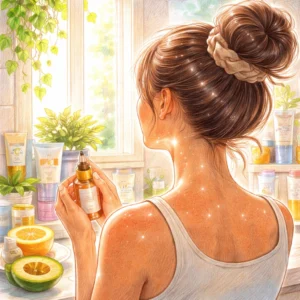
It was a rainy morning—the kind of morning where your alarm goes off, you negotiate with it like a hostage situation, and somehow still end up late. Hair? Thrown into a “this will do” bun. Outfit? Comfortable enough to survive the day. Confidence? Loading… slowly.
You rush to the grocery store because you’re out of coffee, which is frankly unacceptable behavior from past-you.
You’re standing in the checkout line, half awake, half questioning your life choices, when you notice her.
She’s at the front. No makeup. No contour. No Instagram filter working overtime. Her skin tone isn’t extremely fair or dramatically deep—it’s just… alive. When the fluorescent lights hit her face, they don’t expose tired pores or dull patches. Instead, her skin reflects light like it’s been quietly thriving behind the scenes.
You don’t think, “Wow, she’s so fair.”
You think, “What kind of life choices led to that skin?”
That moment right there? That’s the shift.
Because in 2026, the beauty conversation has finally evolved. A fair complexion is no longer the gold standard. Glowing skin is.
And honestly? It’s about time.
The Fair Complexion Obsession: A Beauty Trend That Overstayed Its Welcome
Let’s talk honestly—no judgment, no lectures, just facts and feelings.
For decades, we were sold the idea that beauty came in one shade: lighter. Beauty aisles were stacked with whitening creams, lightening serums, and “instant fairness” promises that worked faster than logic.
The messaging was subtle but persistent:
- Fair equals fresh
- Fair equals beautiful
- Fair equals successful
The problem? Skin doesn’t work that way. And neither does confidence.
Trying to change your natural skin tone is like trying to change your height with positive affirmations. Exhausting. Expensive. Emotionally draining. And often disappointing.
I remember my cousin Sarah in 2024. She spent an entire summer dodging the sun like it owed her money. Wide-brimmed hats. Long sleeves in heatwaves. Enough “brightening” products to open her own store.
By August, she was visibly lighter—mission accomplished.
But she also looked tired, washed out, and weirdly unhappy.
She had the fair complexion.
She did not have the glow.
That’s the difference no one talked about for years.
Why Glowing Skin Is the Real Beauty MVP in 2026
If fair complexion is a color, glowing skin is an experience.
Glowing skin tells a story without saying a word:
- “I hydrate.”
- “My skin barrier is intact.”
- “My body is functioning like it appreciates me.”
Glow isn’t about being lighter—it’s about being healthier.
And here’s the plot twist: glowing skin looks incredible on every shade.
From porcelain to caramel to deep cocoa and everything in between—when skin glows, it doesn’t compete with other skin tones. It celebrates its own.
Glow turns your natural complexion into the main character instead of something you’re trying to fix.
Let’s Talk Toast (Because This Will Make Sense)
Think of skin like bread.
A fair complexion without glow is like plain white bread. It’s fine. Neutral. Exists.
Glowing skin?
That’s warm, golden sourdough. Slightly crisp. Soft inside. Drizzled with honey. The kind you notice.
Same loaf. Different treatment.
When you focus on glowing skin, you stop fighting your face and start working with it. You’re not bleaching—you’re nourishing.
And skin loves to be nourished.
3 Reasons It’s Time to Stop Chasing Fairness
1. Glowing Skin Is Mentally Healthier
Chasing a fair complexion is full of restrictions:
- No sun
- No outdoor fun
- No freckles
- No happiness, apparently
Glow culture flips that script.
It’s full of yeses:
- Yes to hydration
- Yes to sunscreen (without ghost mode)
- Yes to skin that looks like it’s enjoying life
When beauty stops feeling like punishment, it becomes sustainable.
2. Glow Ages Better Than Fairness Ever Could
Healthy, glowing skin is hydrated, elastic, and resilient.
On the other hand, skin repeatedly exposed to harsh lightening agents often becomes:
- Thin
- Sensitive
- Reactive
- Prone to early aging
Glow is long-term beauty. Fairness is short-term illusion.
Think of glow as a retirement plan for your face.
3. Glow Is About Confidence, Not Comparison
Trying to achieve a fair complexion usually means comparing yourself to someone else’s skin.
Glowing skin is personal.
It’s you vs yesterday’s dullness.
It’s not about matching anyone—it’s about maximizing your skin’s potential.
And that hits different.
How to Get Glowing Skin in 2026 (Without Losing Your Mind)
Good news: you don’t need a 15-step routine or a bathroom shelf that looks like a lab.
You just need to focus on four glow pillars.
1. Exfoliation: The “Dusting” Step
You can’t glow through dead skin—it’s not a miracle.
Use a gentle chemical exfoliant (like lactic acid or PHA) 1–2 times a week. Think of it as dusting your skin, not sanding furniture.
Result: smoother texture, better product absorption, instant brightness.
2. Hydration: The “Plumping” Step
Hydration is glow’s best friend.
Look for:
- Hyaluronic acid
- Glycerin
- Ceramides
Well-hydrated skin reflects light better. That’s science and common sense.
Drink your water too. Your moisturizer can’t fix dehydration caused by vibes alone.
3. Vitamin C: The “Brightening” Upgrade
This is where people get confused.
Brightening ≠ lightening.
Vitamin C helps:
- Even skin tone
- Reduce dullness
- Support collagen
- Add that lit-from-within look
It enhances your natural complexion instead of erasing it.
4. Movement: The Free Glow Hack
Ever notice how your skin glows after:
- A walk
- A workout
- A deep laugh
That’s circulation. Blood flow. Oxygen doing its thing.
Movement is skincare your pores understand.
And it costs nothing.
The Glow Mindset Shift We All Need
Here’s the truth no product label ever told you:
You don’t need to be fair to be beautiful.
You need to be well.
Glowing skin is a reflection of care—physical and emotional. It’s what happens when you stop criticizing your face and start supporting it.
In 2026, beauty isn’t about fitting into a shade chart.
It’s about radiating health, comfort, and confidence.
So put down the lightening cream.
Pick up the moisturizer.
Choose sunscreen that loves your undertone.
Drink the water.
Take the walk.
Laugh more.
The world doesn’t need more porcelain dolls.
It needs more people glowing—comfortably, confidently, and unapologetically—in their own skin.
Go get that glow.
References
Harvard Health Publishing – Healthy Skin Habits
Mayo Clinic – Water Intake and Skin Health
Cleveland Clinic – Vitamin C Benefits for Skin
Healthline – How to Get Glowing Skin Naturally
American Academy of Dermatology (AAD) – Sunscreen and Skin Tone Protection