
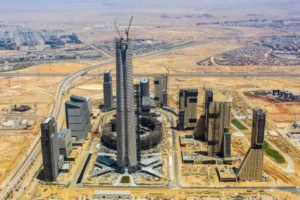
Cairo is a city steeped in history. It was first founded and ruled by King Menes of Egypt, thousands of years ago. His single-handed motto was to unite Upper and Lower Egypt into a unified kingdom and establish ancient Egypt’s first dynasty. Since then, Cairo has been home to many historic marvels, such as the Babylon Fortress on the Nile, the funerary monuments of Memphis and Sakkara, the sphinx, and of course, the Great Pyramids of Giza. So, with so much history and worldwide recognition backing it up, why did the government decide to build an entirely new administrative capital for the country? Well, let’s find out.
Before we begin, it is important to remember that a nation changing its capital city is not anything new. In fact, the capital city of a country is expected to change every 500 years or so. By that metric, Cairo has been holding its title for a long time now.
With time, a lot of problems have started to exist. Cairo, with nearly 10 million people in the city proper, and over 22 million in Greater Cairo, is now overly packed. By 2050, this number could nearly double and so, the already prevailing problems such as overcrowding, pollution, the poor allocation of resources and the congestion of traffic would only become worse in future.
People who have had the experience of being stuck in traffic know how jammed roads can be the bane of one’s existence. In Cairo, traffic and congestion are an even bigger issue because all the administrative buildings in the city are spread out. This makes it difficult for various ministries to work cohesively as government servants spend more time being stuck on roads than serving people. Egypt’s president, Abdel Fattah el-Sisi, decided to tackle the issue by investing in a new administrative capital city – a satellite city 45 kilometers east of Cairo, with the very imaginative placeholder name of “New Administrative Capital”. Until today, no official name has been released for the megaproject, but the Egyptian transportation minister hinted that it might be called – wait for it – Egypt.
The city carries an estimated price tag of around 45–58 billion dollars, and work officially began in 2015. The project would span an area of about 700 square kilometers (270 square miles) which is almost four times the area of Washington DC. Once completed, the city will serve as the new financial and administrative capital of Egypt, have over six million residents and connect Cairo to the Red Sea.
So, with such a hefty price tag, what can we expect from the new capital city?
Actually, quite a lot.
For starters, as a planned city, it benefits from proper zoning which its organic predecessor lacks. Most significant of these zones is the administrative area, containing 30 ministries of the Egyptian government. The scattered ministry buildings will be situated opposite one another, in a much closer proximity. For better coordination between the ministries, the Cabinet Building is proposed to be in the center.
The largest of these ministries is the Egyptian Ministry of Defense, situated in a circular area called the Octagon – not to be confused with the Pentagon of the US, because the Octagon will be even bigger. This will be the headquarters for the Egyptian military, and extending outwards will be residential units for military personnel and their families, as well as facilities like hotels, schools, hospitals, and places of worship, making the district a city within the city.
Besides ministries, the city will house embassies, the parliament, government agencies, knowledge hubs, sports centers, an international airport, business hubs, and a stretch of greenery with water features inspired by the Nile in an area called the “green river”. It will be about six times the size of Central Park of New York. The green river is only one of the ways the government hopes to make Egypt greener, with the promise of allocating 15 square meters of green space per inhabitant.
Another problem the city will tackle is housing. The New Capital City will have 21 residential areas to house its 6.5 million inhabitants. Now people in Egypt mostly stay close to the Nile – understandable, since most of the country is made of the Sahara desert, and the Nile is its crucial source of fresh water. However, as mentioned earlier, this puts a strain on resources and causes overcrowding. For this reason, the government has been stretching cities further out into the desert since the late 70s while keeping in mind the issue of fresh water. A few cities built along such lines include the 10th of Ramadan city, the 6th of October city, Sheikh Zayed city, and El Obour. So, the Cairo City’s idea is not entirely a new one. When it comes to scale, however, the city has no match.
Speaking of houses and scales, the lofty, aptly-named “Presidential Palace”, the most politically powerful place in the country, has caused a stir everywhere. The proposed designs show an opulent building with no shortage of grandeur, inspired by the architecture of pharaonic Egypt to stand tall amidst all the greenery. In fact, much of the city’s design takes inspiration from ancient Egypt. One of the proposed future skyscrapers is the Oblisco Capitale, which would resemble an Egyptian obelisk and rise to the height of 1 km. However, this tower is still a concept and has not entered construction. The Unknown Soldier Monument, overlooking the People’s Square, is another such example.
While the city’s architecture and design takes inspiration from its past, the vision for the city is starkly futuristic. The city hopes to be among the world’s leading “smart cities”, with residents using smart cards and apps for services. From making payments, unlocking doors, to surfing the web from public WiFi installations in lamp posts, much would be done digitally. The New Administrative Capital also has a smart plan for nearly 6,000 security cameras to be used for monitoring the streets and regulating the traffic flow. The city will have its own designated mobile app, which residents will be able to use for accessing local services, reporting complaints, and paying their utility bills.
On paper, the New Administrative Capital sounds like a step towards a utopian future, but the megaproject has its share of critics, who make some very valid points. First of all, who really benefits from the project? Is it the people of old Cairo, or the residents of the New Administrative Capital? Well, let’s see.
The company overseeing the city’s development is the Administrative Capital for Urban Development. 51% of the company is owned by the Egyptian military, and the remainder is owned by the Ministry of Housing. Coincidentally, Abdel Fattah el-Sisi became president of Egypt after a military coup which overthrew the country’s first democratically elected leader, Mohamed Morsi. You connect the dots now.
The military is funding and overseeing the project. It is projected to earn financial benefits from it, as the Administrative Capital for Urban Development is responsible for selling housing units in the new capital. Furthermore, once the government buildings in ‘old Cairo’ are vacated, the ACUD will also be in charge of selling or operating those buildings, which would then sit on prime real estate. The money the military makes from the megaproject will most likely never be audited either.
Critics also wonder who the city is being built for. Some apartment units are being sold for astronomical sums of money, far out of reach of the common Egyptian citizen. This has led people to believe that the new city, being built as a gated community, would house Egypt’s elite and ruling class only. The $45–58 billion being spent on the city could have been used to improve the existing infrastructure of Cairo, and to provide better housing to impoverished communities. Many feel the new capital is merely a vanity project for el-Sisi and his cohorts, and a way for the president to bring Egypt’s powerful and wealthy business class to his side, thereby further legitimizing his position in the country. After all, Egypt can’t have another Arab Spring in Tahrir Square if its ruling elite are cordoned off in their own fortified city, away from the ordinary masses.
The megaproject also brings to light many environmental concerns. The new administrative capital has no local source of water. The government envisions a green city in the middle of a desert, but environmentalists are wondering how sustainable this artificial oasis will be in the long run. Terraforming the desert landscape will impact vulnerable and endangered species. Also, researchers note that the new city will likely be a big consumer of already-scarce freshwater, cause destruction of broad areas of desert habitats, and exclude people who cannot afford cars or expensive housing. The pharaonic design of the city also reflects the desire to consolidate and display power by an autocratic ruler.
But what are your thoughts on Egypt’s New Administrative Capital? Does it merit the criticism, or is it going to set the precedence for such cities in the future? Please share your thoughts in the comments section below, and subscribe to our channel to know more about megaprojects from around the world.
References
Encyclopaedia Britannica. Cairo: History, Population, & Facts.
Administrative Capital for Urban Development (ACUD).