
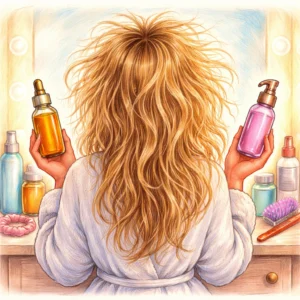
Let’s create a scene!
You’re standing in the beauty aisle, holding two tiny bottles that cost more than your lunch. One promises “liquid gold nourishment.” The other guarantees “mirror-like shine and frizz control.” Your hair? It currently looks like it fought a humid day and lost.
Welcome to the classic beauty dilemma: Oils vs Serums.
If you’ve ever wondered whether you need deep nourishment or instant gloss—or both—you’re not alone. The truth is, the difference isn’t complicated. You don’t need a chemistry degree. You just need to understand what your hair is asking for.
Let’s break it down in real-life language.
The Real Difference: Oils vs Serums
At first glance, they look similar. Both come in small bottles. Both promise transformation. Both claim to be your hair’s best friend.
But they play very different roles.
Hair Oil: The Deep Feeder
Think of hair oil as a home-cooked meal. It goes deeper. It nourishes from within. It strengthens the hair shaft over time.
Oils are usually plant-based—like argan, coconut, jojoba, or grapeseed—and are rich in fatty acids, antioxidants, and vitamins. Many oils can penetrate the hair cuticle and help reduce protein loss, especially in damaged hair.
Hair oils focus on:
- Long-term health
- Scalp nourishment
- Moisture retention
- Repair and strengthening
They are about healing, not hiding.
If your hair could speak, oil would be the apology gift for all the heat styling, bleaching, tight ponytails, and questionable decisions of the past.
Hair Serum: The Surface Protector
Now imagine hair serum as a filter for your hair. It doesn’t deeply repair the inside. Instead, it coats the surface.
Most serums are silicone-based. They form a lightweight protective layer that:
- Adds shine
- Reduces frizz
- Protects against humidity
- Smooths flyaways
- Often provides heat protection
Serums are about instant results. They make your hair look polished, glossy, and camera-ready.
Oil works behind the scenes. Serum works on the red carpet.
That’s the core of Oils vs Serums.
Choosing the Right One for Your Hair Type
Your hair type is the boss. Not trends. Not influencers. Not the fancy packaging.
Let’s figure out which side wins for you.
1. Fine & Flyaway Hair
If your hair gets greasy just by thinking about oil, listen closely.
Winner: Serum
Heavy oils can weigh fine hair down and make it look flat or oily. A lightweight serum smooths frizz without suffocating your strands.
Look for:
- Lightweight formulas
- Non-greasy finish
- Minimal application (1 drop is often enough)
If you really want to use oil, choose lighter options like grapeseed or moringa oil. They’re less heavy than coconut or castor oil.
For fine hair, less is more. Always.
2. Dry & Damaged Hair
If your hair feels rough, brittle, or constantly thirsty, it’s crying out for moisture.
Winner: Oil
Dry hair needs penetration. It needs nourishment from the inside.
Oils like argan and coconut are particularly helpful because they can reduce protein loss and strengthen the hair shaft.
Warm oil treatments once a week can:
- Improve elasticity
- Reduce breakage
- Add softness
- Restore shine over time
You can still use serum—but oil should be your foundation.
In the Oils vs Serums debate for damaged hair, oil wins the long game.
3. Curly & Coily Hair
Curly hair has unique needs. It tends to be naturally drier because scalp oils don’t travel down the hair shaft easily.
Winner: Both (The Power Duo)
Curls love moisture. But they also battle frizz and humidity.
Here’s a simple routine:
- Apply oil to damp hair to lock in hydration.
- Use serum lightly to define curls and reduce frizz.
Oil feeds the curls. Serum seals and smooths them.
Together, they create balance.
4. Heat Styling Lovers
Flat irons. Curling wands. Blow dryers. If these are part of your weekly routine, protection is essential.
Winner: Serum
Many serums are formulated with heat protection properties. They act as a barrier between your hair and high temperatures.
Heat can weaken the protein structure of hair. A protective coating helps reduce moisture loss during styling.
But remember: serum is protection, not permission to overheat. Lower the temperature whenever possible.
The Golden Rules of Application
Using the right product the wrong way can ruin everything.
Let’s get this right.
How to Apply Hair Oil
Best used:
- As a pre-wash treatment
- As an overnight mask
- As a scalp massage treatment
Steps:
- Warm a small amount between your palms.
- Apply from mid-length to ends.
- Massage into scalp if doing a treatment.
- Leave for 30 minutes or overnight.
- Wash thoroughly.
Oil works best when given time to absorb.
Pro tip: Don’t drench your hair. You’re moisturizing it, not deep-frying it.
How to Apply Hair Serum
Best used:
- After washing
- Before styling
- On damp or dry hair
Steps:
- Use 1–2 drops only.
- Rub between palms.
- Apply from ends upward.
- Avoid the scalp.
Applying serum to your scalp can make your hair look greasy quickly.
Start small. You can always add more.
Common Mistakes People Make
In the Oils vs Serums debate, most problems come from misuse.
Here are common errors:
Using too much product
Applying oil to already greasy hair
- Using serum as a repair treatment
- Expecting oil to control humidity instantly
- Applying products directly to the scalp without need
Remember: oil repairs over time. Serum perfects instantly.
They are not interchangeable.
Can You Use Both Together?
Absolutely.
In fact, many people benefit from combining them strategically.
Here’s how:
- Use oil once or twice weekly for nourishment.
- Use serum daily or after washes for shine and frizz control.
Think of oil as skincare for your hair.
Think of serum as makeup for your hair.
Both have their place.
Understanding Your Hair’s Needs
Instead of asking “Which is better?” ask:
- Is my hair dry or just frizzy?
- Do I need repair or shine?
- Am I styling with heat frequently?
- Does my hair get greasy easily?
Hair changes with:
- Weather
- Hormones
- Stress
- Age
- Chemical treatments
Your routine should evolve too.
The Science Behind It (Simplified)
Research shows that certain oils—especially coconut oil—can penetrate the hair shaft and reduce protein loss during washing.
Serums, especially silicone-based ones, coat the hair surface and reduce friction, which minimizes breakage and frizz.
In simple terms:
Oil strengthens from within.
Serum shields from outside damage.
That’s the core of Oils vs Serums.
The Final Verdict
There is no enemy here.
If you want:
- Long-term strength → Choose oil.
- Instant shine → Choose serum.
- Complete care → Use both wisely.
Your hair is your crown. Whether you’re rocking sleek straight strands, bold curls, or a textured bob, understanding your hair’s needs makes all the difference.
The right bottle isn’t the most expensive one.
It’s the one that works for you.
References
Gavazzoni Dias, M. F. R. (2015). Hair cosmetics: An overview. International Journal of Trichology.
Robbins, C. R. (2012). Chemical and Physical Behavior of Human Hair. Springer.
Draelos, Z. D. (2010). Hair care products and the dermatologist. Dermatologic Clinics.