
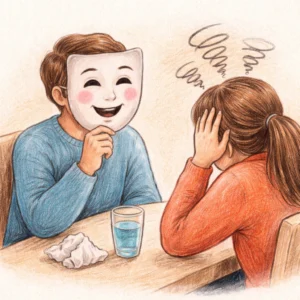
You finally decide to speak up.
Your heart is racing. You’ve practiced your words in your head a dozen times. You’ve promised yourself you’ll stay calm, use “I feel” statements, and not let your emotions take over. You’re not trying to fight — you’re trying to fix something.
You say, gently, “When you did that, it hurt my feelings.”
And then comes the response:
“I’m sorry you feel that way.”
They said sorry. The magic word. So why does it feel like you just got emotionally body-slammed?
Welcome to one of the most confusing corners of human relationships — the place where apologies and manipulation quietly intertwine.
Because the truth is this: not every apology is meant to heal. Some apologies are designed to control.
And once you see it, you can’t unsee it.
The Apology That Isn’t Really an Apology
A real apology builds a bridge.
A manipulative apology builds a wall — but disguises it as a bridge.
On the surface, the word “sorry” sounds like accountability. It sounds like maturity. It sounds like closure.
But manipulation often wears polite clothing.
Instead of taking responsibility, the person subtly shifts focus:
- From their actions → to your reaction
- From harm caused → to feelings perceived
- From accountability → to comfort
When someone uses apologies as manipulation, their goal isn’t resolution. It’s control.
They want:
- The conversation to end
- The discomfort to stop
- Their ego protected
- You to move on without real change
That’s not healing. That’s emotional damage control.
The Psychology Behind Manipulative Apologies
Before we sharpen our pitchforks, let’s understand something important.
Most people who give manipulative apologies are not cartoon villains. They’re often deeply uncomfortable with being wrong.
Research in social psychology shows that admitting fault can trigger feelings of shame, vulnerability, and ego threat (Baumeister et al., 1998). For some individuals, especially those with fragile self-esteem or narcissistic tendencies, accepting responsibility feels like losing identity.
Instead of saying:
“I hurt you.”
They say:
“I’m sorry you’re upset.”
That small shift protects them from guilt while placing the emotional burden back on you.
Understanding this doesn’t excuse the behavior. But it helps you see that manipulation is often rooted in emotional immaturity, not always malice.
The Hall of Fame of Fake Apologies
Let’s decode the most common apology tactics used in manipulation.
Once you learn to spot them, they become painfully obvious.
1. The “If” Apology
“I’m sorry if I offended you.”
That tiny word — if — does heavy lifting.
It suggests:
- Maybe you weren’t really offended.
- Maybe you’re exaggerating.
- Maybe the problem isn’t real.
Instead of acknowledging harm, they question its existence.
Translation:
“I’m not admitting I did anything wrong.”
A real apology removes doubt:
“I’m sorry I offended you.”
No conditions. No loopholes.
2. The “But” Bomb
“I’m sorry I yelled, but you were being really annoying.”
Everything before “but” is deleted.
The word “but” cancels the apology and replaces it with justification.
You go from being hurt to being blamed.
The apology becomes a setup for manipulation:
- They admit just enough to appear reasonable.
- Then they shift responsibility back to you.
If someone truly takes accountability, there’s no “but.”
There may be context — but not blame.
3. The Endless Repeat Offender
They say sorry every time.
Every week.
Every argument.
Every incident.
But nothing changes.
Behavioral psychology teaches us something simple: patterns matter more than promises.
If apologies don’t lead to behavioral change, they’re just noise.
An apology without change is performance.
Consistency is the real proof of remorse.
4. The Martyr Flip
“Fine! I’m sorry! I’m just the worst person ever!”
Now suddenly:
- You’re comforting them.
- You’re reassuring them.
- You’re minimizing your pain.
They flipped the emotional script.
Instead of discussing your hurt, you’re now managing their shame.
This is classic emotional manipulation — shifting focus away from accountability and onto self-pity.
Healthy guilt says:
“I messed up.”
Manipulative guilt says:
“I feel so bad that now you have to make me feel better.”
5. The Silent Treatment Apology
This one is subtle.
They say sorry — and then punish you emotionally for bringing it up.
Cold behavior.
Withdrawal.
Passive-aggressive comments.
It sends a message:
“If you hold me accountable, I’ll make it uncomfortable.”
Over time, you may stop speaking up.
And that’s the goal.
How Manipulative Apologies Affect You
The damage isn’t always loud.
Sometimes it’s quiet erosion.
You start to:
- Question your reactions
- Doubt your memory
- Feel guilty for having boundaries
- Avoid conflict entirely
Repeated exposure to manipulative apologies can lead to emotional confusion and even self-doubt — patterns often associated with gaslighting dynamics (Stern, 2007).
You may think:
“Maybe I am too sensitive.”
But here’s the truth:
Feeling hurt is not manipulation.
Holding someone accountable is not cruelty.
Wanting change is not unreasonable.
What a Real Apology Actually Sounds Like
A genuine apology has three simple parts:
Acknowledgment
“I hurt you.”Understanding
“I understand why that hurt.”Commitment to change
“Here’s what I’ll do differently.”
Notice what’s missing?
No “if.”
No “but.”
No performance.
No emotional theatrics.
It’s simple. Clear. Grounded.
Real apologies feel calming.
Manipulative apologies feel confusing.
Your body often knows before your brain does.
How to Respond Without Losing Your Power
When you recognize manipulation in apologies, you don’t need to explode.
You need clarity.
Here’s how to reclaim your peace:
1. Redirect the Focus
If they say:
“I’m sorry you feel that way.”
You can calmly respond:
“I’m talking about the action, not just my feelings.”
Stay steady. Don’t chase their detour.
2. Separate Words from Behavior
You can say:
“I appreciate the apology. What matters to me is seeing change.”
This gently shifts the standard from speech to action.
3. Set a Boundary
“I can’t move past this unless the behavior changes.”
Boundaries are not punishments. They are clarity.
4. Trust Your Internal Alarm
If you leave an apology conversation feeling:
- Smaller
- Guilty
- Confused
- Silenced
It probably wasn’t sincere.
Your intuition is often your most reliable guide.
Why Healthy Relationships Don’t Need Emotional Acrobatics
In emotionally mature relationships, accountability is not a threat.
People who value you:
- Care about the impact of their actions
- Don’t argue with your feelings
- Don’t need to “win”
Real love — romantic, familial, or friendship — doesn’t require manipulation.
It requires humility.
You deserve relationships where:
- Apologies lead to growth
- Conflict leads to understanding
- Accountability leads to safety
Not emotional gymnastics.
When to Walk Away
If someone repeatedly uses apologies as manipulation, you have to ask yourself:
Is this a misunderstanding — or a pattern?
Patterns reveal character.
You can communicate.
You can clarify.
You can set boundaries.
But you cannot force someone to grow.
At some point, protecting your peace becomes more important than winning an argument.
And that is not selfish.
It’s self-respect.
The Bottom Line
Apologies are powerful.
They can heal trauma.
Repair trust.
Restore intimacy.
But when mixed with manipulation, they become tools of control instead of connection.
Stop accepting “sorry” as a band-aid for wounds that need stitches.
Look for:
- Accountability
- Changed behavior
- Emotional maturity
You are not too sensitive.
You are not dramatic.
You are not asking for too much.
You are asking for sincerity.
And that is the bare minimum.
Have you ever received an apology that felt more like an insult? Share your story in the comments — your experience might help someone else recognize the signs.
References