
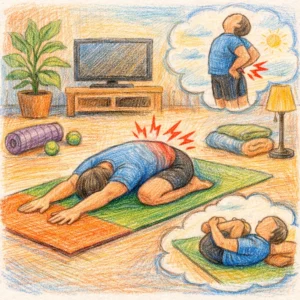
Let me be honest for a moment. Most back pain doesn’t come from heroic activities like lifting a car or climbing a mountain, isn’t it? It usually comes from something far less impressive—like reaching for your phone, tying your shoes, or, in my case, sneezing while leaning for a slice of pizza.
One second you’re living life normally, and the next second you’re frozen in a strange half-bent position wondering if your spine just filed a complaint against you.
If you spend hours sitting at a desk, hunched over a laptop, or stuck in traffic while your body slowly turns into a human question mark, you already know the feeling. Back pain creeps in quietly and then decides to stay like an unwanted houseguest who eats all your snacks and refuses to leave.
The good news? You don’t need expensive treatments, complicated workouts, or superhero flexibility to feel better. In many cases, a few consistent Stretching Routines can dramatically Relieve Back Pain and help your body move the way it was meant to.
Think of these stretches as a daily tune-up for your spine.
Why Your Back Is Acting So Dramatic
Before we jump into stretches, let’s understand why your back might be complaining.
Your spine is not just one solid bone. It’s a complex structure made up of vertebrae, discs, ligaments, nerves, and muscles all working together. When everything is balanced, your back moves smoothly and supports your body without effort.
But modern life has other plans.
Most of us sit for long periods—working, driving, scrolling on our phones, or binge-watching shows. When we sit too much:
- Hip flexors become tight
- Hamstrings shorten
- Glutes become inactive
- Core muscles weaken
- Shoulders roll forward
All of this places extra pressure on the spine.
Imagine your body as a camping tent.
If one side of the ropes becomes extremely tight while the others loosen, the center pole starts leaning. Instead of fixing the ropes, many people just try to “force” the pole upright.
Stretching works differently. It loosens the tight ropes so your spine can stand comfortably again.
That’s why the right Stretching Routines can be one of the most effective ways to Relieve Back Pain naturally.
1. Cat–Cow Stretch: The Spine’s Wake-Up Call
If your spine had a “good morning” routine, this would be it.
The Cat-Cow stretch is one of the simplest and most effective movements for improving spinal mobility. It gently moves the spine through flexion and extension, helping lubricate the discs between your vertebrae.
How to Do It
- Start on your hands and knees.
- Keep your wrists under your shoulders and knees under your hips.
- Inhale and drop your belly toward the floor while lifting your chest and looking up (Cow).
- Exhale and round your back toward the ceiling while tucking your chin (Cat).
- Repeat slowly for 10–15 breaths.
Why It Works
Your spinal discs depend on movement to stay healthy. When you sit all day, those discs barely move. Cat-Cow restores that movement.
Everyday Example
Think of a squeaky door hinge. If you never move it, it stiffens. Add a little oil and motion, and suddenly it works smoothly again.
This stretch is the “oil” for your spine.
2. Child’s Pose: The Back Reset Button
Some days your lower back just feels exhausted. Maybe you lifted something awkwardly, carried heavy grocery bags, or sat too long in a terrible chair.
This is where Child’s Pose becomes your best friend.
How to Do It
- Kneel on the floor.
- Sit back on your heels.
- Fold your torso forward toward the floor.
- Extend your arms forward.
- Rest your forehead on the ground.
Hold the stretch for 30–60 seconds.
Why It Works
Child’s Pose gently stretches the lower back, hips, and spine while allowing the muscles around the spine to relax.
Everyday Example
Imagine pressing the “restart” button on your computer when everything freezes. That’s exactly what this stretch feels like for your back.
It’s especially helpful after a long day at work or after standing for extended periods.
3. Bird-Dog: Stability for a Stronger Spine
Stretching alone isn’t always enough to Relieve Back Pain. Your spine also needs stability.
That’s where the Bird-Dog exercise comes in. It strengthens the core and back muscles that protect your spine.
How to Do It
- Start on your hands and knees.
- Extend your right arm forward.
- Extend your left leg backward.
- Keep your hips level and your core tight.
- Hold for 5–10 seconds.
- Switch sides.
Repeat 8–10 times.
Why It Works
Your spine relies heavily on the core muscles for support. When those muscles are weak, the spine absorbs extra stress.
Bird-Dog teaches your body to stabilize the spine while moving your arms and legs.
Everyday Example
Picture a bookshelf.
If the support beams are weak, the entire shelf wobbles when you add weight. Strengthen the beams, and suddenly the structure becomes stable.
Your core muscles are those support beams.
4. Doorway Chest Stretch: Fixing the Desk Posture Problem
Here’s something most people don’t realize:
Sometimes your back hurts because your chest is too tight.
Hours of typing, texting, and scrolling pull the shoulders forward. Over time, this creates a hunched posture that strains the upper back.
How to Do It
- Stand in a doorway.
- Place your forearms on the door frame.
- Step forward slightly.
- Allow your chest to stretch open.
Hold for 30 seconds.
Why It Works
Stretching the chest allows your shoulders to return to their natural position. When that happens, the muscles in the upper back don’t have to work overtime.
Everyday Example
Imagine wearing a heavy backpack all day.
When you finally take it off, your shoulders instantly relax. That’s the same relief many people feel after this stretch.
5. Pigeon Pose: The Hidden Cure for Lower Back Pain
Tight hips are often the silent cause of lower back pain.
When your hips lose mobility, your lower back compensates by doing extra work. Over time, that stress leads to pain and stiffness.
Pigeon Pose targets the glutes and hip rotators—the muscles that become extremely tight from prolonged sitting.
How to Do It
- Bring one knee forward toward your wrist.
- Extend the opposite leg straight behind you.
- Lower your hips toward the floor.
- Lean forward gently.
Hold for 30–60 seconds on each side.
Why It Works
This stretch opens the hips and releases tension from the glutes, which reduces pressure on the lower back.
Everyday Example
Imagine trying to open a drawer that’s stuck because a utensil is jammed inside.
The drawer won’t move smoothly until you remove the blockage.
Tight hips are that blockage.
Pigeon Pose clears it.
The Secret to Making Stretching Actually Work
Many people try stretching once or twice and give up when the pain doesn’t magically disappear.
The truth is that consistency matters far more than intensity.
Your back doesn’t need a one-hour yoga session once a month.
It needs small, regular care.
Try the 5-Minute Rule
You don’t need extra time in your schedule.
Try this simple approach:
- Cat-Cow: 1 minute
- Child’s Pose: 1 minute
- Bird-Dog: 1 minute
- Doorway Chest Stretch: 1 minute
- Pigeon Pose: 1 minute
Total time: 5 minutes
You can do it while your coffee brews or while waiting for dinner to cook.
Over time, these Stretching Routines can significantly Relieve Back Pain and improve mobility.
Listen to Your Body
Stretching should feel good—not painful.
There are two types of sensations during stretching:
Good Stretch
- Gentle pulling
- Mild tension
- Relaxing release
Bad Stretch
- Sharp pain
- Burning sensation
- Numbness or tingling
If you feel the second type, stop immediately.
Your goal is healing—not pushing your body beyond its limits.
Additional Habits That Help Relieve Back Pain
Stretching works even better when combined with healthy daily habits.
Here are a few simple ones.
1. Move Every 30 Minutes
If you work at a desk, stand up regularly. Even a short walk helps.
2. Strengthen Your Core
Exercises like planks and glute bridges support spinal health.
3. Improve Your Workspace
A good chair and proper screen height can reduce strain.
4. Sleep in a Neutral Position
Use pillows to support your spine while sleeping.
5. Stay Active
Walking, swimming, and yoga all promote spinal health.
Your Journey Toward a Happier Spine
Back pain is incredibly common, but that doesn’t mean you have to accept it as part of life.
With the right Stretching Routines, many people can naturally Relieve Back Pain, improve posture, and restore comfortable movement.
The key is consistency.
Your spine has worked hard for you through years of sitting, lifting, bending, and the occasional awkward sneeze.
Give it just a few minutes of attention each day, and it will reward you with better mobility, less stiffness, and a lot fewer “grumpy spine” moments.
And who knows—maybe next time you reach for that slice of pizza, your back won’t protest.
References
Harvard Health Publishing – Back Pain and Exercise