
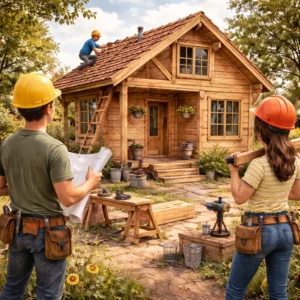
When people imagine a strong, durable house, the first materials that usually come to mind are brick, concrete, or stone. Many of us grew up hearing stories like The Three Little Pigs, where the wooden house was the one that blew away first. Because of that, wood often gets an unfair reputation as a weak building material.
But here’s something interesting: if you walk through residential neighborhoods in countries like the United States, Canada, Sweden, or Norway, you’ll notice that most houses—whether they’re modest suburban homes or luxurious mansions—are built primarily with wood.
This raises an important question: Why do some of the most advanced and wealthiest countries rely so heavily on wood construction for their homes?
The answer isn’t accidental. In fact, wood construction has proven itself to be one of the most practical, efficient, and sustainable building methods available today.
From faster construction times and lower costs to environmental benefits and improved comfort, wood construction offers a surprising number of advantages. Let’s explore why your next dream home might actually be made of wood—and why that’s a very good thing.
1. Wood Construction Is Incredibly Fast
In the construction industry, time equals money. The longer it takes to build a house, the higher the labor costs, material expenses, and delays.
Traditional construction using brick or concrete requires multiple waiting periods. Foundations must cure, mortar must dry, and weather conditions can slow down progress significantly. Rain, humidity, or cold temperatures can delay the entire project.
Wood construction, however, works very differently.
Most timber components used in modern wood construction are pre-cut or prefabricated in factories before they arrive at the building site. These pieces are measured precisely and prepared in advance, which means construction crews can assemble them quickly.
Think of it like building a large, carefully designed puzzle. Once the parts arrive on-site, workers simply fit them together according to the blueprint.
Because of this system, builders can often complete the structural frame of a house in just a few days. For homeowners, this means moving into their new home sooner. For developers, it means faster project completion and reduced costs.
In short, wood construction helps projects move forward efficiently and smoothly.
2. Wood Is One of the Most Sustainable Building Materials
Sustainability has become one of the biggest priorities in modern construction. Many people want homes that are not only comfortable and durable but also environmentally responsible.
Wood construction plays a major role in this effort.
Unlike materials such as steel or concrete, which require extremely high temperatures and energy-intensive manufacturing processes, wood is a renewable natural resource.
Trees absorb carbon dioxide (CO₂) from the atmosphere while they grow. This carbon remains stored within the wood even after the tree is harvested and turned into building materials. When wood is used in construction, that carbon stays locked inside the structure for decades—or even centuries.
This process helps reduce the overall amount of carbon released into the atmosphere.
Additionally, many forestry industries today follow sustainable forest management practices, which means new trees are planted to replace those that are harvested. This ensures forests continue to regenerate and support the environment.
As a result, wood construction has a significantly lower carbon footprint compared to many other building materials.
3. Wood Homes Are Naturally Energy Efficient
Comfort inside a home often depends on how well it retains heat during winter and cool air during summer.
Wood is naturally excellent at insulating buildings. Its internal cellular structure contains tiny air pockets that slow the transfer of heat. This makes wood a far better thermal insulator than materials like concrete or steel.
Because of this property, wood-framed homes can maintain indoor temperatures more efficiently. When combined with modern insulation systems, they create houses that are highly energy-efficient.
This means:
- Heating systems don’t have to work as hard in winter
- Air conditioners run more efficiently in summer
- Energy bills are lower throughout the year
Over time, these savings can make a significant difference for homeowners.
In addition, energy-efficient homes contribute to reduced environmental impact, making wood construction both practical and eco-friendly.
4. Wood Performs Well During Earthquakes
At first glance, it might seem logical that heavy materials like brick or concrete would provide the most protection in natural disasters. However, during earthquakes, flexibility often matters more than weight.
Wood is naturally flexible and lightweight, which allows it to absorb and distribute seismic forces more effectively.
During an earthquake, rigid structures made from stone or brick may crack or collapse because they cannot easily adapt to the sudden ground movement.
Wood structures, on the other hand, can bend slightly without breaking, allowing them to move with the vibrations rather than resisting them.
This flexibility is one reason why many earthquake-prone regions—such as parts of California, Japan, and British Columbia—rely heavily on wood-frame construction for residential buildings.
Modern engineering techniques further strengthen these structures using reinforced connections, shear walls, and other safety features.
5. Wood Construction Is Often More Affordable
Cost is one of the biggest considerations when building a home.
In many regions, wood construction offers a more economical option compared to concrete or masonry structures.
There are several reasons for this:
Lower material costs
Countries with large forest resources—such as Canada, the United States, and Scandinavian nations—have well-developed timber industries that supply wood at competitive prices.
Easier transportation
Wood is significantly lighter than concrete or stone. This reduces transportation costs and makes materials easier to handle on construction sites.
Simpler foundations
Because wood structures weigh less, they require smaller and less expensive foundations.
Lower labor costs
Wood is easier to cut, shape, and assemble than many other building materials. Skilled carpenters can perform most of the work without the need for highly specialized labor.
All of these factors combine to make wood construction a cost-effective solution for both homeowners and developers.
6. Design Flexibility and Easy Remodeling
Another major advantage of wood construction is architectural flexibility.
Wood is easy to cut, shape, and modify, allowing architects and designers to experiment with creative layouts and styles. Whether the goal is a cozy cabin, a traditional family home, or a modern minimalist design, wood can adapt to a wide variety of architectural visions.
Even years after construction, wood-framed homes remain relatively easy to remodel.
For example:
- Adding new windows or doors
- Expanding a kitchen
- Creating an open-concept living space
- Building an additional room
These modifications are generally much easier in wood structures than in concrete buildings, where major changes often require heavy machinery and extensive labor.
This adaptability allows homeowners to adjust their living space as their needs evolve over time.
7. Wood Creates a Warm and Natural Living Environment
Beyond practicality and cost, wood offers something that many other building materials cannot: a natural sense of warmth and comfort.
Wood has a unique aesthetic quality that instantly makes spaces feel more welcoming. Its natural grain patterns, colors, and textures add visual beauty that artificial materials often struggle to replicate.
But the benefits go beyond appearance.
Research has suggested that exposure to natural materials such as wood can have positive psychological effects, including:
- Reduced stress levels
- Improved mood
- Increased productivity
This concept, often referred to as biophilic design, focuses on integrating natural elements into living spaces to enhance human well-being.
For many people, living in a wood-based environment simply feels more relaxing and more connected to nature.
8. Modern Wood Construction Is Highly Advanced
Today’s wood construction techniques are far more advanced than many people realize.
New engineered wood products such as:
- Cross-laminated timber (CLT)
- Glued laminated timber (Glulam)
- Laminated veneer lumber (LVL)
have revolutionized the industry.
These materials are created by layering and bonding wood in ways that significantly increase its strength, durability, and structural performance.
As a result, architects are now using engineered timber to construct multi-story residential buildings, office complexes, and even skyscrapers.
These innovations demonstrate that wood construction is not just a traditional method—it is also a cutting-edge solution for the future of sustainable architecture.
The Future of Wood Construction
As the global population grows and cities expand, the construction industry faces increasing pressure to develop sustainable and efficient building methods.
Wood construction offers a promising path forward because it combines:
- Environmental responsibility
- Structural performance
- Cost efficiency
- Comfort and aesthetics
Governments, architects, and developers around the world are recognizing these benefits and investing more heavily in timber-based construction technologies.
Many experts believe that wood will play a key role in the future of green building and climate-friendly development.
Final Thoughts
Wood construction is far more than a simple building method—it represents a powerful combination of tradition, innovation, and sustainability.
From faster construction times and lower costs to energy efficiency and natural beauty, wood offers a wide range of advantages that make it an ideal material for modern homes.
It also reflects a deeper connection between people and nature, reminding us that the spaces we live in can be both functional and environmentally responsible.
So the next time you see a home being framed with timber, don’t think of it as fragile or outdated. Instead, think of it as a smart, sustainable, and thoughtfully engineered structure designed for modern living.
In many ways, wood construction may truly be the future of housing.
References
Forest Stewardship Council – Sustainable Forestry
Think Wood – Wood Construction Benefits
U.S. Department of Energy – Energy Efficient Building Materials