
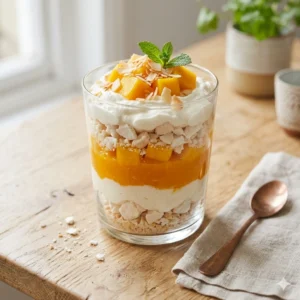
 There are days when you want dessert, but you absolutely do not want to bake.
You don’t want to preheat the oven. You don’t want to separate six eggs. You don’t want to stand around wondering whether your meringue is going to crack, collapse, turn sticky, or somehow develop a personality of its own.
And if it’s a hot summer day, turning on the oven can feel like voluntarily adding a small heater to your kitchen.
That’s where these no-bake Mango Pavlova cups come to the rescue.
They give you all the fun parts of a traditional pavlova—the crisp meringue, creamy middle, juicy fruit, tropical flavor, and beautiful presentation—without requiring you to actually make a pavlova from scratch.
The trick is wonderfully simple: use ready-made meringue nests, fresh mango, and either whipped cream or thick Greek yogurt. Break everything into pieces, layer it into glasses, and suddenly you have a dessert that looks like it came from a fancy café.
The whole thing takes about 10 minutes to assemble.
That’s faster than most people spend deciding what dessert to make.
And although we’re calling this a dessert, there’s another little loophole here. Use unsweetened Greek yogurt instead of whipped cream and keep the portions reasonable, and these colorful mango cups can also make a fun breakfast or brunch treat.
So yes, we’re bending the traditional pavlova rules.
But we’re doing it deliciously.
What Makes This No-Bake Mango Pavlova So Easy?
Traditional pavlova is gorgeous, but it isn’t exactly an instant dessert.
A classic version involves whipping egg whites, gradually adding sugar, shaping the meringue, baking it at a low temperature, and then letting it cool. The finished pavlova is usually topped with cream and fruit just before serving.
That’s wonderful when you have the time.
But sometimes you don’t.
Maybe unexpected guests have announced that they’re “just dropping by” and will arrive in twenty minutes.
Maybe it’s too hot to turn on the oven.
Maybe your mixer is buried somewhere behind three boxes of things you promised yourself you’d organize.
Or maybe you simply want dessert without turning your kitchen into a laboratory.
This shortcut solves all of those problems.
Instead of baking one large pavlova, you’re essentially creating a deconstructed pavlova in individual glasses.
Think of it as pavlova’s wonderfully relaxed cousin.
There’s no need for perfect shapes or flawless layers. In fact, the slightly messy appearance is part of its charm.
The Ingredients You’ll Need
The ingredient list is short, which is exactly what we want from a 10-minute dessert.
1. Ready-Made Meringue Nests
Pick up about 4–6 small meringue nests, depending on their size and how generously you want to fill your glasses.
These provide the crispy, sugary texture that makes pavlova so much fun to eat.
Don’t worry if they aren’t perfectly shaped. You’re going to break them apart anyway.
2. Fresh Mango
Mango is the star here, so choose ripe, juicy fruit.
You’ll need approximately two mangoes.
Use one for small cubes and blend the other into a quick mango sauce. If your mangoes are particularly large, you may only need one and a half.
The combination of smooth mango puree and juicy chunks makes the dessert much more interesting than simply throwing fruit on top.
3. Whipped Cream or Greek Yogurt
For a classic dessert experience, use lightly sweetened whipped cream flavored with a little vanilla.
For a breakfast-style version, use thick Greek yogurt, preferably unsweetened or lightly sweetened.
The yogurt also brings a pleasant tanginess that works beautifully with the sweetness of the meringue.
4. Lime Juice
A small squeeze of fresh lime juice makes a surprisingly big difference.
Mango is naturally sweet, and meringue is even sweeter. Lime adds brightness and keeps the whole dessert from tasting overwhelmingly sugary.
5. Coconut or Pistachios
This is optional, but highly recommended.
A sprinkle of toasted coconut adds a tropical flavor and a little extra crunch.
Chopped pistachios provide color, texture, and a slightly nutty contrast.
6. Fresh Mint
A few tiny mint leaves make the finished glasses look instantly more elegant.
They’re completely optional, but they make you look like you put in much more effort than you actually did.
We won’t tell anyone.
The 10-Minute Mango Pavlova Assembly
Here’s where the magic happens.
You don’t need a cake stand. You don’t need a piping bag. You don’t need decorating skills.
All you need are clear glasses, a spoon, and about ten minutes.
Step 1: Prepare the Mango
Peel your mangoes and cut one into small cubes.
Try to make the pieces roughly bite-sized rather than perfectly identical. This isn’t a mango geometry competition.
Take the remaining mango flesh and place it in a blender or food processor.
Add a small squeeze of lime juice and blend until smooth.
If the mango is already very juicy and sweet, you don’t need to add anything else.
If you’d like a little more sweetness, you can add a tiny amount of honey or maple syrup, but taste the puree first.
Mango can be surprisingly sweet on its own.
Step 2: Break the Meringue
Take your ready-made meringue nests and gently break them into irregular pieces.
This is one of the easiest steps because there’s really no wrong way to do it.
Just don’t crush them into fine powder.
You want a mixture of:
- Small crispy crumbs
- Medium-sized pieces
- Larger crunchy shards
That variety gives every spoonful a different texture.
And honestly, smashing meringue is probably the most therapeutic part of the recipe.
Step 3: Make the Creamy Layer
If you’re using whipped cream, make sure it is chilled and lightly sweetened.
A little vanilla extract or vanilla bean paste works beautifully.
You don’t want the cream to be excessively sweet because the meringue and mango already bring plenty of sweetness.
Using Greek yogurt?
Simply stir it until smooth.
If you want a little extra flavor, add a small splash of vanilla and perhaps a teaspoon of honey.
For a breakfast version, plain Greek yogurt with vanilla is especially nice because it balances the sugary meringue.
Step 4: Start Layering
Grab your serving glasses.
Add a layer of broken meringue to the bottom.
Don’t pack it down. Keep it loose so the pieces retain some of their crunch.
Next, add a spoonful of whipped cream or Greek yogurt.
Then add mango puree and a few fresh mango cubes.
Congratulations.
You already have a dessert.
But we’re going to make it prettier.
Step 5: Repeat the Layers
Add another layer of meringue.
Follow with more cream or yogurt.
Then add another generous spoonful of mango puree and mango cubes.
If some of the mango sauce drips down the inside of the glass, even better.
Those colorful streaks are exactly what make these little desserts look so impressive.
Step 6: Add the Finishing Touches
Finish with a few mango cubes, toasted coconut, chopped pistachios, and perhaps a tiny mint leaf.
Don’t overthink the decoration.
The whole appeal of these cups is that they look naturally abundant and colorful.
Serve them immediately.
The longer the meringue sits against the cream and mango, the softer it becomes.
Why the Texture Is So Good
The real beauty of a Mango Pavlova is the contrast.
You have something crunchy.
Then something creamy.
Then something juicy.
Then something bright and fruity.
Then you get another little crunchy piece.
It’s basically a texture roller coaster in a glass.
The meringue provides sweetness and crispness. The cream or yogurt creates a soft, rich middle. Mango adds freshness and juiciness, while lime keeps the flavors lively.
This is also why you shouldn’t completely pulverize the meringue.
If everything becomes soft and uniform, you lose the contrast that makes the dessert exciting.
Keep those chunky pieces.
Your spoon will thank you.
Mango Pavlova for Breakfast? Absolutely—With One Adjustment
Calling pavlova breakfast may sound slightly rebellious.
And honestly, it is.
But you can make this recipe more breakfast-friendly by changing the creamy layer.
Instead of sweetened whipped cream, use plain Greek yogurt.
You can also reduce the amount of meringue and increase the amount of mango and yogurt.
Add a few berries, chia seeds, chopped nuts, or toasted coconut if you want to make it more substantial.
The result becomes something between a fruit-and-yogurt parfait and a deconstructed pavlova.
It’s colorful enough to make an ordinary morning feel special.
Just remember that meringue is still a sugary treat, so this is better thought of as a fun breakfast-inspired dessert rather than a health-food recipe.
No one needs to know you ate dessert before 9 a.m.
How to Choose the Best Mango
A great Mango Pavlova starts with good mangoes.
Look for mangoes that feel slightly soft when gently pressed.
They should smell fruity near the stem and have rich, fragrant flesh.
Don’t worry too much about the exterior color. Depending on the variety, a ripe mango can have green, yellow, orange, or red skin.
The important things are aroma, softness, and flavor.
If your mango isn’t fully ripe, the puree may taste flat.
If it’s extremely ripe and soft, that’s actually perfect for blending.
Save the firmer pieces for your cubes and use the softer flesh for the sauce.
That’s a very easy way to avoid wasting fruit.
Easy Flavor Variations
Once you’ve made these cups once, you can start playing around.
Mango and Passion Fruit
Add fresh passion fruit pulp over the mango.
The tangy passion fruit is fantastic with sweet meringue and creamy layers.
Mango and Coconut
Use coconut yogurt or coconut cream and finish with toasted coconut flakes.
This turns the dessert into a full tropical vacation.
Your kitchen won’t have changed locations, but your taste buds might disagree.
Mango and Pistachio
Add chopped pistachios between the layers and on top.
The salty, nutty flavor gives the sweet dessert more depth.
Mango and Berries
Add strawberries, raspberries, or blueberries alongside the mango.
The different colors make the glasses look gorgeous.
Mango and Lime
For an extra refreshing version, increase the lime slightly and add a little finely grated lime zest.
It’s especially good on a hot afternoon.
Can You Prepare Mango Pavlova Cups Ahead of Time?
This is where a little planning helps.
You can prepare the individual components ahead of time.
Cut the mango, prepare the puree, chill the cream or yogurt, and break the meringue into pieces.
Keep everything separate.
Then assemble the cups shortly before serving.
Why?
Because moisture is the enemy of crispy meringue.
Once meringue comes into contact with cream, yogurt, or juicy fruit, it gradually begins absorbing moisture and softening.
That’s not necessarily a bad thing. Some people actually love the soft, chewy texture that develops after the dessert sits for a while.
But if you want that satisfying crunchy-meets-creamy experience, assemble the cups as close to serving time as possible.
Pavlova guidance from Women’s Weekly Food similarly recommends dressing pavlova close to serving because the meringue loses its crispness once topped.
For the best result, think:
Prep early. Assemble late. Eat immediately.
That’s the strategy.
What If I Have Leftovers?
If you’ve already assembled the cups, store leftovers covered in the refrigerator.
Just know that the meringue will soften.
But here’s the secret:
It doesn’t become bad.
It simply becomes a different dessert.
The next morning, you may find yourself staring at a soft, creamy, fruity parfait that tastes surprisingly good.
The crunchy pavlova has disappeared, but the mango, cream, and meringue have melded together into something rich and spoonable.
So if you accidentally leave one in the fridge overnight, don’t throw it away.
Call it tomorrow’s breakfast.
Problem solved.
Can I Make This Vegan?
Yes, but you’ll need to make two important substitutions.
Traditional meringue is made with egg whites, so look for vegan meringue made with aquafaba if you want a completely plant-based version.
For the creamy layer, use whipped coconut cream or a plant-based yogurt.
Coconut cream pairs particularly well with mango, so this version can be delicious even if you’re not following a vegan diet.
The result becomes intensely tropical.
Mango, coconut, lime, and crunchy meringue?
That’s basically summer in a glass.
How to Make These Look Restaurant-Worthy
The easiest trick is to use clear glasses.
The layers become part of the decoration.
Don’t try to make every layer perfectly neat. A little randomness actually looks more luxurious.
Use different-sized mango pieces.
Let a little puree run down the sides.
Leave a few large meringue shards visible at the top.
Add a small sprinkle of pistachios or coconut.
Then finish with one mint leaf.
That’s it.
You don’t need elaborate piping or chocolate decorations.
The natural colors do most of the work.
For individual dinner-party servings, small dessert glasses are perfect. For a casual gathering, clear jars can work beautifully too.
The Bottom Line
A traditional pavlova is absolutely worth making when you have the time.
But when you want the flavors without the waiting, these no-bake Mango Pavlova cups are a brilliant shortcut.
You get crunchy meringue, creamy yogurt or whipped cream, juicy mango, bright lime, and optional tropical toppings—all assembled in individual glasses in roughly ten minutes.
There’s no oven.
No complicated meringue technique.
No worrying about whether your pavlova will crack.
And definitely no need to spend your afternoon babysitting egg whites.
It’s not technically a classic baked pavlova, and that’s okay.
It’s a playful, deconstructed version inspired by the same combination of crisp meringue, creamy topping, and fresh fruit. Similar mango-and-meringue combinations are also used in mango Eton Mess recipes, where chopped pavlova is layered with cream, yogurt, and mango.
So the next time someone says, “Can you make dessert?”
You can confidently say yes.
Give yourself ten minutes.
Grab some mangoes.
Break a few meringues.
Layer everything into glasses.
And suddenly, you’ve got a dessert that looks like you spent the entire afternoon making it.
We call that a win.
Quick Recipe at a Glance
Prep time: 10 minutes
Cooking time: None
Servings: 4–6
Difficulty: Very easy
Ingredients
- 4–6 ready-made meringue nests
- 2 ripe mangoes
- 1–2 teaspoons fresh lime juice
- 1½–2 cups whipped cream or thick Greek yogurt
- ½ teaspoon vanilla, optional
- Toasted coconut flakes, optional
- Chopped pistachios, optional
- Fresh mint, optional
Method
- Dice one mango into small cubes.
- Blend the remaining mango with lime juice until smooth.
- Break the meringue nests into chunky pieces.
- Add meringue to the bottom of clear glasses.
- Add whipped cream or Greek yogurt.
- Spoon over mango puree and add mango cubes.
- Repeat the layers.
- Garnish with coconut, pistachios, or mint.
- Serve immediately for maximum meringue crunch.
References
Mango and Passionfruit Pavlova — Women’s Weekly Food