
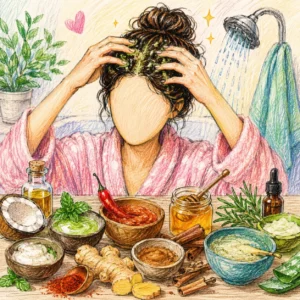
Have you ever spent a small fortune on hair serums, masks, conditioners, oils, and mysterious bottles promising to transform your hair—only to realize you have been giving all the attention to the ends?
There is a funny little problem with that strategy: the visible part of your hair is made of dead cells, while the action that produces new hair happens down at the follicle, inside your scalp.
Think of your hair like a garden. The strands are the leaves and flowers you can see, but the scalp is the soil underneath. If the soil is irritated, neglected, or poorly cared for, pouring another expensive product onto the leaves is not necessarily going to solve the problem.
That is why scalp care deserves a regular place in your beauty routine.
One simple thing you can do is combine gentle scalp massage with a nourishing oil-based treatment. Massage can feel relaxing and may temporarily increase local blood flow, while keeping the scalp clean and comfortable helps create a better environment for healthy-looking hair.
But let’s clear up one important misconception before we raid the kitchen.
Better blood circulation does not automatically mean explosive hair growth.
Hair growth is complicated. Genetics, hormones, age, nutrition, medications, medical conditions, and the specific cause of hair loss can all play a role. There is also no kitchen Masks recipe that can guarantee Rapunzel-level growth overnight.
So instead of promising a miracle, let’s focus on something much more realistic: simple scalp care that supports a healthy routine.
And yes, you may still look hilariously suspicious while wearing a shower cap in your bathroom.
Why Scalp Care Matters for Healthy Hair
Your scalp contains thousands of hair follicles, along with oil glands, nerves, blood vessels, and skin cells. Each follicle needs a healthy environment to function normally.
Blood supplies tissues throughout the body with oxygen and nutrients, so healthy circulation is important for normal skin and follicle function. However, that does not mean you need to aggressively “force” blood into your scalp.
In fact, your scalp does not need to be attacked like a stubborn jar of pickles.
Gentle is better.
A relaxing massage with your fingertips can help loosen your scalp, distribute oils, and make your hair-care routine feel more enjoyable. Dermatologists also recommend gentle hair and scalp care, particularly for people experiencing thinning or hair loss.
With that in mind, here are five simple DIY treatments you can experiment with.
1. Peppermint & Coconut Oil Scalp Massage
Let’s start with the one that sounds like it should come with a tiny warning label:
“Caution: Your head may smell like Christmas.”
Peppermint oil has a cooling sensation because of menthol, which interacts with cold-sensitive receptors in the skin. That refreshing sensation can make your scalp feel awake and tingly.
There is some experimental research on peppermint oil and hair growth, but it is important not to exaggerate the evidence. A well-known study found hair-growth effects in mice—not humans—so it should not be presented as proof that peppermint oil makes human hair grow faster.
What you’ll need
- 2 tablespoons coconut oil
- 2–3 drops peppermint essential oil
How to use it
Warm the coconut oil slightly until it becomes easy to spread. It should feel comfortably warm, never hot.
Mix in the peppermint oil and part your hair into several sections.
Apply a small amount directly to the scalp, then massage gently with your fingertips for about three to five minutes.
No nails.
No aggressive scratching.
No pretending your fingers are tiny construction workers digging for buried treasure.
Leave it on for around 10–15 minutes, then wash thoroughly with a gentle shampoo.
A very important warning
Essential oils are concentrated. More is not better.
Peppermint oil can irritate the skin, especially when used undiluted or in excessive amounts. Avoid your eyes and stop immediately if you experience significant burning, swelling, rash, or discomfort.
If your scalp is already irritated, inflamed, scratched, or sensitive, skip this treatment.
2. Rosemary & Jojoba Oil Scalp Treatment
Rosemary is probably one of the most interesting ingredients on this list because it has actually been studied in humans.
A randomized trial involving people with androgenetic alopecia compared rosemary oil with 2% minoxidil over six months. Both groups experienced an increase in hair count by the six-month point, and the study found no significant difference between the two groups at that endpoint.
That sounds exciting—and it is—but let’s keep our feet on the ground.
One study does not mean rosemary oil is a proven replacement for medical hair-loss treatment. More research is needed, and different types of hair loss require different treatments.
Still, diluted rosemary oil can be a reasonable addition to a gentle scalp-care routine for people who tolerate it.
What you’ll need
- 2 tablespoons jojoba oil
- 3–5 drops rosemary essential oil
How to use it
Mix the oils thoroughly.
Part your hair and apply a small amount directly to your scalp.
Massage gently with your fingertips for about five minutes.
You can leave the mixture on for 20–30 minutes before shampooing.
And here’s something we’re leaving out from many internet hair hacks:
You do not need to hang upside down.
The so-called “inversion method” is often promoted as a way to dramatically increase blood flow and hair growth, but there is not good evidence that flipping your head upside down multiplies hair growth.
It can also make some people dizzy.
Your scalp already has blood vessels. You don’t need to turn yourself into a human bat to take care of it.
3. Honey & Aloe Scalp Comfort Mask
Now let’s give the spice rack a break.
If your scalp prefers the gentle treatment, try a simple honey-and-aloe combination.
Honey is a humectant, meaning it helps attract and retain moisture. Aloe vera can provide a soothing, lightweight feel for some people.
This isn’t a miracle hair-growth treatment. Think of it as a scalp-comfort mask rather than a follicle rocket booster.
What you’ll need
- 1 tablespoon pure aloe vera gel
- 1 teaspoon honey
- 1 teaspoon jojoba oil or another lightweight carrier oil
How to use it
Mix everything into a smooth paste.
Apply a thin layer to your scalp rather than drowning your entire head.
Leave it on for about 15–20 minutes.
Then rinse thoroughly and shampoo if necessary.
Because honey is sticky enough to make your fingers question every life decision you’ve ever made, don’t use too much.
Why include this mask?
Healthy-looking hair begins with healthy-looking skin.
If your scalp feels dry and uncomfortable, a simple moisturizing treatment may be more useful than aggressively stimulating it with strong ingredients.
And remember: if you have persistent itching, scaling, redness, sores, or other scalp symptoms, don’t keep experimenting with DIY recipes. Those symptoms may have an underlying cause that needs proper evaluation.
4. Warm Olive Oil & Gentle Massage Treatment
Sometimes the simplest idea wins.
You don’t need five exotic ingredients, a blender, ceremonial moonlight, and a 17-step bathroom ritual.
You need oil, your fingertips, and five quiet minutes.
What you’ll need
- 1–2 tablespoons olive oil
- Optional: a few drops of jojoba oil
How to use it
Warm the oil slightly between your hands.
Apply it sparingly to your scalp.
Using the pads of your fingers, massage in small circular movements for approximately five minutes.
Move around the scalp rather than repeatedly rubbing one spot.
Let the oil sit for 15–30 minutes and then shampoo.
Why massage matters
The biggest advantage here may be the massage itself.
You’re giving yourself a few minutes to gently manipulate the scalp rather than scratching, pulling, or aggressively brushing it.
Just remember that massage should feel pleasant.
If your scalp hurts afterward, you’ve gone too hard.
Think spa, not car-wash pressure hose.
Also avoid extremely hot oil. The American Academy of Dermatology advises people experiencing hair loss to avoid hot-oil treatments because excessive heat can further damage fragile hair.
5. Ginger-Free “Wake-Up” Scalp Massage
Ginger is frequently promoted online as a circulation-boosting hair-growth ingredient. Unfortunately, many claims surrounding ginger and hair growth are much stronger than the available evidence.
So instead of putting concentrated ginger juice on your scalp and hoping for fireworks, let’s steal the useful part of the idea:
gentle stimulation through massage.
The simple version
You don’t actually need ginger.
Apply a small amount of a basic carrier oil—such as jojoba or coconut oil—to your fingertips.
Part your hair into sections.
Massage your scalp gently for five minutes.
Start at the front, move toward the crown, then work toward the sides and back.
Use small circular movements and light-to-moderate pressure.
That’s it.
No burning.
No dramatic tingling.
No standing in front of the mirror wondering why you voluntarily put kitchen ingredients on your head.
Why this is a better approach
DIY beauty routines sometimes confuse “strong sensation” with “strong results.”
They aren’t the same thing.
Burning doesn’t automatically mean better circulation.
Tingling doesn’t automatically mean your follicles are growing.
And redness is not a certificate of effectiveness.
A calm, comfortable scalp is a much better goal.
The Golden Rules of DIY Scalp Masks
Before you start mixing things together, keep these rules in mind.
1. Always patch-test new ingredients
Essential oils, spices, and botanical ingredients can cause irritation or allergic reactions.
Test a small amount first and give your skin time to react.
If you develop burning, swelling, rash, or significant irritation, wash it off and don’t use it again.
2. Never apply essential oils directly
Essential oils are highly concentrated.
Always dilute them in a suitable carrier oil according to a conservative dilution.
And if you have particularly sensitive skin, eczema, scalp inflammation, or known allergies, speak with a healthcare professional before experimenting.
3. Don’t scratch your scalp
Your fingernails can cause tiny injuries and worsen irritation.
Use your fingertips instead.
Imagine you’re petting a very expensive kitten.
Gentle.
Slow.
Respectful.
4. Don’t use every mask at once
Your scalp isn’t a chemistry laboratory.
Choose one treatment and see how your skin responds.
Using peppermint Monday, cinnamon Tuesday, cayenne Wednesday, ginger Thursday, and rosemary Friday is not a hair-care routine.
It’s a cry for help.
5. Don’t expect overnight growth
Hair grows gradually.
Even treatments with clinical research behind them generally take months—not a weekend—to show noticeable changes.
The rosemary trial mentioned earlier evaluated results over six months, not six days.
Give your routine time.
6. Don’t confuse hair breakage with hair growth
Sometimes your hair isn’t failing to grow.
It’s growing from the scalp but breaking before it gets longer.
Gentle washing, conditioning, reduced heat, and avoiding tight hairstyles can help minimize unnecessary damage. The American Academy of Dermatology recommends gentle hair care and avoiding hairstyles that constantly pull on the scalp.
Can Better Blood Circulation Actually Make Hair Grow Faster?
This is where we need to separate beauty advice from internet mythology.
Your hair follicles require blood supply because living follicular tissue needs oxygen and nutrients.
But that doesn’t mean simply increasing scalp blood flow will overcome every cause of hair loss.
Hair loss can happen for many reasons, including hereditary hair loss, certain illnesses, hormonal changes, medications, nutritional problems, and scalp disorders. The American Academy of Dermatology emphasizes that finding the cause is important because treatment depends on what is actually causing the hair loss.
So think of scalp massage and DIY Masks as supportive self-care, not medical treatment.
If you’re suddenly losing large amounts of hair, developing bald patches, noticing a widening part, or experiencing persistent scalp symptoms, see a dermatologist rather than trying increasingly aggressive kitchen experiments.
Your scalp may be asking for medical attention, not another spoonful of cinnamon.
A Simple Weekly Scalp Routine
If you want to keep things easy, try this approach:
Once a week:
Choose one gentle oil-based scalp treatment and massage for five minutes.
Every wash day:
Clean your scalp according to how oily or dirty it becomes, rather than following a rigid schedule.
Every day:
Avoid excessive pulling, scratching, and harsh styling.
Over the next few months:
Pay attention to changes in shedding, thickness, breakage, scalp comfort, and overall hair condition.
The American Academy of Dermatology recommends tailoring washing and conditioning to your hair type and focusing shampoo primarily on the scalp rather than aggressively cleansing the entire hair length.
The Real Secret to Healthier-Looking Hair
Here’s the part nobody wants to hear because it isn’t nearly as exciting as a magical hair-growth potion:
Consistency beats drama.
You don’t need to turn your bathroom into a laboratory.
You don’t need to burn your scalp with cayenne.
You don’t need to hang upside down like a confused bat.
You don’t need to massage your head until it feels sore.
And you definitely don’t need to believe every “grow 5 inches in one week” claim that appears on social media.
Instead, build a boring-but-effective foundation.
Take care of your scalp.
Handle your hair gently.
Avoid unnecessary heat and tension.
Eat a balanced diet.
Get appropriate medical advice when hair loss is significant or persistent.
And if you enjoy a simple DIY Mask, use it as a relaxing part of your self-care routine.
Your hair follicles aren’t sitting underground waiting for a superhero to arrive.
They’re already doing their job.
Your job is to avoid making things harder for them.
So grab your favorite carrier oil, put your hair into sections, massage your scalp gently, and enjoy those five quiet minutes.
You may not wake up tomorrow with a waist-length mane.
But you might have a calmer scalp, a more thoughtful hair-care routine, and one less excuse to ignore the roots while obsessing over the ends.
And honestly, that’s a pretty good place to start.
References
American Academy of Dermatology — Everyday Scalp Care
American Academy of Dermatology — Tips for Healthy Hair: AAD: Tips for healthy hair
American Academy of Dermatology — Hair Loss: Tips for Managing