
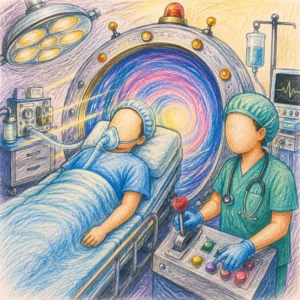
If you have ever sat in a hospital waiting room before surgery, you probably know the feeling. The room is a little too cold, the clock seems to have stopped moving, and suddenly that innocent-looking medical equipment starts resembling props from a science-fiction movie.
You know your doctors are trained. You know the procedure is necessary. You may even have been told, “Don’t worry, you’ll be asleep.”
And yet your brain has one extremely persistent question:
“What exactly happens when they put me under?”
That question is completely normal.
Anesthesia can feel mysterious because its greatest success is making you unaware of what is happening. One moment you are talking to the medical team, and the next thing you know, someone is telling you that your procedure is finished.
It can feel like someone pressed a pause button on time.
But anesthesia isn’t magic, and it isn’t simply a switch that turns your brain off. It is a carefully managed medical process involving medications, monitoring, specialized equipment, and a trained anesthesia professional who watches over you throughout the procedure.
Let’s pull back the curtain and see what is really happening.
What Is Anesthesia?
In simple terms, anesthesia is the use of medications to prevent or reduce pain and awareness during medical procedures.
The exact experience depends on the type of anesthesia being used. You might be completely awake with one small area numb, relaxed and sleepy with another, or completely unconscious under general anesthesia.
Think of your nervous system as a giant communication network.
When something hurts, nerves send signals toward your brain. Your brain receives those signals and interprets them as pain. Anesthetic medications can interrupt or alter that process, depending on the drug, dose, and technique being used.
But anesthesia isn’t only about pain.
Different medications may be used to achieve different goals, such as reducing anxiety, causing unconsciousness, preventing movement, controlling pain, or helping your body tolerate a procedure comfortably.
That is why there isn’t one universal “anesthesia drug” that everyone receives.
Your anesthesia plan is selected according to the procedure, your medical history, your current health, medications, allergies, and other individual factors.
The Four Main Types of Anesthesia
Although anesthesia can be delivered in different ways and at different depths, four broad categories are commonly discussed: local anesthesia, regional anesthesia, sedation, and general anesthesia.
1. Local Anesthesia: The Tiny Force Field
Local anesthesia is probably the type you’ve encountered most often.
Imagine getting stitches after cutting your finger or having a small skin procedure. The clinician may inject anesthetic around the area being treated.
The medication temporarily blocks sensation in that small region.
You’re still awake. You can hear conversations. You can answer questions. You might even be tempted to check your phone while the doctor works.
What you generally won’t feel is the sharp pain from the procedure itself. You may still notice pressure, pulling, movement, or touch.
Local anesthesia is commonly used for relatively small procedures, including some biopsies, skin procedures, and wound repairs.
2. Regional Anesthesia: Numbing a Whole Neighborhood
Regional anesthesia goes a step further.
Instead of numbing one small spot, medication is placed near a group of nerves responsible for sensation in a larger area of the body.
Examples include spinal anesthesia, epidurals, and peripheral nerve blocks.
For example, an epidural can provide pain relief during childbirth, while a nerve block may numb an arm or leg for certain operations.
You may remain awake during regional anesthesia. Depending on the procedure and your preferences, sedation may also be used to help you relax.
The fascinating part is that the surgical area can be comfortably numb while your brain remains awake and functioning normally.
3. Sedation: Somewhere Between Awake and Asleep
Sedation is the middle ground.
You aren’t necessarily completely unconscious, but you may become extremely relaxed and sleepy. Depending on the level of sedation, you may still respond to questions or instructions.
This approach is commonly used for shorter or less invasive procedures, including some endoscopic procedures.
Some patients remain fairly alert. Others become so sleepy that they remember very little afterward.
And yes, this is where people sometimes emerge from the recovery area wondering why they suddenly have absolutely no memory of the last hour.
Sedation can range from minimal to deep, and deeper sedation can affect breathing, which is why appropriate monitoring and the ability to manage the airway are important.
4. General Anesthesia: The Deep-Sleep Experience
General anesthesia is what most people picture when they hear the phrase “put under.”
It produces a state of controlled unconsciousness. You aren’t simply taking an unusually good nap. Your consciousness is intentionally suppressed with medications so you don’t experience or remember the procedure.
General anesthesia is commonly used for major operations, including many abdominal, orthopedic, cardiac, and other complex surgeries.
It can involve medications delivered through an IV, inhaled anesthetic agents, or a combination of medications.
Because general anesthesia can affect breathing and other body functions, the anesthesia team continuously monitors you and may use specialized airway equipment to support your breathing.
And when the procedure is finished, the medications are reduced or stopped and your team guides you through the process of waking up.
That’s the part that feels like a time machine.
Your Anesthesiologist: The Person Watching the Dashboard
Here’s something many patients don’t realize:
During surgery, the anesthesia professional isn’t simply standing around waiting for you to wake up.
They are continuously assessing and managing your condition.
An anesthesiologist is a medical doctor specializing in anesthesia, pain management, and related areas of critical care. Depending on the healthcare system and procedure, other qualified anesthesia professionals may also be part of the anesthesia care team.
Before your procedure, the anesthesia professional reviews important information about you, including your medical history, medications, allergies, previous experiences with anesthesia, and other factors that could affect your care.
During the procedure, they monitor vital signs such as:
- Heart rate
- Blood pressure
- Oxygen levels
- Breathing
- Carbon dioxide levels
- Heart rhythm
- Temperature when appropriate
They can adjust medications and other aspects of your care as the procedure progresses.
In other words, the anesthesia team isn’t pressing one button and walking away.
They’re actively managing your condition from the beginning of anesthesia through recovery.
Why Anesthesia Is Carefully Customized
Two people can have the same operation but receive different anesthesia plans.
Why?
Because people aren’t identical machines.
Your age, medical conditions, medications, allergies, previous reactions to anesthesia, the type and duration of surgery, and other factors can influence the plan.
That is why the preoperative conversation matters.
If your doctor asks whether you take supplements, don’t assume the answer is irrelevant because “it’s natural.”
If you’re taking prescription medication, over-the-counter medicine, vitamins, or herbal products, tell your healthcare team.
Also mention relevant habits such as alcohol or nicotine use when asked.
You’re not being interrogated.
Your medical team is collecting information that helps them make safer decisions.
The Myth of “Waking Up” During Surgery
This is probably one of the biggest anesthesia fears.
And here’s the important distinction: anesthesia awareness can happen, but it is rare.
The American Society of Anesthesiologists reports that awareness during general anesthesia occurs in approximately one or two cases per 1,000 adult patients receiving general anesthesia.
It is also important to understand that awareness isn’t the same as remembering something from immediately before anesthesia starts or as you are waking up.
Some patients may dream during anesthesia, while others may remember parts of the preparation or recovery period. Those experiences aren’t necessarily evidence that they were awake during surgery.
If this possibility worries you, tell your anesthesia professional before the procedure. Your concerns are worth discussing.
“Will I Reveal All My Secrets?”
Movies have had a lot of fun with this one.
Someone wakes up from anesthesia and immediately announces their deepest romantic feelings, reveals a mysterious family secret, and confesses to eating the last slice of cake.
Real life is usually much less dramatic.
You may be sleepy, confused, emotional, talkative, or simply very uninterested in forming complete sentences immediately after anesthesia.
But anesthesia isn’t a magical truth serum.
Your behavior during recovery can vary, and your medical team is accustomed to seeing patients in that groggy transition period.
So if you wake up and repeatedly ask, “Is it over yet?” don’t be embarrassed.
You’re not the first person.
You won’t be the last.
Why Fasting Before Anesthesia Matters
One of the most important instructions you may receive before anesthesia is to avoid eating or drinking for a specified period.
This isn’t your medical team being unnecessarily strict.
Anesthesia can reduce protective reflexes and affect the normal mechanisms that keep stomach contents from entering the airway. Having food or liquid in the stomach can therefore increase certain risks during anesthesia.
However, don’t assume that everyone should automatically stop eating and drinking at midnight.
Fasting instructions can vary depending on the procedure, anesthesia plan, medical condition, and institutional protocol.
Follow the exact instructions given by your surgical and anesthesia team. If you accidentally eat or drink when you weren’t supposed to, tell them rather than hiding it.
Honesty is much safer than trying to impress the medical team with your ability to follow instructions perfectly.
Your Medication List Matters More Than You Think
Before surgery, your anesthesia team may ask about everything you’re taking.
That can include:
- Prescription medications
- Over-the-counter pain relievers
- Vitamins
- Herbal supplements
- Weight-management medications
- Blood-thinning medications
- Recreational substances
- Alcohol and nicotine
Some medications may need to be continued. Others may need to be temporarily adjusted or stopped.
But here’s the important part:
Never stop a prescription medication on your own simply because you’re having surgery.
Ask your doctor or anesthesia team exactly what you should take, skip, or change.
The goal is not to create unnecessary rules. It’s to prevent avoidable complications and help your medical team plan appropriately.
What Happens When You Wake Up?
Eventually, the operation ends.
The medications are adjusted or stopped, and your body begins returning toward its normal state.
But waking up isn’t always like flipping a light switch.
You may initially feel sleepy, disoriented, cold, thirsty, or slightly nauseated. Some people experience shivering or a sore throat, particularly when airway equipment has been used during general anesthesia.
Fortunately, recovery areas are designed specifically for this transition.
Nurses and anesthesia professionals monitor you as you become more alert and help manage symptoms when necessary.
And if you’re having outpatient surgery, don’t expect to jump into your car afterward and head home like nothing happened.
Anesthesia and sedating medications can temporarily affect judgment, coordination, and reflexes. You’ll generally need someone else to take you home, and your medical team will give you specific recovery instructions.
Is Anesthesia Safe?
This is the question behind many of the other questions.
The honest answer is that no medical procedure is completely risk-free.
Anesthesia risks vary according to the type of anesthesia, the procedure, and the patient’s individual health.
However, modern anesthesia care includes extensive monitoring, improved medications, better equipment, standardized safety practices, and careful preoperative assessment.
For most patients, anesthesia is a highly controlled part of medical care—but your personal risk can only be properly assessed by your healthcare team.
So instead of asking, “Is anesthesia dangerous?”
A more useful question is:
“What are my individual anesthesia risks, and what is my medical team doing to reduce them?”
That’s a conversation worth having.
How to Make Your Anesthesia Experience Easier
You don’t control every part of surgery, but you can make your side of the process much smoother.
Be completely honest
Tell your medical team about medications, supplements, allergies, previous anesthesia problems, and relevant health information.
Follow your fasting instructions
Don’t improvise.
If the instructions are unclear, call your healthcare provider and ask.
Ask questions
If you’re frightened, say so.
Ask what type of anesthesia you’re likely to receive, how you’ll be monitored, what recovery might feel like, and when you can eat, drink, walk, or drive afterward.
Tell them about previous experiences
If you experienced severe nausea, difficult waking, unexpected pain, or another problem after previous anesthesia, mention it.
That information can help your team plan.
Arrange your recovery
If you’re having sedation or general anesthesia as an outpatient, organize transportation and follow the instructions about supervision and activity afterward.
The Real Medical Time Machine
Anesthesia doesn’t literally stop time.
But from a patient’s perspective, it can certainly feel that way.
You enter the operating room nervous and uncomfortable. Your medical team carefully prepares you. Medications take effect. Your awareness changes.
Then, seemingly moments later, you’re in recovery.
The incredible part isn’t simply that you didn’t feel the surgery.
It’s the enormous amount of planning and monitoring happening behind that experience.
Anesthesia is the result of decades of medical research, improved technology, specialized training, careful patient assessment, and constant attention to safety.
So the next time someone says, “They’re going to put you under,” don’t picture a mysterious button being pushed.
Picture a carefully managed medical process.
Picture a team checking your history, selecting an appropriate plan, watching your vital signs, adjusting medications, supporting your breathing when necessary, and guiding you safely through the procedure and recovery.
And if you’re nervous?
That’s okay.
Ask questions. Tell your medical team you’re anxious. You don’t have to pretend you’re fearless.
Because the most reassuring thing about anesthesia isn’t that you won’t remember the procedure.
It’s knowing that while you’re temporarily disconnected from the experience, a trained medical team is paying very close attention to you.
Important Note
This article is intended for general education and is not a substitute for personalized medical advice. Anesthesia plans and fasting, medication, and recovery instructions vary from person to person and procedure to procedure. Always follow the instructions provided by your surgeon and anesthesia team.