
Have you ever been perfectly fine one minute and then suddenly felt as though your body had received an emergency memo?
Maybe you’re waiting for your turn to speak in a meeting. Perhaps you’re about to walk into a job interview. Maybe you’re sitting in traffic when someone suddenly cuts you off. Or perhaps your boss sends the legendary message:
“Do you have a minute?”
Suddenly, your heart starts pounding.
Your palms become suspiciously damp. Your shoulders creep toward your ears. Your stomach decides it would rather be somewhere else entirely. And your brain, which was functioning perfectly five seconds ago, suddenly forgets how words work.
You know you’re not being chased by a tiger.
Your body apparently has not received that memo.
This is where the idea of an Autonomic Reset becomes interesting.
You’ve probably heard that you can influence your nervous system through breathing, movement, temperature, and other physical signals. One particularly unusual technique involves creating pressure by trying to exhale against a closed airway—a maneuver known as the Valsalva maneuver.
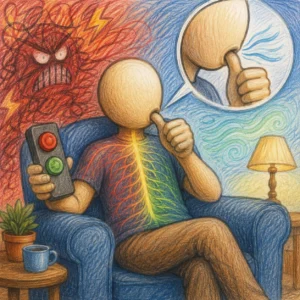
And yes, there is a version of this that can involve blowing against resistance, which is probably where the internet’s wonderfully strange “blow on your thumb” trick comes from.
But before you put your thumb in your mouth and start blowing like you’re trying to inflate an invisible balloon, there’s an important distinction:
This isn’t a magical anxiety off-switch.
The Valsalva maneuver is a recognized physical maneuver that can influence heart rate and blood pressure and is used medically for certain abnormal fast heart rhythms, particularly supraventricular tachycardia (SVT). It isn’t proven to instantly erase ordinary anxiety or panic.
Still, understanding what’s happening inside your body can teach you something fascinating:
Your nervous system isn’t just reacting to your thoughts. Your body is constantly sending signals back to your brain, too.
And that is where things get interesting.
Your Nervous System Has an Accelerator and a Brake
Imagine your nervous system as a car.
Not a sleek sports car.
More like an old car whose dashboard occasionally lights up for reasons nobody understands.
Your autonomic nervous system helps regulate things you don’t have to consciously control, including heart rate, blood pressure, digestion and breathing.
Two major branches are especially important here.
The sympathetic nervous system: the accelerator
This is the system associated with your body’s “fight-or-flight” response.
When your brain detects danger—or something it interprets as danger—it can increase heart rate, redirect blood flow, increase alertness and prepare your body for action.
This response is incredibly useful when you actually need it.
If a car suddenly comes toward you, you don’t want your nervous system to politely schedule a meeting to discuss the situation.
You want:
MOVE. NOW.
The problem is that your nervous system doesn’t always distinguish perfectly between physical danger and psychological stress.
A job interview isn’t a tiger.
A difficult conversation isn’t a tiger.
An embarrassing presentation definitely isn’t a tiger.
But your body can still produce some very convincing tiger-like symptoms.
The parasympathetic nervous system: the brake
The parasympathetic nervous system is involved in the body’s calmer, restorative functions.
The vagus nerve is a major component of this system and plays an important role in regulating heart rate.
Certain physical maneuvers can influence vagal activity and slow heart rate. These are called vagal maneuvers. Healthcare professionals may use them for specific situations involving excessively fast heart rhythms.
That’s the important science behind the idea of a physical “reset.”
But there’s a catch.
A maneuver that can influence heart rhythm isn’t automatically a treatment for anxiety.
That’s a distinction worth keeping.
So What Is the Thumb-Blowing Trick?
Here’s where the internet gets delightfully weird.
You may have seen people recommending putting a thumb in the mouth, sealing the lips around it, and attempting to blow against the resistance.
The theory is that you’re creating pressure similar to a Valsalva maneuver.
A traditional Valsalva maneuver involves taking a breath and attempting to exhale while keeping the mouth and nose closed, creating pressure inside the chest. Medical sources describe it as a technique that can influence the cardiovascular system and, in appropriate cases, help slow certain abnormal fast heart rhythms.
Your cardiovascular system contains pressure sensors called baroreceptors. These sensors help your body respond to changes in blood pressure.
When pressure changes occur during a Valsalva maneuver, your cardiovascular system responds through several stages involving changes in blood pressure, blood return to the heart and heart rate.
That sounds impressive.
And it is.
But it’s not quite the same as:
“Blow on your thumb for 15 seconds and your anxiety disappears.”
Science doesn’t support that promise.
The more accurate takeaway is:
A controlled pressure maneuver can affect your cardiovascular and autonomic responses, but its effect on stress or anxiety varies and shouldn’t be treated as a guaranteed emergency reset.
That version may be less dramatic.
It’s also much more honest.
Why Your Body Can Feel Out of Control During Stress
One reason physical stress feels so frightening is that the symptoms themselves can become part of the problem.
Imagine this:
Your heart begins beating faster.
You notice it.
Your brain thinks:
“Why is my heart beating so fast?”
That thought creates more alarm.
Your body becomes even more activated.
Your heart beats faster.
You notice that.
And suddenly you’re trapped in a feedback loop.
This doesn’t mean the symptoms are imaginary.
Quite the opposite.
The physical sensations are real.
Your heart really can beat faster. Your breathing can change. Your muscles can tense. You can sweat. You can feel shaky or light-headed.
The brain and body communicate continuously.
That’s why physical strategies can sometimes be useful when you’re overwhelmed.
Instead of trying to argue with your thoughts while your body is screaming DANGER!, you can use a physical technique to help shift your attention and physiological state.
But there are safer and simpler options than forcing a powerful Valsalva maneuver whenever you’re nervous.
A Safer Way to Think About an Autonomic Reset
Rather than treating the Autonomic Reset as a magical 15-second cure, think of it as a reminder:
Your body can influence your state of mind.
You don’t always have to solve stress by thinking harder.
Sometimes you can start with your body.
Try this simple sequence instead.
Step 1: Stop what you’re doing
If possible, sit down.
Put both feet on the floor.
Drop your shoulders.
Unclench your jaw.
Your nervous system doesn’t need another task right now.
Step 2: Breathe normally
Don’t immediately start taking enormous breaths.
Huge breaths can sometimes make you feel more uncomfortable, especially if you’re already breathing rapidly.
Instead, breathe gently and comfortably.
Step 3: Make your exhale easy
Allow your exhale to be relaxed rather than forceful.
You can make the exhale slightly longer than the inhale if that feels comfortable.
The goal isn’t to win a breathing competition.
The goal is to stop fighting your own body.
Step 4: Ground yourself physically
Notice your feet against the floor.
Feel the chair beneath you.
Relax your hands.
Look around and identify a few things you can see.
This gives your brain additional information:
I’m here. I’m sitting down. I’m safe in this moment.
Step 5: Give the body a moment
Don’t expect your nervous system to go from “AAAAAA!” to “spa day” instantly.
Give it a little time.
Your body isn’t a light switch.
It’s more like a dimmer.
But What About the Actual Valsalva Maneuver?
This is where we need to separate internet wellness advice from medical practice.
Healthcare professionals use vagal maneuvers, including the Valsalva maneuver, for certain types of rapid heart rhythms.
For example, the maneuver may be used for supraventricular tachycardia (SVT) in appropriate patients. It works by changing pressure and influencing autonomic activity, which can affect the heart’s electrical activity.
The modified Valsalva technique can sometimes be more effective than the standard technique for SVT, and clinical guidance recognizes vagal maneuvers as an option for suitable patients.
But this is very different from using it casually as a universal anxiety treatment.
If you have recurrent episodes of a racing heart, don’t automatically assume they’re anxiety.
A fast heartbeat can have many possible causes, and some require medical evaluation. The American Heart Association notes that different types of tachycardia have different causes and are generally evaluated using tools such as an ECG.
So if your heart repeatedly races for no obvious reason, talk to a healthcare professional rather than turning yourself into a human pressure cooker.
When Should You NOT Try It?
This part isn’t as entertaining as the thumb trick.
It’s much more important.
Valsalva-type maneuvers can produce significant changes in blood pressure and heart rate. Reported complications can include dizziness, fainting, chest pain and abnormal heart rhythms.
Don’t use a physical maneuver as a substitute for emergency medical care.
If you’re experiencing chest pain, severe shortness of breath, fainting, severe weakness, or symptoms that could indicate a heart attack or another serious medical problem, seek urgent medical attention rather than attempting to “reset” yourself.
Likewise, if your heartbeat is suddenly very fast and you’re unsure why, especially if this happens repeatedly, get medical advice.
Your body is clever.
But it isn’t always predictable.
And TikTok University does not issue medical degrees.
Can an Autonomic Reset Really Stop Anxiety?
Here’s the honest answer:
Not necessarily.
A physical maneuver may influence heart rate and autonomic activity, but that doesn’t mean it treats the underlying cause of anxiety.
Think about it like turning down the volume on a fire alarm.
The alarm becoming quieter doesn’t necessarily mean you’ve discovered why the alarm went off.
Long-term anxiety may require entirely different strategies, including sleep, exercise, stress management, psychological support, therapy or medical treatment when appropriate.
A quick physical technique can be one tool.
It shouldn’t be your entire toolbox.
The Bigger Lesson: You Are Not Your Racing Heart
There’s something genuinely reassuring about understanding your nervous system.
When your heart starts pounding before an important event, it can feel like your body has betrayed you.
It hasn’t.
Your body is trying to protect you.
The racing heart, sweaty palms, tense muscles and rapid breathing are all parts of a biological response designed to prepare you for action.
The problem is that modern life frequently presses the same alarm button without providing an actual tiger to chase.
Your presentation is not a tiger.
Your inbox is not a tiger.
Someone saying “we need to talk” is definitely not a tiger.
Although, depending on the conversation, your nervous system may disagree.
Understanding this can change how you respond.
Instead of thinking:
“Something is wrong with me.”
You can think:
“My nervous system is activated. I can give my body some time and safe signals that I’m okay.”
That shift alone can make the experience less frightening.
Build Your Own 15-Second Reset Routine
You don’t need a complicated ritual.
When stress suddenly hits, try this:
Pause.
Plant your feet.
Relax your shoulders.
Breathe comfortably.
Lengthen the exhale if it feels natural.
Look around your environment.
Remind yourself: “This feeling is uncomfortable, but I don’t have to fight it.”
Then give yourself another few moments.
That’s your practical version of an Autonomic Reset.
No expensive gadget.
No supplement.
No mystical energy crystal required.
And, thankfully, no need to explain to your coworkers why you’re sitting at your desk blowing aggressively into your thumb.
Final Thoughts
The human nervous system is remarkably sophisticated.
It constantly monitors what’s happening around you and inside you, adjusting heart rate, breathing, blood pressure and countless other functions without asking you to fill out a permission form.
That also means you can sometimes influence your physical state through physical actions.
The Valsalva maneuver is a real medical technique with legitimate uses, particularly for certain abnormal fast heart rhythms. But it isn’t a guaranteed 15-second cure for anxiety, and forceful versions should not be treated casually.
The more useful lesson behind the viral thumb trick is simpler:
Your body and brain are constantly talking to each other.
When stress hits, you don’t necessarily have to win an argument with your thoughts.
Sometimes you can start by helping your body feel a little safer.
Sit down.
Relax your shoulders.
Breathe comfortably.
Notice where you are.
Let the wave pass.
And remember that feeling intensely activated doesn’t automatically mean you’re in danger.
Your nervous system may simply have slammed the accelerator.
Your job isn’t to panic about the accelerator.
It’s to learn how to gently find the brake.
References
Cleveland Clinic — Valsalva Maneuver
Cleveland Clinic — Vagal Maneuvers