
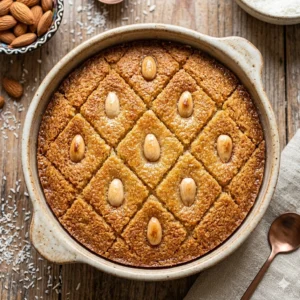
There are cakes you eat because they are sitting on the dessert table, and then there are cakes that make you stop mid-conversation because someone has just brought them out of the oven.
Basbousa with almonds and coconut belongs firmly in the second category.
Golden around the edges, tender in the middle, lightly crumbly without being dry, and soaked with fragrant sugar syrup, basbousa is the kind of dessert that makes a simple cup of tea feel like a special occasion. It does not need towering layers, complicated frosting, or a suspicious amount of food coloring to make an impression. Its charm comes from something much simpler: semolina, coconut, butter or ghee, yogurt, almonds, and a beautifully scented syrup.
And that texture? That is where basbousa really shows off.
Unlike a conventional sponge cake, basbousa has a slightly grainy, delicate bite from semolina. The coconut adds chewiness and aroma, while the syrup works its way through the cake, giving every bite a soft, sweet finish. A whole almond pressed into each diamond-shaped piece adds the final little crunch.
Best of all, you do not need to be a professional baker to make it.
If you can mix ingredients in a bowl, spread batter into a pan, and resist opening the oven every four minutes to “check” the cake, you are already qualified.
Let’s make it.
What Exactly Is Basbousa?
Basbousa is a traditional Middle Eastern semolina cake that is also known by different names depending on the region, including variations such as hareesa or revani. Recipes vary from country to country and from family to family, but the basic idea remains wonderfully recognizable: semolina-based batter, a golden bake, and sweet syrup poured over the finished cake.
That syrup is what gives basbousa its signature character.
Instead of relying on frosting or cream to keep the cake moist, basbousa gets its richness from soaking up a scented sugar syrup after baking. Rose water or orange blossom water can add a delicate floral note, while lemon juice helps balance the sweetness.
Basbousa has also appeared in published recipe collections as a Middle Eastern semolina slice, showing just how widely the dessert has traveled beyond its traditional home kitchens.
And while today’s version focuses on Basbousa, Almonds, Coconut, there is plenty of room for regional and family variations.
Why You’ll Love This Basbousa
There is something wonderfully uncomplicated about this cake.
You do not need to separate eggs.
You do not need to cream butter and sugar for ten minutes.
You do not need to stack three layers while praying they do not slide sideways.
You certainly do not need a piping bag.
Instead, you combine the ingredients, allow the semolina to hydrate, spread everything into a pan, score the surface, decorate it with almonds, bake until golden, and soak it with syrup.
That’s it.
The finished result is rich but not overwhelmingly buttery, sweet but balanced by lemon and floral notes, and wonderfully fragrant thanks to the combination of coconut, semolina, and syrup.
It is also naturally egg-free, making it a particularly useful dessert when you want something satisfying without using eggs.
Ingredients You’ll Need
For the Basbousa
2 cups fine or medium semolina
Semolina is the foundation of this cake. Fine or medium semolina generally gives a pleasant texture without making the finished dessert excessively coarse.
½ cup desiccated coconut
This is where the tropical personality enters the room. Coconut gives the cake extra aroma, texture, and richness.
½ cup granulated sugar
You do not need an enormous amount because the cake will later be soaked in syrup.
1 teaspoon baking powder
This gives the cake a little lift without turning it into a fluffy sponge.
1 cup plain yogurt
Yogurt adds moisture and tenderness while helping the semolina soften before baking.
½ cup melted butter or ghee
Butter gives a creamy richness, while ghee brings an especially fragrant, traditional-style flavor.
Whole blanched almonds
These are pressed into the surface before baking. They are not merely decoration; they give each serving a satisfying nutty crunch.
For the Syrup
1 cup sugar
1 cup water
1 teaspoon lemon juice
1 teaspoon rose water or orange blossom water
You can use either floral water depending on your preference. Rose water creates a distinctly floral aroma, while orange blossom water gives the syrup a citrusy, almost honey-like fragrance.
A little restraint is useful here. Floral waters can be powerful, so you want a gentle perfume rather than a dessert that tastes like someone accidentally emptied a bottle of perfume into it.
How to Make Basbousa with Almonds and Coconut
Step 1: Prepare the Pan
Start by lightly greasing an 8-inch square baking pan.
Butter works beautifully, but there is another trick worth trying: tahini.
Brush a very thin layer of tahini across the bottom and sides of the pan. It adds a subtle sesame flavor that pairs surprisingly well with the sweet syrup and nutty semolina.
If you are using tahini, do not go overboard. We are making basbousa, not tahini pudding.
Set the pan aside.
Step 2: Combine the Dry Ingredients
In a large mixing bowl, combine:
- Semolina
- Desiccated coconut
- Sugar
- Baking powder
Give everything a good stir.
You want the coconut and baking powder evenly distributed through the semolina so every piece of the finished cake has a consistent texture.
There is no need for aggressive whisking here. This is not a competition.
Step 3: Add the Yogurt and Butter
Pour in the melted butter or ghee and add the yogurt.
Use a wooden spoon or spatula to mix everything together until you have a thick, cohesive batter.
The mixture should be moist and spreadable but definitely not runny.
This is one of the places where basbousa differs from ordinary cake batter. You are not trying to create a smooth, airy mixture. Semolina should remain the star of the show.
Avoid overmixing. Once everything is evenly combined, stop.
Step 4: Let the Batter Rest
This little pause is important.
Transfer the batter into the prepared pan and spread it evenly.
Smooth the surface using the back of a spoon or a slightly damp spatula.
Then let it rest for around 15–20 minutes.
Why?
Because semolina needs time to absorb moisture.
Think of the grains as tiny thirsty sponges. Give them a few minutes and they begin absorbing the yogurt and butter mixture. This helps create the characteristic tender-but-textured crumb.
Skipping this stage can contribute to a cake that feels overly coarse or dry.
So yes, you have officially been instructed to stand around doing nothing for 15 minutes.
Baking has never sounded better.
Step 5: Score the Cake
While the batter rests, preheat your oven to 375°F (190°C).
Once the batter has rested, use a sharp knife to score the top into diamond or square shapes.
Do not cut all the way through the batter.
You are simply creating guide lines that will make the finished cake easier to portion later.
Now comes the fun part.
Place one almond in the center of each diamond.
Press it gently into the surface so it stays in place during baking.
Suddenly, your thick bowl of semolina mixture has transformed into something that looks like it belongs behind a glass display case.
Step 6: Bake Until Golden
Place the pan in the preheated oven.
Bake for approximately 30–35 minutes, or until the top is deeply golden and the edges are nicely browned.
The exact baking time can vary depending on your oven, pan, and the thickness of the cake, so use the color and texture as your main clues.
You want a beautiful golden surface.
Pale basbousa is edible, but golden basbousa is the goal.
For an especially deep golden top, some bakers briefly use the upper heat or broiler near the end of baking. If you do this, watch it carefully because the difference between beautifully bronzed and “I have created charcoal” can happen remarkably quickly.
Meanwhile, Make the Syrup
While your cake is baking, prepare the syrup.
Add the sugar and water to a saucepan.
Bring the mixture to a gentle boil, stirring until the sugar dissolves.
Add the lemon juice and simmer for around 5 minutes.
Turn off the heat and stir in the rose water or orange blossom water.
Then set the syrup aside.
The syrup can be warm when poured over the hot cake. The important thing is that the baked basbousa is hot when it receives the syrup so the liquid can penetrate the crumb effectively.
This is the moment when your kitchen starts smelling unfairly good.
Step 7: Give the Cake Its Syrupy Bath
Remove the golden basbousa from the oven.
Immediately pour the syrup slowly and evenly over the hot cake.
You should hear a gentle sizzling sound as the syrup meets the hot surface.
Pour slowly rather than dumping everything into one spot.
Give the cake time to absorb the syrup.
You may initially think, “That looks like way too much syrup.”
Don’t panic.
This is basbousa.
The semolina is thirsty.
Allow the syrup to work its way into the cake rather than immediately attempting to drain any excess.
Step 8: Let It Cool
Now comes the hardest instruction of the entire recipe:
Leave it alone.
Allow the cake to cool completely before serving.
If you cut into it immediately, the pieces may not hold together properly because the semolina has not finished absorbing and settling with the syrup.
For the cleanest slices, give it at least an hour.
Once cooled, follow your original score lines and cut the cake into diamonds or squares.
And there you have it: golden Basbousa with almonds and coconut, ready to disappear suspiciously quickly.
How to Get Perfect Basbousa Every Time
Don’t Make the Batter Too Wet
Basbousa batter should be thick.
If you create something resembling pancake batter, the texture will not be what you are looking for.
The semolina needs enough moisture to soften but enough structure to hold its shape.
Let the Semolina Rest
That short resting period matters.
It gives the semolina time to absorb moisture before the cake enters the oven.
Think of it as the difference between rushing into a recipe and actually giving the ingredients a chance to cooperate.
Don’t Skip the Syrup
The syrup is not an optional finishing drizzle.
It is part of the identity of the dessert.
Without enough syrup, the cake can feel dry and crumbly. With the right amount, it becomes tender, moist, and beautifully fragrant.
Watch Your Oven
A dark golden surface is desirable, but burnt edges are not.
Every oven has its own personality. Some run hotter than their temperature setting suggests, while others seem to need an invitation before they start doing their job.
Keep an eye on the cake during the final few minutes.
Almonds, Coconut, and Delicious Variations
The classic almond topping is hard to beat, but you can have fun with this recipe.
Try Pistachios
Replace some or all of the almonds with pistachios for a colorful finish and a slightly different nutty flavor.
Add Orange Zest
A little finely grated orange zest can complement the orange blossom water beautifully.
Experiment With Cardamom
A small amount of ground cardamom can add warmth and depth to the syrup.
Use Ghee
If you want a richer, more traditional-style flavor, ghee is an excellent choice instead of butter.
Try Different Shapes
Diamonds are classic, but squares and rectangles work perfectly well. The important thing is to score the cake before baking so you have clean cutting guides afterward.
What If Your Basbousa Turns Out Dry?
Don’t immediately blame yourself.
Several things can cause dry basbousa.
The batter may not have rested long enough. Your oven may have been hotter than expected. The cake may have baked for too long. Or the syrup may not have been distributed evenly.
The good news is that basbousa is quite forgiving.
If you notice that the cake looks dry immediately after baking, make sure the syrup is evenly distributed across the surface. Give it time to absorb before judging the final texture.
And remember: basbousa should have texture.
It is not supposed to feel like a fluffy vanilla sponge cake.
That slightly grainy, tender bite is part of its charm.
How to Store Basbousa
Once cooled, store basbousa in an airtight container.
At room temperature, it can generally be kept for a few days, provided the environment is cool and the cake is stored properly. For longer storage, refrigeration is an option.
If refrigerated, allow a piece to sit at room temperature for a little while before serving if you prefer a softer texture.
And here is a delicious little secret: basbousa can taste even better the next day.
Why?
Because the syrup has had more time to move through the cake and the flavors have had time to settle.
So if you somehow manage not to eat the entire pan on day one, tomorrow’s dessert may reward you.
Frequently Asked Questions
Is Basbousa traditionally made with eggs?
Many traditional basbousa recipes are egg-free, although recipes vary by region and household. This version does not require eggs; yogurt provides moisture and helps create the desired texture.
Can I use coconut milk instead of yogurt?
It is better not to substitute coconut milk directly in this recipe because its consistency and fat content differ from yogurt. If you want a coconut-forward flavor, keeping the yogurt and using desiccated coconut gives you more predictable results.
Can I use coarse semolina?
You can, but the texture will be noticeably more rustic. Fine or medium semolina is generally easier to work with when you want a tender, pleasant crumb.
Can I reduce the sugar?
You can reduce the sugar in the batter somewhat, but remember that the syrup is an essential part of the dessert. Reducing both the batter sugar and syrup substantially can change the characteristic flavor and texture of basbousa.
Why does my basbousa fall apart?
It may have been cut while still very hot, or the mixture may have been too soft. Allow the cake to cool and set properly before slicing.
Can I freeze basbousa?
Yes, properly wrapped portions can generally be frozen. Thaw them gradually and allow the texture to return to normal before serving.
The Sweet Little Lesson Behind Basbousa
There is something wonderfully comforting about traditional desserts.
They remind us that good food does not always need complicated equipment, expensive ingredients, or dozens of steps.
Sometimes it is simply semolina mixed with yogurt, coconut folded through the batter, almonds pressed into the top, and fragrant syrup poured over a golden cake.
And suddenly, an ordinary afternoon feels different.
Maybe that’s the real magic of Basbousa with almonds and coconut.
It is not trying to be fashionable. It does not need a dramatic frosting tower or a dozen decorations. It simply arrives golden, fragrant, slightly crisp around the edges, soft in the middle, and completely unapologetic about being sweet.
Serve it with tea or coffee. Put it on a family dessert table. Make it for guests. Or make it on a random Tuesday because you deserve cake on a Tuesday.
Cut yourself a diamond-shaped piece, watch that almond sitting proudly on top, and take a bite.
First comes the buttery semolina.
Then the coconut.
Then the sweet floral syrup.
And finally, that little almond crunch.
That’s not a boring cake.
That’s a cake with a personality.
Final Thoughts
If you have never made basbousa before, this is a wonderfully approachable place to start.
The recipe is simple, the ingredients are easy to find, and the process does not demand complicated baking techniques. The biggest secrets are patience, proper hydration, an evenly golden bake, and giving the syrup enough time to soak into the hot cake.
Once you’ve mastered the basic version, you can experiment with pistachios, cardamom, orange zest, different floral waters, or even your own family-inspired twists.
But don’t change too much too quickly.
First, experience the classic combination of Basbousa, Almonds, Coconut and fragrant syrup.
Then start experimenting.
Because sometimes the best baking upgrade isn’t a complicated technique.
It’s simply discovering a cake you wish you’d tried years ago.
References
Basbousa – Semolina Cakes With Syrup — Food.com