
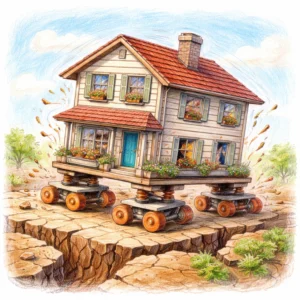
If I simply say let’s discuss base isolation many of you might not get what I am talking about so how about you Imagine this.
You’re at a beautiful dinner party. The lights are warm, conversations are flowing, and right in the center of the table sits a stunning five-tier cake—perfectly balanced, almost too pretty to eat.
Then chaos enters.
A toddler, fueled by curiosity and zero concern for social order, grabs the tablecloth and yanks it hard.
In most cases? That cake is gone. Sliding, tilting, crashing into a sugary disaster.
But now picture something different.
The cake isn’t directly on the table—it’s sitting on a smooth, frictionless tray. When the table jerks, the tray absorbs the movement. The table shakes, but the cake barely notices.
It stays upright. Untouched. Safe.
That’s exactly how Base Isolation works.
And if you live in an earthquake-prone region—or honestly, even if you don’t—it’s one of the smartest engineering innovations you should know about.
1. What Is Base Isolation (Without the Complicated Talk)?
Traditionally, buildings are constructed like trees—firmly rooted into the ground. Foundations are rigid, designed to hold everything in place no matter what.
Sounds strong, right?
But here’s the problem: when the ground shakes during an earthquake, that rigidity becomes a weakness.
The ground moves. The building follows. Stress builds up. Cracks appear. Sometimes… collapse happens.
Base Isolation flips this idea completely.
Instead of locking a building to the ground, engineers place it on special flexible supports called isolators. These act like shock absorbers, separating the building from the violent motion of the earth.
So when the ground moves aggressively beneath, the building above stays relatively calm.
It doesn’t fight the earthquake—it avoids it.
2. The “Roller Skate” Concept (The Easiest Way to Understand It)
Let’s make this even simpler.
Stand still in regular shoes. Now imagine someone shakes the ground beneath you. You’ll struggle to stay balanced, right?
Now imagine you’re wearing roller skates.
When the ground shifts, your wheels move with it. Your body doesn’t absorb the full force—you glide instead of fall.
That’s the magic of Base Isolation.
The building sits on systems that allow sideways movement. Instead of resisting the force, it rolls with it—literally.
These isolators are usually made of:
- Rubber (for flexibility)
- Steel (for strength)
- Lead (for energy absorption)
Together, they create a foundation that’s both strong and adaptable.
3. Why Not Just Build Stronger Buildings?
This is the most common question—and honestly, it sounds logical.
“Why not just use thicker concrete and stronger steel?”
Here’s the truth: strength alone isn’t enough.
Think of dropping:
- A glass → strong but rigid → shatters
- A rubber ball → flexible → survives
Traditional buildings behave like glass under stress. They resist movement until they can’t—and then they fail.
Base Isolation buildings behave like rubber. They absorb energy, adapt, and remain intact.
Instead of battling seismic forces head-on, they reduce the impact before it even reaches the structure.
It’s not about being stronger.
It’s about being smarter.
4. The Three Types of Base Isolation Systems
Not all Base Isolation systems are the same. Engineers choose different types depending on the building’s size, purpose, and location.
1. Elastomeric Bearings (The “Rubber Sandwich”)
These are layers of rubber and steel stacked together.
- Rubber allows movement
- Steel provides structural strength
They’re the most common and widely used type.
2. Lead Rubber Bearings (The Shock Absorber Upgrade)
This system includes a lead core inside the rubber layers.
Why lead?
Because it absorbs energy extremely well.
When an earthquake hits, the lead core reduces vibrations and prevents the building from swaying too much after the shaking stops.
3. Friction Pendulum Systems (The Sliding Genius)
Imagine a marble inside a curved bowl.
When shaken, the marble slides but naturally returns to the center.
That’s how this system works. The building slides on a curved surface and then gently moves back to its original position.
5. It’s Not Just About the Building—It’s About What’s Inside
Here’s something people don’t realize:
In many earthquakes, buildings survive—but everything inside gets destroyed.
Think about:
- Computers crashing to the floor
- Hospital equipment becoming unusable
- Pipes bursting and flooding rooms
- Sprinklers activating unnecessarily
- Priceless artifacts getting damaged
A building might still stand, but its function is gone.
This is where Base Isolation truly shines.
Because the shaking inside is minimal, things remain stable.
In some cases, even a glass of water doesn’t spill.
That’s why this technology is widely used in:
- Hospitals
- Museums
- Data centers
- Emergency response buildings
It protects not just the structure—but life, work, and history.
6. The Cost Question (Let’s Be Honest)
Yes—Base Isolation is more expensive upfront.
There’s no sugarcoating that.
It requires:
- Advanced engineering
- Specialized materials
- Careful installation
But here’s the bigger picture.
After an earthquake:
- A traditional building may need massive repairs
- Some structures may be completely demolished
- Businesses lose time, money, and operations
A base-isolated building?
Often usable immediately.
No major repairs. No downtime. No chaos.
Think of it like insurance—but built into your structure.
You pay more once, so you don’t pay endlessly later.
7. Real-World Impact: Why It Matters More Than Ever
Earthquakes don’t give warnings.
They don’t check schedules.
They don’t care about how “strong” a building looks.
But technologies like Base Isolation give us an advantage.
Instead of living in fear of natural forces, we adapt to them.
Cities around the world—especially in earthquake-prone areas—are already embracing this approach. And as technology evolves, costs are gradually decreasing.
What once seemed like luxury engineering is slowly becoming a standard for safety.
8. A Life Lesson Hidden in Engineering
There’s something deeply human about Base Isolation.
It teaches us a simple truth:
Rigidity breaks. Flexibility survives.
In life, just like in engineering:
- If you resist every force, you eventually crack
- If you adapt, you endure
Base Isolation isn’t just about buildings—it’s a mindset.
When things get shaky, don’t fight blindly.
Absorb. Adjust. Stay standing.
9. Can Homes Use Base Isolation Too?
Right now, Base Isolation is mostly used for:
- Large buildings
- Bridges
- Critical infrastructure
Why?
Because the system works best with heavier structures.
But things are changing.
Engineers are now developing residential-scale isolation systems, and in some parts of the world, modern homes are already being built with simplified versions.
It may not be mainstream yet—but it’s coming.
And when it does, earthquake safety could become a standard feature in homes—not a luxury.
10. The Future of Safer Cities
Imagine cities where:
- Buildings don’t collapse during earthquakes
- Hospitals remain fully operational
- Families stay safe inside their homes
- Recovery takes days—not years
That’s the future Base Isolation is helping create.
It’s not science fiction.
It’s already happening.
And as awareness grows, people will start demanding safer, smarter construction.
Because once you understand this technology, going back to traditional methods feels… outdated.
Final Thoughts: Would You Rather Fight or Flow?
So here’s a simple question.
Would you rather live in:
- A rigid house that resists until it cracks
OR - A flexible house that moves and survives
Base Isolation proves one powerful idea:
You don’t have to fight nature to survive it.
You just have to move smarter than it.
References
Federal Emergency Management Agency (FEMA)