
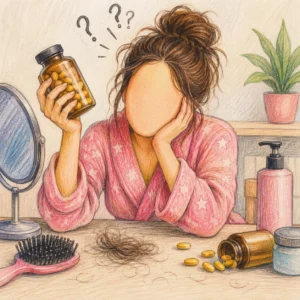
We’ve all had one of those frustrating moments.
You look down at your hairbrush and notice far more hair than you’d like. A nail snaps just before an important event. Your skin suddenly looks dull despite using every trending skincare product you could find.
Naturally, you do what most of us do—you grab your phone and search for answers.
Within minutes, social media floods your screen with videos promising unbelievable transformations. Long, shiny hair. Strong, unbreakable nails. Flawless skin. The secret? A tiny bottle labeled Biotin.
The message sounds simple:
“Take one capsule a day and watch your beauty transform.”
So you buy it, faithfully take it every morning, and wait for the magic.
A few weeks later…
Your hair looks exactly the same.
Your nails still chip.
And suddenly your face is introducing you to a collection of pimples you definitely didn’t invite.
At that point, it’s easy to wonder:
Is biotin a scam, or am I using it the wrong way?
The truth is much more interesting.
Biotin is a real vitamin with important jobs inside your body. However, many of the claims surrounding it have been exaggerated by clever marketing. Understanding what biotin actually does—and how to use it correctly—can save you money, disappointment, and even a few unexpected breakouts.
Let’s separate fact from fiction.
What Is Biotin?
Biotin, also known as Vitamin B7, is one of the eight B-complex vitamins your body needs every day.
Think of it as one of your body’s energy managers.
Every time you eat carbohydrates, proteins, or healthy fats, biotin helps convert those nutrients into usable energy. Without enough biotin, many important metabolic processes simply wouldn’t work efficiently.
But that’s not why biotin became famous.
Biotin also helps your body produce keratin, the protein that makes up your:
- Hair
- Nails
- Skin
Because of this connection, biotin quickly became one of the world’s most popular beauty supplements.
However, there’s one important detail that advertisements often leave out:
More biotin doesn’t automatically mean more hair growth.
Your body only needs a relatively small amount to perform its job.
Once those needs are met, taking huge doses usually doesn’t produce dramatically better results.
How Biotin Actually Supports Hair Growth
Healthy hair begins beneath the surface.
Every strand grows from a tiny follicle in your scalp. These follicles require nutrients, oxygen, proteins, healthy fats, vitamins, and minerals to build strong new hair.
Biotin supports this process by helping your body efficiently use the nutrients you already consume.
If you’re deficient in biotin, correcting that deficiency may improve:
- Hair thinning
- Brittle nails
- Dry skin
- Weak hair structure
However, if your biotin levels are already normal, taking extremely high doses may provide little additional benefit.
This is one reason scientific studies have found strong evidence for biotin supplementation primarily in people who have a true deficiency—not in everyone hoping for thicker hair.
Mistake #1: Assuming Higher Doses Work Better
This is one of the biggest misconceptions surrounding biotin.
Many supplements contain:
- 5,000 mcg
- 10,000 mcg
- Even 20,000 mcg
At first glance, those numbers sound impressive.
But here’s what many people don’t realize.
Biotin is a water-soluble vitamin.
Unlike vitamins A, D, E, and K, your body doesn’t store large amounts of biotin for future use.
Instead, it takes what it needs and removes the excess through urine.
That means swallowing an extremely high-dose supplement doesn’t automatically translate into better hair growth.
In many cases, your body simply gets rid of what it doesn’t need.
For most healthy adults, the recommended daily intake is only around 30 mcg, although healthcare providers may recommend different amounts for certain medical conditions.
Bigger numbers on the bottle don’t always mean better results.
Mistake #2: Ignoring Your Diet
Supplements should support a healthy diet—not replace one.
Many people already consume biotin naturally without realizing it.
Excellent food sources include:
Eggs
Cooked eggs are among the richest natural sources of biotin.
Avoid regularly eating raw egg whites because they contain avidin, a protein that can interfere with biotin absorption.
Nuts and Seeds
Almonds, peanuts, walnuts, sunflower seeds, and pecans all provide biotin alongside healthy fats that support overall hair health.
Salmon
Salmon supplies biotin, protein, and omega-3 fatty acids that nourish both your scalp and skin.
Sweet Potatoes
These provide biotin, antioxidants, and fiber while supporting overall wellness.
Avocados
Healthy fats combined with biotin make avocados an excellent addition to a balanced diet.
Mushrooms
Several varieties naturally contain biotin and other beneficial nutrients.
A varied, nutrient-rich diet often provides much of what your body needs.
Mistake #3: Expecting Overnight Results
Hair grows slowly.
Very slowly.
On average, human hair grows around half an inch (1.25 cm) each month.
That means even if biotin is helping, visible improvements won’t happen after one or two weeks.
Hair follicles need time to produce healthier strands.
Most people who benefit from nutritional improvements begin noticing changes after approximately two to three months, while more significant improvements may take even longer.
Patience matters just as much as consistency.
Can Biotin Cause Acne?
Some people notice more breakouts after starting high-dose biotin supplements.
Researchers haven’t conclusively proven that biotin directly causes acne.
However, there is a theory that very large doses may compete with Vitamin B5 (pantothenic acid), which also plays a role in healthy skin.
Some individuals report improvements after lowering their biotin dosage or switching to a balanced B-complex vitamin.
If you notice acne appearing shortly after starting biotin, speak with your healthcare provider before continuing high-dose supplementation.
Who May Actually Need Biotin Supplements?
Most healthy people receive enough biotin through food.
However, supplementation may be recommended for individuals who:
- Have a diagnosed biotin deficiency
- Are pregnant (under medical guidance)
- Have certain digestive disorders affecting nutrient absorption
- Take medications that interfere with biotin metabolism
- Have inherited conditions affecting biotin utilization
Your healthcare provider can determine whether supplementation is appropriate for your situation.
An Important Warning Before Blood Tests
This is one of the most important things to know about biotin.
High-dose biotin supplements can interfere with certain laboratory blood tests.
They may affect tests related to:
- Thyroid function
- Heart health
- Hormones
- Other diagnostic blood work
Incorrect laboratory results could lead to unnecessary testing or delayed diagnosis.
If you’re taking high-dose biotin and have blood work scheduled:
- Tell your healthcare provider.
- Inform the laboratory staff.
- Follow your provider’s advice about whether you should temporarily stop taking biotin before testing.
Never stop prescribed supplements without professional guidance.
The Best Way to Take Biotin
If your healthcare provider recommends biotin, these simple habits can help you get the most from it:
Take it consistently.
Daily use is generally more effective than taking it occasionally.
Eat a balanced diet.
Biotin works alongside protein, iron, zinc, vitamin D, and other nutrients.
Stay hydrated.
Healthy hydration supports your body’s normal metabolic functions.
Manage expectations.
Healthy hair takes time.
Don’t chase mega doses.
More isn’t always better.
Focus on overall health.
Sleep, stress management, exercise, and nutrition all influence hair health.
Hair Growth Requires More Than One Vitamin
Biotin is only one piece of the puzzle.
Healthy hair also depends on:
- Protein
- Iron
- Zinc
- Vitamin D
- Omega-3 fatty acids
- Adequate calories
- Good scalp health
- Hormonal balance
- Genetics
If you’re losing significant amounts of hair, it’s worth discussing the issue with a healthcare professional rather than relying solely on supplements.
Sometimes hair loss is linked to thyroid disease, iron deficiency, hormonal changes, medications, or other medical conditions that require proper treatment.
Common Myths About Biotin
Myth: Biotin makes everyone’s hair grow faster.
Reality: It mainly helps people who have inadequate biotin levels.
Myth: The highest dose is the best dose.
Reality: Your body only uses what it needs.
Myth: Results appear in a few days.
Reality: Hair growth takes months.
Myth: Biotin alone fixes hair loss.
Reality: Hair health depends on many nutritional and medical factors.
Myth: Supplements replace healthy eating.
Reality: Food should always be your first source of nutrients whenever possible.
Final Thoughts
Biotin has earned its place as one of the most popular beauty supplements, but it isn’t a miracle pill.
Used appropriately, it supports your body’s natural processes and may contribute to healthier hair, stronger nails, and healthy skin—especially if you have a deficiency.
The key is using it wisely.
Instead of chasing enormous doses and unrealistic promises, focus on a balanced diet, healthy lifestyle habits, and consistent care.
Beautiful hair isn’t built overnight.
It’s built one healthy choice at a time.
When you understand how biotin really works, you’re far more likely to make informed decisions that benefit both your hair and your overall health.