
Picture this: You’re cleaning out your garage on a perfectly peaceful Saturday morning when you discover your old bicycle buried beneath a mountain of forgotten boxes. Once upon a time, it was your pride and joy. Now, its tires are cracked, the chain is rusted, the seat looks like it survived a natural disaster, and the frame has a suspicious bend that definitely wasn’t part of the original design.
What do you do?
A sensible person might take a nostalgic picture, thank the bicycle for its years of service, and send it off for recycling.
But imagine deciding that this rusty masterpiece deserves another chance. You buy expensive tools, spend your weekends replacing parts, watch seventeen repair tutorials, and sacrifice your social life to bring it back to its former glory.
Finally, you take it for a test ride. Five minutes later, the handlebars come loose, and you find yourself introducing your face to a rosebush.
Congratulations! You’ve learned an expensive lesson about the difference between appreciating something’s history and pretending it still works.
Strangely enough, we often behave this way with people, relationships, friendships, workplaces, and situations that have already shown us why they don’t belong in our lives.
We return to relationships that repeatedly hurt us. We reopen conversations that never lead anywhere. We chase apologies that may never come and spend years trying to repair connections that require us to sacrifice our happiness just to keep them alive.
Why?
Sometimes, we miss the good memories. Sometimes, we’re attached to who someone used to be. And sometimes, we simply struggle to accept that something important to us has reached its natural ending.
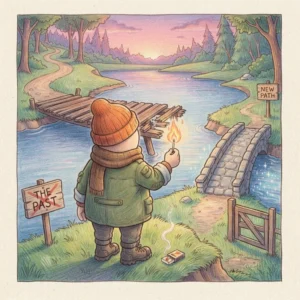
But here’s a truth worth remembering: not every broken bridge needs rebuilding, and not every closed path deserves another attempt.
Choosing to move on doesn’t automatically make you bitter, selfish, or unforgiving. Sometimes, it means you’ve finally learned to recognize the difference between a challenge worth overcoming and a situation that keeps hurting you.
Let’s explore why leaving certain bridges behind can be one of the healthiest decisions you ever make.
1. Understand Why the Bridge Collapsed
Before deciding whether to rebuild a relationship, take an honest look at why it fell apart.
Was it a misunderstanding that both people genuinely want to resolve? Was it a difficult season that tested an otherwise healthy connection? Or was there a repeated pattern of dishonesty, disrespect, manipulation, or broken promises?
These situations aren’t the same, and they shouldn’t all receive the same response.
Imagine ordering seafood at a restaurant and discovering that something is seriously wrong with your meal. You wouldn’t return the next day, order the same dish, and hope that your stomach has developed a stronger personality overnight.
You would investigate the problem and decide whether the restaurant deserved another chance.
Relationships deserve the same thoughtful evaluation.
Perhaps a friend repeatedly shares your private information despite knowing how much it hurts you. Maybe a partner apologizes after every argument but never changes the behavior that caused it. Or perhaps a former colleague constantly undermines your work while pretending to support your success.
One mistake doesn’t necessarily define a person. Everyone makes mistakes, and healthy relationships leave room for accountability, honest conversations, and growth.
However, a repeated pattern tells you something important.
If someone continually crosses your boundaries, dismisses your feelings, or expects forgiveness without making meaningful changes, you have good reason to reconsider how much access they should have to your life.
Forgiveness does not require unlimited access.You can wish someone well without inviting them back into the same position they once occupied.
Sometimes, the bridge collapsed because the relationship needed repair. Other times, it collapsed because the structure was never safe enough to begin with.
Knowing the difference can save you years of unnecessary heartache.
2. Stop Waiting for Perfect Closure
We’ve all seen those movie scenes where two people finally sit across from each other, explain everything, apologize beautifully, and walk away with peaceful smiles.
Real life doesn’t always cooperate with the screenplay.
Sometimes, the person who hurt you doesn’t understand what they did. Sometimes, they understand perfectly well but refuse to accept responsibility. And sometimes, you may never get a satisfying explanation for why things ended the way they did.
Waiting for that explanation can keep you emotionally attached to a situation long after it has stopped serving you.
Imagine a reckless scooter rider knocks you into a muddy puddle, damages your phone, and disappears without checking whether you’re okay.
Would you spend the next six months searching for that person, hoping they would eventually admit fault before allowing yourself to enjoy life again?
Probably not. You would clean yourself up, repair your phone, and get on with your day.
Yet, when emotional pain is involved, we often give other people extraordinary control over our recovery.
We tell ourselves that we cannot move forward until they apologize, acknowledge our sacrifices, explain their behavior, or finally understand how deeply they hurt us.
But your healing doesn’t have to depend on another person’s willingness to cooperate.
You can acknowledge what happened, grieve what you lost, learn from the experience, and decide what you want your future to look like.
That doesn’t mean you must suppress your feelings or pretend the experience didn’t matter. It means you can stop making your next chapter dependent on someone else’s response.
Sometimes, closure is a conversation. Sometimes, it’s a gradual process of healing. And sometimes, it’s simply the moment you realize that you no longer need to reopen a painful chapter to prove that it happened.
You can close the gate without receiving a key from the person standing on the other side.
3. Don’t Let the Past Control Your Future
Why is it so difficult to leave certain relationships behind?
One reason is that we often confuse the amount we’ve invested in something with the amount of time we should continue investing in it.
Psychologists call one version of this problem the sunk cost fallacy. It describes our tendency to continue an investment because of what we’ve already spent, even when continuing may not be worthwhile.
Think about buying a ticket to a terrible movie.
Fifteen minutes into the film, you realize the plot makes no sense, the dialogue is painful, and the main character appears to have made every possible bad decision before breakfast.
You could leave and spend the remaining two hours doing something enjoyable. Instead, you stay because you paid for the ticket.
Unfortunately, the movie doesn’t improve simply because you’re suffering through it.
The money is already spent. Staying doesn’t bring it back.
Relationships can create the same dilemma.
You may think, “We’ve been friends for fifteen years. I can’t just walk away.”
Or, “I’ve spent so much time trying to make this relationship work. Surely, I should give it another chance.”
Your shared history matters. The happy memories may be genuine, and the relationship may once have played an important role in your life.
But your past investment doesn’t automatically justify a future investment.
You can appreciate what a relationship once gave you while recognizing that it no longer belongs in your life in the same way.
Ask yourself three questions:
-
If I met this person today, knowing what I know now, would I choose this relationship?
-
Am I staying because the relationship is healthy, or because leaving feels like admitting defeat?
-
What could I do with the time and energy I’m spending trying to repair it?
Your answers may reveal that you’re not afraid of losing the relationship as much as you’re afraid of letting go of the years you’ve already given it.
Remember, you don’t have to sacrifice the next ten years to prove that the previous ten meant something.
4. Let the Ash Become New Ground
Ending a meaningful relationship can leave an uncomfortable emptiness.
You may miss the familiar conversations, the inside jokes, the shared routines, or the simple knowledge that someone was part of your everyday life.
Even when leaving was the right decision, the absence can hurt.
That’s normal.
Sometimes, we interpret that pain as evidence that we made the wrong choice. We start remembering only the beautiful moments, conveniently forgetting the reasons we needed distance in the first place.
But missing someone doesn’t automatically mean you should return to them.
You can miss the good parts of a relationship while still recognizing that the whole relationship wasn’t good for you.
Think about a forest after a fire. Although some fires cause devastating ecological damage, certain natural fire cycles can also clear accumulated vegetation, return nutrients to the soil, and create opportunities for new growth.
Your personal life can experience a similar transition.
When you stop spending your energy on a draining connection, you create room for other things to grow.
You might rediscover a hobby you abandoned. You may begin sleeping more peacefully because you’re no longer anticipating the next argument. You might reconnect with supportive friends, pursue a professional goal, or simply enjoy an afternoon without analyzing somebody else’s confusing behavior.
At first, the empty space may feel strange.
Give it time.
You don’t need to fill every quiet moment with another person or another project. Sometimes, the first stage of rebuilding your life is learning to feel comfortable in the space that remains.
Let yourself grieve. Write down what you learned. Talk with someone you trust. Celebrate small improvements, even when they seem insignificant.
The goal isn’t to erase your history. It’s to stop allowing that history to dictate every decision you make today.
Sometimes, the most beautiful thing that grows from an ending is a version of yourself who finally has room to breathe.
5. Choose a Better Destination
Once you stop circling an old bridge, you can start deciding where you actually want to go.
This is where moving on becomes more than an exercise in avoiding pain. It becomes an opportunity to build a life that reflects your values.
Instead of repeatedly asking why a former partner treated you badly, ask what a healthy partnership would look like to you.
Instead of obsessing over why a friendship ended, consider the qualities you want in your future friendships.
Instead of spending every evening replaying a difficult workplace experience, think about the kind of professional environment where you could learn, contribute, and feel respected.
Try asking yourself:
-
What qualities make me feel safe, respected, and appreciated?
-
Which relationships encourage me to become a healthier version of myself?
-
What personal goals have I neglected while dealing with unnecessary drama?
-
What boundaries would help protect my time, energy, and well-being?
-
What would a peaceful, fulfilling ordinary Tuesday look like for me?
Notice that last question.
We often imagine happiness as a dramatic transformation: a new job, a perfect relationship, a beautiful home, or an extraordinary adventure.
But much of our quality of life is determined by ordinary days.
It’s being able to enjoy your breakfast without worrying about a hostile message. It’s having friends who celebrate your achievements without turning them into competitions. It’s being able to express an opinion without fearing punishment or humiliation.
You don’t need an extravagant new life to move forward. You need a direction that feels healthier and more aligned with who you want to become.
And you don’t need to prove that your future is better than your past.
You simply need to make choices that support the life you’re trying to build.
6. Keep the Gate Closed When Old Paths Reappear
Here’s the part nobody likes to discuss: deciding to move on is one thing. Maintaining that decision when the past comes knocking is another.
A former friend sends a cheerful holiday message. An ex-partner suddenly remembers your birthday. Someone who disappeared for months casually asks how you’ve been.
Suddenly, your brain opens a private museum of memories, complete with emotional background music and a greatest-hits collection of all the good times.
You begin wondering whether things might be different now.
Sometimes, they genuinely can be. People grow, circumstances change, and relationships can recover when both parties take responsibility and demonstrate consistent improvement.
But nostalgia alone isn’t evidence of change.
Before reopening a door, look for meaningful signs:
-
Accountability:Does the person acknowledge what happened without blaming you for everything?
-
Consistency:Have their actions changed over time, or are they making promises in the moment?
-
Respect:Do they accept your boundaries, even when those boundaries aren’t what they want?
-
Mutual effort:Are both people contributing to repairing the relationship?
-
Emotional safety: Can you communicate honestly without fear of retaliation, humiliation, or manipulation?
You don’t have to conduct an elaborate investigation every time someone contacts you. The point is to evaluate behavior rather than relying entirely on feelings.
If you decide not to reconnect, you can keep your response simple.
You might say, “I appreciate you reaching out, but I don’t want to reopen this relationship. I wish you well.”
You may also choose not to respond when a response isn’t necessary or safe.
You don’t need to write a five-page explanation defending your boundaries. You don’t have to win an argument about why you left. And you don’t need the other person to agree with your decision before you can honor it.
If contact becomes threatening, persistent, or harassing, consider documenting it, blocking the person where appropriate, and seeking trusted or professional support.
A closed path doesn’t need a dramatic announcement. Sometimes, it simply requires you to stop walking down it.
7. Learn the Difference Between Boundaries and Bitterness
There’s an important distinction between protecting yourself and carrying anger everywhere you go.
Keeping a bridge closed doesn’t mean you must spend the rest of your life hoping the other person suffers. It doesn’t mean every former friend was evil, every breakup was a waste, or every difficult relationship should end permanently.
Some relationships can be repaired. Others are best left in the past.
The decision depends on the circumstances, the patterns involved, your well-being, and whether meaningful change is possible.
Healthy boundaries aren’t punishments. They’re decisions about what you will accept in your own life.
You can forgive someone without trusting them again. You can release resentment without resuming contact. You can acknowledge your own mistakes without accepting responsibility for someone else’s behavior.
And you can recognize that a relationship was meaningful without insisting that it must last forever.
Life changes. People change. Sometimes, two people simply stop being compatible with the lives they’re trying to build.
That doesn’t erase every good memory or make the entire experience worthless.
It simply means the relationship may have reached its natural conclusion.
You are allowed to move forward without turning your past into an enemy.
Conclusion: Stop Building Bridges Back to Pain
Your life has a limited amount of time, attention, and emotional energy. Where you invest those resources matters.
You cannot control whether another person recognizes their mistakes, offers a sincere apology, or becomes the person you hoped they would be.
You can, however, decide what you do with the information their behavior has given you.
You can stop confusing loyalty with endless tolerance. You can stop treating shared history as a lifelong obligation. And you can stop believing that every closed door is a challenge you’re supposed to overcome.
Some bridges deserve repair. Some paths deserve another chance. But others have shown you, repeatedly and clearly, why moving forward means choosing a different direction.
Let the lesson remain, even when the relationship does not.
Keep the memories that help you grow. Release the expectations that keep you stuck. Invest in people who show respect through their actions, and build routines that make your everyday life feel more peaceful and fulfilling.
Most importantly, don’t burn bridges simply to prove a point. Walk away when necessary, set boundaries with intention, and protect your well-being without making revenge your destination.
You don’t need to spend your future repairing every structure that collapsed behind you.
Sometimes, the bravest thing you can do is put down the toolbox, turn toward the horizon, and take the first step along a better path.
Your past may explain where you’ve been, but it doesn’t have to decide where you go next.
References
American Psychological Association (APA) — Sunk-Costs Effect.
NHS Every Mind Matters — Maintaining Healthy Relationships and Mental Wellbeing.
National Park Service — Wildland Fire Ecology Resource Brief.