
Picture this.
It’s the 1980s. You’re an architect hunched over a giant drafting table. Blueprints are spread everywhere. Coffee stains are practically part of the design. You carefully draw every wall, window, and pipe by hand.
Now imagine this: you decide to move one tiny window… just a few inches.
Sounds simple, right?
Not even close.
That one change means reworking dozens of drawings. You erase, redraw, double-check measurements, and hope you didn’t miss anything. If you did miss something, you won’t find out until construction starts—when fixing it becomes painfully expensive.
That was construction back then: slow, stressful, and full of “uh-oh” moments.
Now fast forward to today.
We’ve stepped into a world where buildings are designed, tested, and perfected before a single brick is laid. And at the heart of this transformation is one powerful idea: BIM (Building Information Modeling).
What Is BIM? (More Than Just a 3D Model)
Let’s clear up a common misconception.
Many people think BIM is just a fancy 3D model. Something that looks cool on a screen.
But BIM is far more than that.
Think of it like this:
A traditional drawing shows what a building looks like.
A BIM model knows how the building works.
In BIM, every element is intelligent.
A wall isn’t just a shape—it knows its material, thickness, cost, and performance.
A window doesn’t just sit there—it knows how much light it lets in, how energy-efficient it is, and even how much it costs to install.
You’re not just drawing anymore.
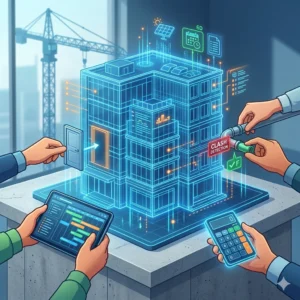
You’re creating a living digital version of the building—a complete virtual twin that behaves like the real thing.
It’s like building your project twice:
- First in the computer (where mistakes are free)
- Then in real life (where everything runs smoothly)
The Power of Seeing Problems Before They Exist
Here’s where BIM really starts to feel like magic.
In traditional construction, problems often appear on-site.
And when they do, everything slows down.
Imagine a plumber installing pipes exactly where an electrical system already exists.
Now what?
Work stops. People argue. Costs rise. Deadlines slip.
This is where BIM changes everything.
Using BIM, teams can run something called clash detection.
This means the system scans the entire digital building and identifies conflicts before construction even begins.
It’s like having a crystal ball that says:
“Hey… that duct and that beam are about to collide. Fix it now.”
Instead of solving problems in concrete and steel, you solve them in pixels—quickly, cheaply, and stress-free.
Beyond 3D: Enter the World of 4D, 5D, and 6D
If you thought BIM stopped at 3D, think again.
BIM adds extra layers of intelligence that completely transform how buildings are planned and managed.
4D BIM – Time
Now your model includes scheduling.
You can literally watch your building come to life step-by-step.
You know exactly when materials arrive, when tasks happen, and how the project flows.
It’s like hitting “play” on your construction timeline.
5D BIM – Cost
Every design decision instantly affects the budget.
Change a material? The cost updates.
Add a feature? The system calculates it.
No more guessing. No more surprise expenses.
6D BIM – Sustainability & Maintenance
This is where BIM thinks long-term.
Your model can track:
- Energy performance
- Maintenance schedules
- Lifecycle costs
It even knows when systems might need repairs years in the future.
BIM doesn’t just help you build—it helps you manage the building for decades.
A New Way to Work: Collaboration Over Chaos
Construction used to feel like a relay race.
The architect designed something…
Then handed it off to engineers…
Who passed it to contractors…
Somewhere along the way, information got lost.
BIM changes that completely.
Now, everyone works on the same shared model.
- Architects design
- Engineers analyze
- Contractors plan execution
All in real time.
If one person makes a change, everyone sees it instantly.
No confusion. No miscommunication. No “I didn’t know that changed.”
It becomes a true team effort—like building something together, not passing it along.
Why BIM Matters (Even If You’re Not an Engineer)
You might be wondering:
“Okay… this is cool, but why should I care?”
Fair question.
Here’s why BIM matters to everyone:
For homeowners
Renovations become smoother, faster, and more predictable.
Fewer surprises = less stress.
For businesses
Projects finish on time and within budget.
That means better planning and higher returns.
For cities and taxpayers
Public projects like roads, hospitals, and bridges are built more efficiently—saving money and resources.
In simple terms, BIM brings clarity to chaos.
And in construction, that’s priceless.
The Bigger Idea: Designing Life Like BIM
There’s something deeper here.
BIM isn’t just a construction tool—it’s a mindset.
It teaches us:
- Plan before you act
- Visualize outcomes
- Collaborate openly
- Fix problems early
Imagine applying that to your own life.
Before making big decisions, you “model” the possibilities.
You think ahead. You adapt. You improve.
In a way, BIM is about building smarter—not just buildings, but everything.
Is BIM Hard to Learn?
At first glance, BIM software might look intimidating.
And yes, professional tools like Autodesk Revit or Navisworks can be complex.
But the concept of BIM is simple:
Build it digitally first. Build it physically second.
If you’re comfortable using modern apps or basic design tools, you can start understanding BIM principles quickly.
And once you do, you’ll never look at buildings the same way again.
BIM and the Future of Smart Cities
We’re moving toward a world of:
- Smart cities
- Sustainable buildings
- Data-driven infrastructure
BIM is the foundation of all of it.
It connects design, construction, and operation into one seamless system.
From energy-efficient homes to futuristic skyscrapers, BIM is quietly shaping the world around us.
Final Thoughts: The Invisible Brain Behind Every Great Building
Next time you see a stunning building, pause for a moment.
Look beyond the glass, steel, and concrete.
Behind it all is something you can’t see:
A digital brain.
A complete virtual model.
A system that made everything work before construction even began.
That’s the power of BIM.
It saves time.
It reduces costs.
It prevents mistakes.
And most importantly—it turns great ideas into reality with confidence.
References