
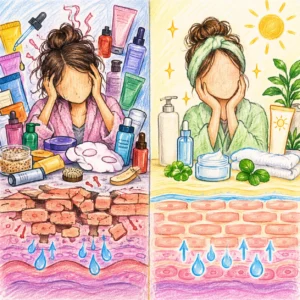
Have you ever looked at your bathroom shelf and realized you own enough exfoliating acids, retinol, scrubs, masks, toners, and “pore-refining” potions to open a tiny skincare laboratory?
And yet, somehow, your skin looks worse.
It feels tight after cleansing. It stings when you apply moisturizer. Your cheeks are red. Your forehead is flaky. You have random breakouts, and your once-simple skincare routine has turned into a 12-step chemistry experiment.
If that sounds familiar, your skin may not need another powerful active. It may need a break.
This is where Corneotherapy enters the conversation.
Rather than constantly attacking visible skin concerns with stronger and stronger treatments, Corneotherapy focuses on caring for the stratum corneum, the outermost layer of the skin. The philosophy is simple: protect the skin barrier, reduce unnecessary irritation, provide supportive ingredients, and give your skin the conditions it needs to maintain itself.
In other words, instead of treating your skin like a stubborn enemy, start treating it like an organ that deserves a little cooperation.
And honestly, your bathroom shelf may breathe a sigh of relief too.
What Exactly Is Corneotherapy?
The word Corneotherapy comes from the idea of caring for the stratum corneum, which is the outermost part of the epidermis.
This layer is much more sophisticated than the phrase “dead skin cells” makes it sound.
Think of it as your home’s outer security system. It helps reduce excessive water loss while providing protection against environmental irritants and other outside challenges.
The stratum corneum contains flattened cells called corneocytes, surrounded by an organized mixture of lipids, including ceramides, cholesterol, and fatty acids.
A healthy barrier helps maintain hydration and contributes to the skin’s ability to protect itself.
When this barrier becomes disrupted, things can get uncomfortable. Skin may become dry, rough, flaky, tight, itchy, or more sensitive. Products that normally feel perfectly comfortable may suddenly sting.
That is why barrier care has become such an important part of modern dermatology and skincare.
The Brick-and-Mortar Explanation
Here’s an easy way to visualize the skin barrier.
Imagine a brick wall.
The bricks are the corneocytes.
The mortar surrounding those bricks is made largely from lipids such as ceramides, cholesterol, and fatty acids.
When the wall is well maintained, it provides a strong protective structure.
But imagine repeatedly scraping that wall, washing it with harsh chemicals, and then sanding it down every night because someone on social media promised that “more exfoliation equals more glow.”
Eventually, the wall isn’t exactly thrilled.
Your skin can similarly become irritated when you repeatedly expose it to excessive cleansing, aggressive exfoliation, irritating products, or combinations of strong actives that your skin cannot comfortably tolerate.
This doesn’t mean that exfoliating acids, retinoids, or other active ingredients are automatically bad.
They can be useful when selected appropriately and introduced carefully.
The problem is overdoing them.
Corneotherapy encourages you to ask a different question:
“What does my skin need right now?”
Instead of:
“What stronger product can I add?”
Why Your Skin Barrier Matters So Much
Your skin barrier performs several important jobs.
One of its major functions is helping regulate the movement of water between your body and the environment. When barrier function is impaired, transepidermal water loss can increase, contributing to dryness and irritation.
A disrupted barrier can also make the skin more vulnerable to external irritants.
This creates an annoying cycle.
Your skin becomes irritated.
You notice roughness.
You add an exfoliant.
The exfoliant makes the irritation worse.
You notice more texture.
You add another active.
Now your skin is practically sending you a formal resignation letter.
The answer isn’t necessarily to eliminate every active ingredient forever. It’s to recognize when your routine has become too aggressive for your skin.
Corneotherapy Isn’t About Doing Absolutely Nothing
This is an important distinction.
Corneotherapy doesn’t mean throwing every skincare product into a drawer and living exclusively on water and positive thoughts.
It means becoming more strategic.
The goal is to support the skin’s natural barrier rather than constantly disrupting it.
A barrier-focused routine generally emphasizes:
- Gentle cleansing
- Adequate moisturization
- Barrier-supportive ingredients
- Reduced unnecessary irritation
- Sun protection
- Consistency
- Fewer competing products
It is less about having the longest routine and more about having a routine your skin can actually tolerate.
The Ingredients Worth Knowing
You don’t need to become an ingredient-list detective with a magnifying glass, but understanding a few key ingredients can make shopping much easier.
Ceramides
Ceramides are important lipids naturally found in the stratum corneum.
They play a significant role in the organization and function of the skin barrier, which is why ceramide-containing moisturizers are commonly recommended for dry or barrier-impaired skin.
You’ll often see names such as ceramide NP, AP, or EOP on product labels.
Think of ceramides as part of the mortar in your imaginary brick wall.
Cholesterol
Yes, cholesterol.
Your skin actually needs it.
Cholesterol is one of the major lipids involved in the structure of the stratum corneum. Alongside ceramides and fatty acids, it contributes to the organized lipid matrix that helps support barrier function.
This is a great reminder that skincare ingredients don’t always sound glamorous.
Sometimes the hero ingredient has a name associated with your last blood test.
Fatty Acids
Free fatty acids are another important component of the stratum corneum’s lipid matrix.
Together with ceramides and cholesterol, they help create the organized lipid structures necessary for an effective barrier.
You may encounter ingredients derived from different fatty acids in moisturizers and other skincare formulations.
Glycerin
Glycerin is a classic humectant.
It helps attract and retain water, making it particularly useful in moisturizing formulations.
It isn’t trendy or mysterious, but that’s part of its charm.
Sometimes boring skincare ingredients are boring because they’ve been doing their job for decades.
Panthenol
Panthenol, also known as provitamin B5, is commonly used in skincare formulations designed to moisturize and soothe the skin.
It can be particularly appealing when your routine is focused on comfort rather than maximum intensity.
Squalane
Squalane is an emollient that can help soften the skin and reduce the feeling of dryness.
Its lightweight texture makes it popular in moisturizers and facial oils.
If your skin dislikes extremely heavy products, a formulation containing squalane may be worth considering.
Centella Asiatica
Often called cica, Centella asiatica is widely used in products formulated for sensitive or irritated-looking skin.
However, remember that botanical doesn’t automatically mean irritation-free.
Your skin doesn’t care whether an ingredient grew in a garden or was made in a laboratory. If it irritates you, it irritates you.
What About Niacinamide?
Niacinamide is one of those ingredients that seems to appear everywhere—and for good reason.
It can support several aspects of skin health and is used in formulations targeting concerns such as uneven tone, oiliness, and barrier function.
However, more isn’t necessarily better.
Some people tolerate high concentrations perfectly well, while others find them irritating.
If your skin is already angry, starting with a simpler, lower-strength formulation may make more sense than immediately reaching for the strongest version available.
Remember the Corneotherapy mindset:
Your skin doesn’t get bonus points for surviving a stronger product.
Your Simple Corneotherapy Routine
Now let’s make this practical.
If your skin feels irritated, dry, tight, or unusually sensitive, consider simplifying your routine rather than adding another corrective product.
Step 1: Cleanse Gently
Use a gentle cleanser that doesn’t leave your face feeling stripped or squeaky.
That squeaky feeling may sound clean, but your skin doesn’t need to feel like a freshly washed dinner plate.
Use lukewarm rather than very hot water.
If your skin is particularly dry or sensitive, you may not need an elaborate morning cleansing routine. Your needs depend on your skin type, products, climate, and overnight oil or sweat production.
Step 2: Add Hydration
This is where ingredients such as glycerin, panthenol, and hyaluronic acid can be useful.
A hydrating serum is optional, though.
If your moisturizer already provides enough hydration, you don’t need to buy another bottle simply because the internet says every routine requires one.
Minimalism is allowed.
Step 3: Moisturize
This is the heart of a barrier-focused routine.
Look for a moisturizer containing ingredients that support hydration and barrier function, such as ceramides.
If your skin is very dry, a cream or ointment may feel more comfortable than a lightweight gel.
If you’re acne-prone or oily, a lighter, non-comedogenic formulation may be preferable.
There is no universal “perfect” moisturizer.
Your skin gets a vote.
Step 4: Protect Your Skin From the Sun
Barrier care isn’t complete without sun protection.
Use a broad-spectrum sunscreen with SPF 30 or higher and choose a formulation you can comfortably wear consistently.
If your skin is sensitive, look for products formulated for sensitive skin. Some people tolerate mineral sunscreens containing zinc oxide or titanium dioxide particularly well.
And don’t forget that hats, shade, and protective clothing can also help reduce UV exposure.
Should You Stop All Active Ingredients?
Not necessarily.
This is one area where skincare advice often becomes unnecessarily extreme.
Retinoids, exfoliating acids, vitamin C, and acne treatments can have legitimate uses. The question is whether your particular skin can tolerate them and whether you’re using them appropriately.
If your skin is visibly irritated, simplify first.
Once your skin feels comfortable and stable again, you can consider reintroducing products gradually.
Introduce one change at a time rather than bringing back five actives simultaneously and then wondering which one caused the problem.
Your face is not a laboratory control group.
The “Skin Detox” Myth
Let’s retire one phrase while we’re here:
skin detox.
Your skin doesn’t need a magical detox period to remove imaginary toxins.
What you may actually be doing when you take a break from irritating products is giving the skin barrier an opportunity to recover from repeated irritation.
That’s a much less exciting explanation—but it’s also much more useful.
You don’t need your face to peel dramatically to prove that a routine is working.
You don’t need redness to prove that a product is powerful.
And you definitely don’t need burning to prove that an ingredient is “doing something.”
Sometimes the best sign that your skincare routine is working is remarkably unexciting:
Your skin feels comfortable.
Signs Your Routine May Be Too Aggressive
Your routine deserves a second look if you regularly experience:
- Persistent tightness after cleansing
- Burning or stinging when applying ordinary products
- Excessive dryness or flaking
- Increasing sensitivity
- Redness that repeatedly appears after skincare
- Rough, uncomfortable texture
- Frequent irritation after introducing new products
These symptoms don’t automatically mean your skin barrier is damaged. Conditions such as eczema, contact dermatitis, rosacea, acne, and other skin disorders can produce overlapping symptoms.
If irritation is severe, persistent, painful, cracked, bleeding, or associated with a rash, it’s better to consult a dermatologist rather than trying to solve everything with another moisturizer.
What Corneotherapy Can—and Can’t—Do
This is where we need to keep expectations realistic.
Supporting the skin barrier can improve comfort, hydration, and resilience, particularly when dryness or irritation is part of the problem.
But Corneotherapy isn’t a magical cure for every skin concern.
It won’t automatically eliminate acne.
It won’t erase wrinkles overnight.
It won’t permanently remove pigmentation.
And it shouldn’t replace medical treatment for diagnosed skin conditions.
Instead, think of it as a foundation.
Healthy-looking skin needs a functioning barrier. Once that foundation is stable, targeted treatments can be considered more thoughtfully.
The Biggest Corneotherapy Lesson: Stop Fighting Your Skin
Perhaps the most useful part of Corneotherapy isn’t a particular ingredient.
It’s the mindset.
Modern skincare can make us feel as though every pore represents a problem that needs to be attacked.
A little texture?
Exfoliate.
A wrinkle?
Retinol.
A spot?
Acid.
Dullness?
Another acid.
Oiliness?
Strip everything away.
Then, when our skin becomes irritated, we buy another product to repair the damage.
It becomes a skincare version of accidentally setting your kitchen on fire and purchasing a prettier fire extinguisher every week.
A barrier-first approach asks you to slow down.
Look at your skin.
Notice what it tolerates.
Remove unnecessary irritation.
Moisturize consistently.
Protect it from UV exposure.
And give your routine enough time to work before adding something else.
A Calmer Way to Think About Skincare
Your skin isn’t lazy because it doesn’t peel.
It isn’t unhealthy because it isn’t constantly tingling.
And a 12-step routine isn’t automatically better than a three-step routine.
Sometimes skincare gets better when you stop chasing intensity and start paying attention.
That is the heart of the Corneotherapy approach.
Protect the outer layer.
Support its structure.
Keep hydration in.
Reduce unnecessary irritation.
Use active ingredients thoughtfully rather than aggressively.
And remember that beautiful skin doesn’t have to look chemically exhausted.
The goal isn’t to make your skin constantly “feel” that you’re doing something.
The goal is to help your skin feel comfortable enough to do what it is already designed to do.
And honestly, that’s a much more peaceful relationship to have with your face.
Final Note
If you’re dealing with persistent redness, painful acne, severe dryness, eczema, rosacea, or a rash, don’t assume that simplifying your skincare routine is enough. A dermatologist can help identify the underlying cause and recommend appropriate treatment. Corneotherapy is best viewed as a supportive, barrier-focused skincare philosophy—not a replacement for medical care.
References
American Academy of Dermatology — How to Pick a Moisturizer
PubMed — The Skin: An Indispensable Barrier
PubMed — Ceramides in Skin Health and Disease: An Update
American Academy of Dermatology — How to Choose the Right Sunscreen