
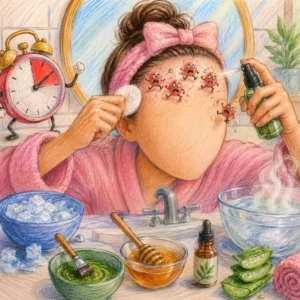
You wake up, shuffle into the bathroom, switch on the light, and run your fingers across your forehead.
Uh-oh.
Instead of feeling smooth, your skin feels like a tiny mountain range. You grab your phone, turn on the flashlight, and inspect the situation from approximately seventeen different angles.
There they are: tiny bumps.
They aren’t necessarily big, angry pimples. They may not even hurt. They’re simply little raised spots that make your forehead feel rough, make foundation sit strangely, and somehow become the only thing you can see when you look in the mirror.
And naturally, this happens right before something important.
A job interview.
A wedding.
A date.
Family photographs.
The day you’ve finally decided to take approximately 400 selfies.
Suddenly, you want to attack your forehead with every skincare ingredient in the kitchen.
But here’s the first thing to know: you probably cannot completely eliminate tiny bumps in 48 hours, especially if they’re caused by clogged pores or folliculitis. Skin needs time to change. What you can do in two days is reduce irritation, avoid making the bumps worse, improve the appearance of roughness, and create a calmer environment for your skin to recover.
And that’s actually much better than declaring war on your face.
So let’s replace the original “aggressive eviction” strategy with something smarter: a gentle 48-hour forehead reset.
First, What Are Those Tiny Bumps?
Before reaching for a remedy, it’s worth figuring out what you’re looking at.
“Tiny bumps” is a description, not a diagnosis. Several different skin conditions can create forehead texture.
1. Clogged pores
Sometimes the answer is wonderfully unglamorous: oil, dead skin cells, and debris are hanging around inside your pores.
These bumps may be flesh-colored or slightly white and can feel rough when you run your fingers over the area.
Acne can include comedones, papules, pustules, and other types of lesions. The American Academy of Dermatology also warns that aggressive scrubbing and picking can make acne worse.
2. Folliculitis
Another possibility is folliculitis, which happens when hair follicles become inflamed.
It can look surprisingly similar to acne, which is one reason self-diagnosing every forehead bump can become confusing.
3. Malassezia folliculitis
You’ve probably heard this called “fungal acne,” although that nickname can be misleading.
Malassezia is a yeast that naturally lives on human skin. Under certain conditions, including heat, humidity, sweating, high oil production, and occlusion, it can contribute to folliculitis.
It often appears as small, similar-looking bumps that may be itchy, particularly around areas such as the forehead and hairline.
That distinction matters because something that helps ordinary acne isn’t necessarily the right treatment for Malassezia folliculitis.
4. Irritation
Sometimes the bumps aren’t really a “dirty pores” problem at all.
Your skin may simply be irritated by a new product, hair product, fragrance, excessive washing, sweating, friction, or too many active ingredients.
Contact dermatitis, for example, can produce irritation and small raised bumps after exposure to an irritating or allergenic substance.
So before you declare your forehead guilty, remember: not every bump needs to be attacked.
Sometimes it needs to be left alone.
Your 48-Hour Tiny Bumps Reset
The goal for the next two days is simple:
Clean gently. Reduce irritation. Avoid clogging. Stop touching. Keep things boring.
Yes, boring.
Your skin doesn’t need a 14-step routine right now. It needs a little peace and quiet.
Day 1 Morning: Start With a Gentle Cleanse
Wash your face with a mild cleanser and lukewarm water.
Use your fingertips rather than a rough washcloth, facial brush, exfoliating glove, or anything that makes you feel as though you’re polishing a kitchen counter.
Massage gently and rinse.
Then pat your skin dry with a clean towel.
The American Academy of Dermatology specifically recommends gentle cleansing rather than scrubbing acne-prone skin because irritation can worsen breakouts.
What about apple cider vinegar?
This is where we’re going to make an important change to the original routine.
You may see DIY recipes recommending apple cider vinegar for bumps, but I wouldn’t recommend putting diluted vinegar on your forehead as a 48-hour emergency treatment.
Why?
Because vinegar is acidic, and irritated facial skin does not necessarily appreciate surprise chemistry experiments.
A product being “natural” doesn’t automatically make it gentle. Strong irritants can damage the skin barrier and trigger irritation or contact dermatitis.
If your goal is calmer skin before an important event, experimenting with vinegar for the first time is a particularly bad time to gamble.
Your forehead has already filed enough complaints.
Day 1 Morning: Moisturize
After cleansing, apply a light moisturizer that suits your skin type.
If you’re prone to clogged pores, look for products labeled non-comedogenic or “won’t clog pores.”
The AAD recommends choosing non-comedogenic skincare, sunscreen, makeup, and hair products when acne is a concern.
And yes, even oily skin needs moisture.
Trying to “dry out” your forehead by repeatedly washing it or applying harsh products can leave the skin irritated and uncomfortable.
Day 1: Keep Your Hair Products Away From Your Forehead
This is an underrated suspect.
Think about everything that touches your hair:
- Leave-in conditioner
- Hair oils
- Styling creams
- Pomades
- Hair sprays
- Heavy serums
- Dry shampoo
Now imagine all of that sitting against your forehead under sweat and humidity.
Not exactly a five-star vacation for your pores.
If your tiny bumps cluster around your hairline, temporarily keep heavy hair products away from the area.
Also, pin your hair back when you’re exercising or sweating.
You don’t need to shave your head. Just give your forehead some breathing room.
Day 1 Afternoon: Don’t Touch
This sounds ridiculously simple.
It is also surprisingly difficult.
We touch our faces constantly without realizing it.
You feel a bump.
You poke it.
You check it.
You scratch it.
You check it again five minutes later because perhaps the bump has magically disappeared.
It hasn’t.
And now it’s irritated.
The AAD recommends resisting touching, picking, and popping acne because doing so can worsen inflammation and increase the risk of more noticeable lesions and scarring.
So establish a temporary rule:
Your forehead is a no-touch zone.
Admire it from a respectful distance.
Day 1 Evening: Wash Away the Day
Cleanse your face gently again before bed, especially if you’ve worn sunscreen, makeup, or been sweating.
But don’t wash repeatedly throughout the day just because your forehead feels oily.
More washing isn’t automatically better.
The AAD notes that repeatedly changing treatments or overdoing skincare can irritate acne-prone skin, and meaningful improvement usually takes much longer than a couple of days.
After cleansing, moisturize.
That’s it.
No ingredient Olympics.
No six masks.
No scrubbing.
No squeezing.
No “I saw this hack on social media at 2 a.m.”
Day 1 Night: Change Your Pillowcase
This one is easy and harmless.
Put a clean pillowcase on your pillow.
You don’t need to believe your pillowcase is secretly responsible for every forehead bump on Earth. It isn’t.
But regularly washing bedding and keeping things clean is a sensible hygiene habit, particularly if you use hair products or sweat heavily at night.
And honestly, fresh bedding feels fantastic anyway.
Your future forehead may not send a thank-you card, but you’ll appreciate it.
Day 2 Morning: Keep It Calm
Wake up and resist the urge to immediately inspect your forehead under a flashlight.
Seriously.
Natural bathroom lighting is enough.
Wash gently, moisturize, and apply sunscreen during the day.
If you’re using makeup for an event, choose products that are non-comedogenic and avoid piling multiple layers of unfamiliar products onto the area.
This isn’t the day to test a brand-new exfoliating acid, peel, scrub, mask, serum, or mystery potion.
Your skin has enough going on.
What About Ice?
A cool compress can temporarily make skin feel more comfortable and may reduce the appearance of swelling.
If you want to try it, use a clean cool cloth rather than pressing bare ice directly onto your skin.
Keep the contact brief and gentle.
Think “refreshing,” not “freeze-drying my forehead.”
Also remember that cooling can temporarily change the appearance of redness or swelling; it doesn’t remove the underlying cause of the bumps.
Day 2 Afternoon: Skip the DIY Clay Experiment
Clay masks can be tempting when your forehead feels oily.
But if your skin is already irritated, a drying mask can make things feel worse.
The same applies to homemade mixtures containing lemon juice, baking soda, undiluted essential oils, toothpaste, or other internet-famous kitchen ingredients.
Your kitchen is excellent for making lunch.
It does not automatically qualify as a dermatology laboratory.
And What About Tea Tree Oil?
Tea tree oil is frequently recommended online for acne and “fungal acne.”
But concentrated essential oils can irritate facial skin, especially when used incorrectly or on already irritated skin.
So don’t smear pure tea tree oil over your entire forehead.
If you’re dealing with persistent acne-like or itchy uniform bumps, it’s better to determine what you’re actually treating rather than throwing essential oils at the problem.
For suspected Malassezia folliculitis, dermatology references describe antifungal treatments such as topical ketoconazole or selenium sulfide rather than relying on kitchen remedies.
If the bumps keep returning, getting the correct diagnosis can save you weeks of frustrating experimentation.
Day 2 Evening: The “Do Less” Routine
Tonight, your routine should be almost boring enough to put you to sleep.
Cleanse.
Moisturize.
Leave your face alone.
That’s it.
You don’t need to steam your face for five minutes.
Despite the popular idea that steam “opens your pores,” pores don’t work like little doors waiting for you to turn the handle.
Steam may make your skin feel temporarily softer, but it isn’t a magical extraction treatment.
And if your skin is sensitive, excessive heat can make irritation and redness more noticeable.
So skip the boiling-water facial spa.
Your face will survive.
Three Things to Avoid During Your 48 Hours
1. Don’t Pick the Tiny Bumps
This is probably the most important rule.
If a bump doesn’t have something obvious to extract, trying to force it out can simply create inflammation.
You may start with one tiny bump and finish with one irritated red spot that is considerably more noticeable.
The AAD strongly advises against popping and squeezing acne.
2. Don’t Start Five New Products
This is the classic skincare panic response.
You buy:
- A new cleanser
- An exfoliating toner
- A clay mask
- A vitamin serum
- An essential oil
- A peel
Then you use everything on the same night.
The next morning your forehead is red, tight, burning, and somehow bumpier.
Now you have no idea which product caused the problem.
Instead, keep your routine simple.
3. Don’t Scrub Your Forehead
Tiny bumps can make you desperate to “smooth” the skin physically.
Resist.
Scrubbing doesn’t magically sweep clogged pores away, and irritation can make acne-prone skin worse.
Gentle is not lazy skincare.
Gentle is smart skincare.
What Can Actually Change in 48 Hours?
Let’s keep expectations realistic.
You might notice that your forehead feels:
- Less irritated
- Less oily
- Less swollen
- Smoother to the touch
- Less red
- Less congested-looking
But complete clearance may not happen.
The AAD notes that acne treatment generally requires weeks to show meaningful improvement, with complete clearing often taking several months.
So if you wake up on Day 3 and still see a few bumps, don’t panic.
That doesn’t mean your routine failed.
It means your skin isn’t a microwave meal.
When Tiny Bumps Need a Dermatologist
Sometimes the best “natural remedy” is knowing when to stop experimenting.
Consider seeing a dermatologist if the bumps:
- Are very itchy and all look remarkably similar
- Keep returning despite a simple skincare routine
- Become painful or swollen
- Spread quickly
- Produce pus or crusting
- Leave scars or dark marks
- Appear after starting a medication
- Don’t improve with sensible skincare
Persistent uniform itchy bumps around the forehead or hairline can sometimes be associated with Malassezia folliculitis, which requires a different approach from ordinary acne.
Likewise, painful skin, signs of infection, or symptoms that persist despite self-care deserve professional attention.
Getting the right diagnosis is much more useful than trying 12 random remedies and hoping one wins.
Your New Forehead Philosophy
Here’s the biggest lesson from this whole 48-hour experiment:
Don’t punish your skin because you don’t like its texture today.
Your skin isn’t misbehaving because it has tiny bumps.
It’s living tissue dealing with oil, sweat, hormones, products, friction, weather, microorganisms, and countless other factors.
Sometimes it gets a little bumpy.
That doesn’t make your face unattractive.
And it certainly doesn’t mean you need to attack it with vinegar, boiling water, harsh scrubs, or concentrated essential oils.
If you have an event coming up, focus on calming rather than aggressively correcting.
Keep your routine gentle.
Keep your hands away.
Keep heavy hair products away from your forehead.
Choose non-comedogenic products.
Wash gently.
Moisturize.
Use sunscreen.
And give your skin time.
The goal isn’t to wake up with a completely poreless forehead that looks like it was rendered by a computer.
The goal is healthier, calmer, more comfortable skin.
And if your forehead happens to look smoother along the way?
Wonderful.
Consider that a bonus.
So the next time you wake up, run your hand across your forehead, and discover a tiny collection of unwanted texture, don’t grab the nearest bottle of vinegar.
Take a breath.
Put down the tweezers.
Step away from the magnifying mirror.
Your forehead does not need an eviction squad.
It needs a little patience.
References
American Academy of Dermatology — Acne Skin Care Tips
American Academy of Dermatology — Acne: Things to Try When It Won’t Clear
DermNet — Malassezia (Pityrosporum) Folliculitis