
Picture this: You’ve just finished a delicious, balanced dinner. Your stomach is full, your hunger has disappeared, and you’re feeling pretty pleased with yourself for making healthy choices throughout the day.
Then you settle onto the couch to watch your favorite show.
Suddenly, something changes.
You start thinking about chocolate. Then ice cream. Maybe a packet of gummy candies tucked away in the kitchen cupboard. Before you know it, you’re standing in front of the refrigerator, wondering why your brain is demanding dessert when your stomach clearly doesn’t need another bite.
Sound familiar?
If you’ve experienced this, you’re certainly not alone. Sugar cravings can show up even when you’re physically satisfied, and they can feel surprisingly difficult to ignore.
The usual advice is predictable: drink water, eat a handful of almonds, or distract yourself until the craving passes. Sometimes these tricks help. Other times, they leave you thinking about chocolate even more.
But here’s something interesting: your desire for sweet foods isn’t controlled by willpower alone. Your taste receptors, brain, emotions, habits, sleep, and eating patterns can all influence what you want to eat.
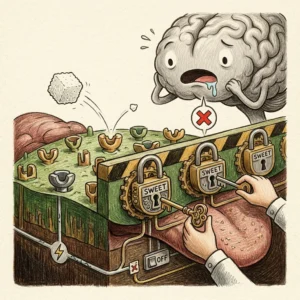
Scientists have also been investigating a fascinating possibility: could temporarily changing how your tongue detects sweetness make sugary foods less appealing?
Research suggests that certain compounds from a plant called Gymnema sylvestre can temporarily suppress sweet-taste perception. Some human studies have even found reduced desire for sweet foods after using these compounds.
It’s an intriguing discovery, but there’s an important distinction: changing how sweetness tastes is not the same as instantly eliminating every sugar craving.
Let’s explore how the receptors on your tongue work, why sugar can be so tempting, what researchers have discovered about this botanical approach, and how to manage cravings without turning healthy eating into a daily battle.
1. Your Tongue: The First Stop in the Sugar-Reward System
Your brain doesn’t directly touch or taste your food. Instead, it depends on specialized sensory cells in your mouth to identify what you’re eating.
Your tongue has thousands of tiny surface structures called papillae. Many contain taste buds, which house specialized taste cells capable of detecting chemicals in food.
These cells help you recognize five widely accepted basic taste qualities:
Sweet
Salty
Sour
Bitter
Umami, often described as savory
Different taste cells respond to different chemical signals, allowing your brain to distinguish a ripe strawberry from a salty cracker or a bitter cup of coffee.
When you eat something sweet, molecules interact with proteins on the surface of specialized taste cells. The cells then generate signals that travel through sensory nerves to the brain, where the taste is interpreted.
Sweetness detection involves a receptor made from two proteins known as T1R2 and T1R3.
Think of these receptors as tiny molecular sensors. When an appropriate substance activates them, they help initiate the chain of events that tells your brain, “This tastes sweet.”
However, your tongue doesn’t work in isolation. Your sense of smell, the texture of food, your memories, and your expectations also influence how enjoyable a meal feels.
That’s why biting into a favorite chocolate dessert can be a much richer experience than simply detecting sweetness.
2. Why Your Brain Loves Sweet Foods
Why can a cookie seem irresistible after a satisfying dinner?
Part of the explanation lies in human evolution.
For our ancestors, sweet-tasting foods such as ripe fruit could provide valuable energy. A preference for sweetness therefore had practical advantages when food was harder to find.
Today, sweet foods are available almost everywhere. Supermarkets, restaurants, vending machines, and kitchen cupboards make sugary treats remarkably easy to access.
Modern desserts can also combine sugar with fat, appealing textures, and powerful aromas. These features can make them especially enjoyable.
When you eat something pleasurable, your brain’s reward systems become involved. Dopamine, a chemical messenger associated with motivation, learning, and reward, helps your brain recognize experiences worth repeating.
Importantly, dopamine isn’t simply a happiness chemical, and sugar doesn’t cause an identical dopamine surge every time you eat it. The reward system is more complicated than that.
Your brain learns from experience. If you regularly enjoy chocolate while watching television, for example, your evening routine may eventually become a cue for wanting chocolate.
The craving can arise before you’ve even opened the cupboard.
This is why sugar cravings aren’t always a sign of physical hunger. Sometimes, they’re connected to routine, stress, boredom, emotions, or the anticipation of something enjoyable.
Understanding that distinction is the first step toward managing them.
3. Can You Temporarily Block Sweet-Taste Receptors?
This is where the science becomes particularly interesting.
Researchers have studied Gymnema sylvestre, a climbing plant traditionally used in Ayurvedic practices. Its leaves contain compounds called gymnemic acids.
Some of these compounds can temporarily interfere with the tongue’s ability to perceive sweetness.
In simple terms, they can make sweet foods taste less sweet for a period of time.
Imagine taking a bite of your favorite chocolate bar and discovering that its sweetness is surprisingly muted. The chocolate still has its texture, aroma, and other flavor characteristics, but one of its most appealing features may be reduced.
For someone who particularly enjoys sweetness, that change could make the experience less satisfying.
This mechanism is sometimes described as sweet-taste suppression. It is different from permanently disabling taste buds or shutting down the entire sensory connection between your tongue and brain.
The effect is temporary, and the degree of suppression can vary depending on the preparation and the individual.
A 2020 study involving 56 healthy adults found that a mint containing gymnemic acids reduced participants’ desire for additional chocolate and the amount of chocolate they consumed during a short testing session compared with a placebo.
A later study published in 2023 investigated a 14-day intervention and found some short-term effects on chocolate consumption, although longer-term dietary outcomes were less conclusive.
More recently, a 2025 randomized crossover study involving 32 adults who identified as having a sweet tooth reported reduced sugar cravings and lower consumption of sugar-sweetened beverages under one of its Gymnema intervention conditions.
These findings are promising, but the studies were relatively small. They don’t establish that everyone will experience the same results or that the method can instantly eliminate cravings in everyday life.
The most accurate takeaway is that temporarily suppressing sweet taste may help some people find sugary foods less appealing.
That is a useful research finding, not a magic switch for appetite control.
4. What Happens When Your Favorite Dessert Tastes Less Sweet?
Imagine that you’ve been thinking about a chocolate cookie all afternoon.
You remember its sweetness, the soft center, and the way it tastes with a cup of coffee. By the time you get home, you’re already anticipating the first bite.
Now imagine that the sweetness is temporarily reduced.
The cookie may still smell delicious. Its texture might remain exactly as you remember it. But the taste experience may not match your expectations.
That mismatch can influence how much you enjoy the food.
You might decide that one bite is enough. You might still enjoy the cookie and eat the whole thing. Or you might find that the craving remains even though the sweetness has changed.
All of these responses are possible.
This is an important point because cravings involve more than taste receptors. If you’re reaching for sweets because you’re stressed, lonely, tired, or looking for a comforting routine, changing the taste of a dessert may not address the underlying reason.
For example, someone who associates ice cream with relaxing after a difficult day may still want it even if it tastes less sweet.
On the other hand, a person whose enjoyment depends heavily on intense sweetness might find the experience less rewarding.
In other words, altering the taste can change one part of the craving experience, but it doesn’t necessarily erase the desire itself.
5. A Practical Approach to Managing Sugar Cravings
You don’t need to experiment with your taste receptors every time you want dessert. In fact, there are several straightforward ways to make cravings easier to manage.
Step 1: Pause and identify the craving
Before opening the cupboard, give yourself a moment.
Ask yourself:
Am I physically hungry?
Did I eat enough at dinner?
Am I tired, stressed, or bored?
Am I craving something sweet because it’s part of my usual evening routine?
There are no wrong answers. The purpose is to understand what your body or mind might be asking for.
If you’re hungry, eating something satisfying is a reasonable response. If you’re bored or stressed, a different activity might help.
Step 2: Check whether your meals are satisfying
Trying to eat as little as possible during the day can leave you physically hungry later.
Meals containing protein, fiber-rich carbohydrates, healthy fats, and other nourishing foods can help you feel satisfied.
For example, a dinner of lentils, vegetables, rice, and yogurt may provide a more satisfying combination than a meal consisting mainly of low-calorie vegetables.
You don’t have to eliminate carbohydrates or avoid every sweet food. The goal is to eat enough to support your needs.
Step 3: Make room for enjoyable foods
Strict food rules can make eating feel like a constant test of self-control.
If you label chocolate as completely forbidden, you may find yourself thinking about it more often. That doesn’t happen to everyone, but rigid restriction can make food decisions stressful for some people.
Instead, consider allowing yourself to enjoy a reasonable portion of dessert without guilt.
Eating slowly, paying attention to the flavor, and avoiding distractions can help you recognize when you’ve had enough.
A healthy eating pattern doesn’t need to exclude every food you love.
Step 4: Change the evening routine
If your cravings appear at the same time each night, look at what happens immediately before them.
Perhaps you sit on the couch, switch on the television, and automatically reach for something sweet.
Try changing one part of that routine. Make a cup of unsweetened tea, take a short walk, call a friend, or spend a few minutes on a hobby.
You can also keep satisfying snacks available if you’re genuinely hungry.
The idea isn’t to punish yourself for wanting dessert. It’s to give yourself more choices instead of relying on one familiar response.
Step 5: Explore taste-suppression research carefully
If you’re interested in Gymnema-based products, remember that research on specific preparations doesn’t mean every supplement, liquid extract, or homemade rinse will produce the same effect.
Don’t assume that brushing your tongue with ordinary toothpaste, using a bitter herbal rinse, or drinking ice-cold water will block sweet receptors in the same way. These methods haven’t been established as equivalent substitutes for the preparations studied in clinical research.
Avoid putting concentrated herbal extracts, tea tree oil, or other non-oral products in your mouth unless they’re specifically formulated for that use. Some products can irritate or harm oral tissues.
Gymnema supplements can also affect blood glucose, potentially creating problems for people taking diabetes medication. If you have diabetes, take glucose-lowering medication, are pregnant or breastfeeding, or have a relevant medical condition, consult a qualified healthcare professional before using these products.
You don’t need to suppress your sense of taste to make progress toward healthier eating.
6. Why Willpower Isn’t the Whole Story
There’s a reason the advice to “just stop eating sugar” can feel frustrating.
Food choices are influenced by a combination of biology, environment, habits, and emotions. Expecting yourself to make perfect decisions every day ignores how complicated those influences can be.
Think about what happens after a stressful day.
You may be tired, your usual routines are disrupted, and the easiest available comfort is a sweet snack. In that situation, repeatedly telling yourself to be stronger may not be particularly helpful.
A more practical approach is to make your environment and routines work in your favor.
Keep nourishing foods readily available. Eat regular, satisfying meals. Get adequate sleep when possible. Notice the situations that trigger cravings. And allow yourself flexibility rather than treating every dessert as a failure.
Research into taste receptors offers another interesting angle: if the sensory reward of sweetness can be temporarily reduced, some people may find it easier to moderate their intake.
However, this doesn’t mean receptor suppression is better than every behavioral approach. Scientists still need more evidence about who benefits, how long the effects last, and whether short-term changes translate into lasting dietary improvements.
For most people, a combination of sustainable habits and a flexible attitude toward food is a more dependable starting point than searching for a single biological shortcut.
7. Can You Retrain Your Sweet Tooth Over Time?
Your preferences aren’t necessarily fixed forever.
Repeated experiences can influence how you perceive and enjoy food. For example, gradually reducing the sweetness of drinks or choosing less-sweet versions of familiar foods may help some people adjust to lower sweetness levels.
You might begin by using a little less sugar in tea or coffee, selecting plain yogurt and adding fruit, or experimenting with recipes that use spices and naturally flavorful ingredients.
Cinnamon, cardamom, vanilla, citrus zest, and ripe fruit can add flavor without requiring as much added sugar.
There’s no need to change everything overnight. Small adjustments are often easier to maintain than strict rules.
Also, don’t assume that every craving must be eliminated. Wanting a slice of cake at a birthday party or enjoying ice cream on a warm evening is a normal part of life.
The goal is to develop a relationship with food that supports your health while leaving room for pleasure.
If cravings feel overwhelming, occur alongside episodes of feeling out of control around food, or cause significant distress, a registered dietitian or qualified healthcare professional can help you explore the underlying factors without shame or unnecessary restriction.
Conclusion: Understand Your Taste Receptors, Not Just Your Cravings
Sugar cravings can feel surprisingly powerful, especially when they arrive after dinner or during a stressful evening. But they don’t automatically mean you lack discipline or that your healthy habits have failed.
Your tongue’s taste receptors help you detect sweetness, while your brain, memories, emotions, and routines shape how much you want particular foods.
Research into Gymnema sylvestre suggests that temporarily suppressing sweet-taste perception may reduce the appeal of sugary foods for some people. Early human studies are encouraging, but the evidence remains limited, and this approach cannot guarantee that an intense craving will disappear instantly.
The most useful lesson is that you have more options than simply resisting temptation.
You can eat satisfying meals, recognize emotional triggers, adjust routines, experiment with less-sweet foods, and enjoy desserts without guilt. If you consider taste-suppressing supplements, do so carefully and seek professional advice when appropriate.
You don’t need to wage war against your sweet tooth. Understanding how your body responds to food is a much better place to start.
The next time that familiar chocolate craving appears, take a breath, get curious about what triggered it, and choose your next step intentionally.
Sometimes, the most powerful change isn’t switching off a receptor. It’s learning how to respond to a craving without letting it make every decision for you.
References
National Institute on Deafness and Other Communication Disorders (NIDCD) — Taste Disorders and How Taste Works.
Consuming Gymnema sylvestre Reduces the Desire for High-Sugar Sweet Foods. Nutrients (2020) — The research on PubMed Central.
The Effect of a 14-Day Gymnema sylvestre Intervention to Reduce Sugar Intake in People Self-Identifying With a Sweet Tooth. Appetite (2025) — The research on PubMed.