
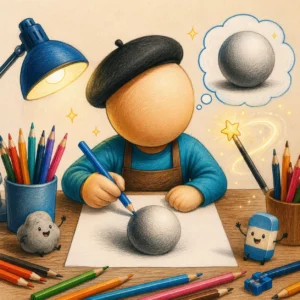
Pencil sketching is one of the most accessible yet profound art forms in the world. With just a simple piece of graphite and a sheet of paper, an artist can construct entire worlds, capture raw human emotion, and replicate the complex interplay of light and shadow with breathtaking realism. Yet, many aspiring artists find themselves trapped in a frustrating cycle: they can draw accurate outlines, but the moment they begin shading, their artwork loses its life, looking flat, smudged, or messy.
If your drawings look more like muddy graphite stains than the crisp, three-dimensional masterpieces you see on Pinterest, you are not lacking talent. You are simply missing the structural blueprint of tonal control.
In this comprehensive manual, we will break down the exact mechanics behind the “Pencil Magic” technique. We will explore everything from the molecular behavior of graphite to advanced blending theory, ensuring that your very next sketch commands attention and leaps off the page.
Chapter 1: The Science of Your Tools (Graphite Demystified)
To master pencil magic, you must first understand the chemistry of the tools in your hand. A pencil is not merely a writing instrument; it is a precision instrument designed to deposit varying densities of carbon onto a textured surface.
The Grading Scale: H vs. B Pencils
Most people grow up using a standard No. 2 pencil, which corresponds to an HB grade on the professional art scale. However, a single pencil is mathematically incapable of rendering a full value scale. Professional drawing sets are categorized using a alphanumeric system:
- The “H” Series (Hard Lead): Pencils ranging from H to 9H contain a higher percentage of clay binder and less graphite. The core is physically hard, holds a sharp point for an extended duration, and deposits a light, silver-grey line. These are your foundational tools for structural mapping, guidelines, and ultra-light skin tones.
- The “B” Series (Black/Soft Lead): Pencils ranging from B to 9B contain minimal clay binder and are packed with dense, soft graphite. The core crumbles easily under pressure, depositing rich, velvety blacks and deep shadows. These are your engines of depth and contrast.
- The “HB” and “F” Mid-Points: These pencils sit exactly in the middle of the spectrum, offering a balance of hardness and darkness, perfect for initial sketching and mid-tone transitions.
Choosing the Right Paper Texture (Tooth)
You can possess the finest technique in the world, but if you attempt to shade on ultra-smooth printer paper, your artwork will inevitably look flat. Paper possesses an structural texture known as tooth.
When you drag a pencil across a sheet of paper, the micro-ridges of the tooth act like a grater, shaving off microscopic particles of graphite and holding them trapped in the valleys of the paper. For realistic shading, you want a medium-tooth paper, such as cold-press bristol board or medium-weight sketching paper (around 130–160 GSM). This allows you to layer graphite repeatedly without creating a slick, shiny surface where the lead can no longer grip.
Chapter 2: The Core Mechanics of Pencil Control
Realistic shading is a physical discipline. The way your hand physically interacts with the pencil dictates the uniformity of the tone deposited onto the page.
1. The Underhand Grip vs. The Writing Grip
When most people begin to shade, they instinctively hold the pencil close to the tip using a standard writing grip. This is a critical error. The writing grip forces all the energy of your hand down through the precise point of the lead, digging harsh grooves into the fibers of the paper that can never be erased.
Instead, transition to the Underhand Grip (or Overhand Grip). Rest the body of the pencil along your index and middle fingers, holding it in place with your thumb. Your hand should sit several inches away from the tip. This grip forces you to utilize the flat, broad side of the pencil lead rather than the sharp point. It distributes the weight of your hand evenly, allowing you to deposit broad, soft swaths of tone effortlessly.
2. The Micro-Circular Motion Principle
If you shade back and forth in rapid, parallel zig-zag lines, you create directional texture. The human eye easily detects these parallel lines, which shatters the illusion of a smooth, continuous surface.
To eliminate these directional lines, train your hand to move in continuous, overlapping micro-circles. Imagine your pencil tip is a buffer polishing a fine surface. By moving in tiny circular patterns, you fill the microscopic valleys of the paper’s tooth from every conceivable angle. This results in a completely uniform, velvet-like texture that forms the baseline of realistic rendering.
3. The Layering Rule over Pressure Force
When beginners want to create a dark shadow, they instinctively grab a pencil and press down with maximum force. This technique, known as burnishing, flattens the tooth of the paper completely, creating an un-erasable, highly reflective, metallic sheen that looks unnatural.
Pencil magic relies on patience and progressive layering. To achieve a rich dark value, start with a light layer using a 2B pencil. Apply zero physical pressure; let the weight of the pencil do the work. Once that layer fills the paper’s tooth, overlay a second layer moving in the opposite direction. If it needs to be darker, switch to a 4B, then a 6B. By stacking layers gently rather than forcing the lead down, you preserve the paper’s depth and achieve a pure, matte black that absorbs light rather than reflecting it.
Chapter 3: Understanding the 5 Zones of Light and Shadow
Shading is not merely the act of making things darker; it is the visual language used to communicate three-dimensional volume to the human brain. To trick the brain into seeing a flat piece of paper as a physical object, you must accurately map the five distinct zones of illumination. Let’s look at how light behaves across a spherical surface:
                  \  \  \  Light Source
                   \  \  \
                    ▼  ▼  ▼
               .─────────────────.
            .-'   [ HIGHLIGHT ]   '-.
          .'                         '.
         /  [ LIGHT / MID-TONE ]       \

        |                               |
        |     ( CORE SHADOW )           |
         \     \                       /
          '.    ▼                    .'
            '-. [ REFLECTED LIGHT ]-'
               '─────────────────'
              ===================== ◄─── [ CAST SHADOW ]
1. The Highlight
This is the precise point on the object where the light source strikes directly at a 90-degree angle. In realistic pencil drawing, the highlight is almost always the pure white of the paper itself. You do not shade this zone at all. Protect this area fiercely; keeping your highlights crisp and entirely free of stray graphite is what gives your drawings their brilliant, luminous pop.
2. The Mid-Tone (True Value)
As the surface of the object begins to curve away from the direct light source, it enters the mid-tone zone. This represents the actual, natural color and texture of the object without intense light or deep shadow altering it. This is where your smooth blending gradients are most critical, transitioning smoothly from light grey down into deeper values.
3. The Core Shadow
The core shadow is a dark band that marks the exact point where light can no longer physically reach the curving surface of the object. It is the dividing line between the illuminated side and the shadowed side. Crucially, the core shadow is frequently darker than the rest of the shadow side because it receives absolutely no direct light and no bounced light.
4. The Reflected Light
This is the hidden secret that separates amateur drawings from professional masterworks. When an object sits on a surface (like a ball sitting on a table), light hits the table and bounces back up into the underside of the object. Therefore, the very bottom edge of your object should never be completely black. There must be a subtle, pale glow of reflected light trapped just beneath the dark core shadow.
5. The Cast Shadow
This is the darkness thrown onto a neighboring surface because the object is physically blocking the path of the light source. Cast shadows have two distinct properties:
- The Umbra (Hard Edge): Closest to the object, the cast shadow is incredibly dark and sharp because virtually all light is blocked.
- The Penumbra (Soft Edge): As the shadow stretches further away from the object, ambient environmental light leaks in, causing the edges of the shadow to blur, soften, and become lighter in value.
Chapter 4: Advanced Blending Theory (The Danger of the Finger)
Once graphite is placed on the page, the next step in the pencil magic workflow is smoothing out the transitions. However, this is the exact phase where many artists accidentally destroy hours of meticulous work.
Why Your Bare Finger is the Enemy of Art
It is a universal instinct: you see a harsh line of graphite, and you rub it with your index finger to smooth it out. You must break this habit immediately.
Your skin naturally secretes microscopic oils and sweat. When you rub your bare skin against raw graphite, these oils mix with the carbon particles, creating a permanent, greasy sludge. This acid paste glues the graphite into the fibers of the paper, making it completely impossible to erase or adjust down the line. Furthermore, it creates uneven patches that repel future pencil layers, leaving muddy, streaky splotches across your mid-tones.
The Professional Tool Kit for Blending
To achieve silk-smooth gradients safely, construct a dedicated blending kit using these inexpensive materials:
- Paper Tortillons and Blending Stumps: Made from tightly rolled, compressed paper, these pointed tools allow you to buff and burnish small, intricate areas with absolute structural precision without adding grease to the page.
- Chamoiss Leather Cloth: A scrap of ultra-soft chamois cloth wrapped gently around your hand is the holy grail for smoothing out massive areas, like large backgrounds or sweeping landscapes. It lifts excess graphite dust away while leaving a perfectly distributed tone underneath.
- Soft Makeup Brushes: A clean, dry, synthetic eyeshadow or blending brush works wonders for delicate portrait work. It gently moves loose graphite dust across the surface of the paper’s tooth without crushing the texture, yielding an incredibly soft, airbrushed finish.
Chapter 5: Erasing as a Form of Drawing
In traditional writing, an eraser is viewed as a tool for correcting mistakes. In the world of pencil magic, the eraser is a creative instrument, used to carve light out of darkness.
The Architecture of the Kneaded Eraser
A standard pink rubber eraser is highly abrasive; it tears at the paper fibers and leaves behind messy, colorful crumbs. Professional artists rely almost exclusively on a Kneaded Rubber Eraser.
This pliable grey putty can be pulled, twisted, and molded into any shape imaginable. Need to pull a razor-thin highlight out of a realistic eye reflection? Mold your kneaded eraser into a sharp, needle-like point and gently tap the paper. Need to lighten an entire shadow area that became slightly too dark? Flatten the eraser into a pancake disk and press it firmly against the drawing to cleanly lift away a uniform layer of graphite dust without smudging the underlying artwork.
Precision Tools: Precision Eraser Pens
For hyper-realistic detailing—such as rendering individual strands of hair catching the sun, skin pores, or fine clothing textures—invest in a mechanical eraser pen (like the Tombow Mono Zero). These tools feature an ultra-fine, 2.3mm rubber core that behaves exactly like a mechanical pencil, allowing you to accurately draw crisp white lines directly into heavy fields of dark graphite.
Chapter 6: Step-by-Step Practical Application Exercise
Now that we have covered the complete structural theory, let us put the pencil magic system into practical use. Follow this exact workflow to render a hyper-realistic geometric shape from scratch:
[ Step 1: Soft Outlines ] ➔ [ Step 2: Lay Down Core Shadows ] ➔ [ Step 3: Circular Mid-Tones ] ➔ [ Step 4: Buff with Brush ] ➔ [ Step 5: Pop Highlights ]
- The Structural Map: Using a sharp 2H pencil and an ultra-light underhand grip, map out the faint contour lines of your subject. Do not use any pressure. These lines should be so faint that they practically disappear once shading begins.
- Locate the Void: Establish where your primary light source originates. Block out your cast shadow and core shadow boundaries using a soft, neutral 2B pencil. Maintain your micro-circular hand path to ensure even distribution.
- Establish the Gradient: Moving outward from your core shadow toward the light source, slowly decrease your hand pressure to build out your mid-tones. Switch to an HB pencil as you near the highlight zone to ensure the transition remains bright and seamless.
- The Smooth Polish: Take a clean, medium-sized synthetic makeup brush. Using light, sweeping circular motions, blend across the mid-tone gradients. Watch as the mechanical pencil lines dissolve into a smooth, continuous surface texture.
- Carve the Light: Take your kneaded eraser, shape it into a sharp point, and cleanly lift away any stray graphite from your primary highlight zone.
- Anchor the Depth: Finally, take your darkest pencil (such as a 6B or 8B) and darken the absolute deepest points of the shadow areas—such as the contact point where the object physically touches the ground. This punch of deep black provides the ultimate pop of realism.
Turning Your Artistic Passion into Reality
Mastering the physical art of pencil shading takes time, focus, and deliberate practice. Every single sketch you complete deepens your hand-eye coordination and expands your understanding of visual design. As you continue to refine your “Pencil Magic” workflows, remember that every master artist started exactly where you are standing right now.
Want to expand your collection of original reference artwork, view or purchase premium finished sketches? Click the link below to browse my official handcraft portfolio and secure your next original fine art piece today!
References