
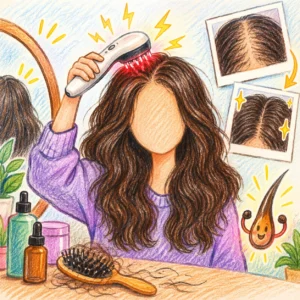
Have you ever stood in front of the bathroom mirror, looked at the hair in your brush, and thought, “Okay… is this normal shedding, or is my hair slowly disappearing?”
It is one of those tiny moments that can instantly ruin your morning.
You notice more strands in the shower. Your ponytail feels a little thinner. Your part seems slightly wider than it used to be. Then, naturally, you start searching for answers.
First come the biotin gummies. Then the oils. Then the scalp serums. Then the expensive shampoo promising “fuller-looking hair.” Before long, your bathroom shelf looks like a small hair-care laboratory.
And yet, your hair still seems determined to ignore your efforts.
That frustration has pushed people to look beyond traditional topical products and toward technologies that target the scalp itself. One of the more interesting options gaining attention is micro-current hair stimulation, sometimes discussed more broadly as low-level electrical stimulation or electrotrichogenesis.
The idea sounds wonderfully futuristic: instead of simply putting another product on your hair, could gentle electrical stimulation encourage the scalp environment to support healthier hair growth?
Interestingly, early research says the idea deserves attention. A 2026 randomized, double-blind, sham-controlled clinical trial involving men with androgenetic alopecia found that a wearable low-level electrical stimulation device produced significantly greater improvements in total and terminal hair density than a sham device after six months.
That does not mean every micro-current brush will magically produce Rapunzel-level hair.
But it does mean this technology is becoming much more interesting than a simple beauty-world trend.
So, let’s get into what micro-current hair stimulation actually is, what the science says, how it may work, and how to approach it safely.
What Exactly Is Micro-Current Hair Stimulation?
The name sounds slightly intimidating, but the basic concept is fairly simple.
Micro-current devices deliver very small electrical signals to the skin. In hair-focused applications, the goal is to stimulate the scalp and potentially influence the environment around the hair follicles.
This is very different from the dramatic image of someone getting “electrocuted.”
You are not plugging your head into an outlet.
Instead, specialized devices are designed to deliver controlled, low-level electrical stimulation through electrodes or other contact points.
Researchers have been investigating electrical stimulation and hair growth for years. Laboratory studies have found that electrical stimulation can influence human dermal papilla cells, which are important cells involved in hair-follicle function.
The exciting part is that this isn’t purely theoretical anymore.
A recent clinical trial involving 81 men with androgenetic alopecia found that participants using an electrotrichogenic wearable device daily for 24 weeks experienced greater improvements in hair density and thickness than those using a sham device.
That is promising.
But “promising” is the key word.
It is more accurate to think of micro-current hair stimulation as an emerging supportive technology, rather than a guaranteed cure for hair loss.
Your Hair Follicles Are More Complicated Than They Look
One reason hair loss is so frustrating is that there isn’t one universal cause.
Hair follicles operate through a complicated growth cycle. Individual hairs move through phases of growth, transition, rest, and shedding. Changes in hormones, genetics, illness, nutritional deficiencies, stress, medications, inflammation, and even hairstyles can affect that process.
For example, hereditary hair loss can cause follicles to gradually shrink, eventually producing finer and shorter hairs. Meanwhile, temporary excessive shedding can happen after major stress, illness, surgery, childbirth, or significant weight loss.
That distinction matters.
If your hair is falling because of an iron deficiency, thyroid problem, medication, autoimmune condition, or another underlying issue, simply stimulating the scalp may not solve the actual problem.
Your scalp is not a broken appliance waiting for someone to press the reset button.
It is a living biological system.
And that is precisely why understanding the cause of hair loss should come before choosing a treatment.
So How Might Electrical Stimulation Help?
Scientists are still investigating exactly how different electrical stimulation methods affect hair follicles.
One area of interest is the behavior of cells around the follicle.
Laboratory research has found that micro-current stimulation can affect signaling pathways and growth-related factors in hair follicle-derived dermal papilla cells. Animal research has also produced encouraging findings.
In simple language, electrical stimulation may provide biological signals that influence cellular activity around the follicle.
Think of it less like giving your hair follicles an espresso and more like changing the signals in their neighborhood.
That distinction is important because we don’t yet have enough evidence to say that micro-current simply “supercharges” follicles.
And while ATP—the molecule often described as cellular energy currency—is involved in countless biological processes, claims that consumer micro-current devices increase scalp ATP by a specific amount, such as 500%, should not be treated as established clinical fact.
Science is much messier than a beauty advertisement.
Fortunately, it can still be exciting.
What Does the New Human Research Show?
This is where things get particularly interesting.
A 2026 randomized, double-blind, sham-controlled study evaluated a wearable electrotrichogenic device in 81 men aged 18 to 55 with androgenetic alopecia.
Participants used either the active device or a sham version for 30 minutes a day over 24 weeks.
At six months, the active-treatment group had a significantly greater increase in total hair density compared with the sham group. Researchers also reported improvements in terminal hair density and cumulative hair thickness. No serious adverse events were reported, while some participants experienced mild symptoms such as itching, redness, or scaling.
That’s a meaningful development.
However, there are still limitations.
The study focused on men with androgenetic alopecia, so we shouldn’t automatically assume the same results apply to women, people with other forms of hair loss, or everyone experiencing shedding.
A previous pilot study involving 21 men also reported improvements in hair density after six months of daily use, but the researchers themselves emphasized the need for larger and more diverse studies.
In other words:
The technology is promising, but the research is still developing.
Micro-Current Isn’t the Same as Every Scalp Gadget
The phrase “micro-current hair device” can cover a wide variety of products, and not every gadget uses the same electrical current, intensity, waveform, electrode design, treatment duration, or technology.
Some products combine electrical stimulation with LED or other technologies.
Others may primarily provide massage.
Others may use different forms of electrical stimulation altogether.
That means you can’t look at one successful clinical study and assume that every device sold online has been proven to produce the same results.
The device matters.
The electrical parameters matter.
The treatment schedule matters.
And the quality of the research matters.
So if you’re considering a device, don’t just look for words such as advanced, professional, cellular, or revolutionary on the box.
Look for actual information about how the device works and whether its technology has been studied.
What About Blood Flow?
You’ve probably seen scalp-stimulation products claim that they dramatically increase circulation.
There is some biological logic behind why scalp stimulation could influence local circulation, and research has investigated microcirculation alongside electrical and light-based.
References
American Academy of Dermatology — Hair Loss: Diagnosis and Treatment
PubMed — 2026 Randomized Trial of Electrotrichogenic Hair Stimulation
Journal of Cosmetic Dermatology — Electrotrichogenic Device Pilot Study