
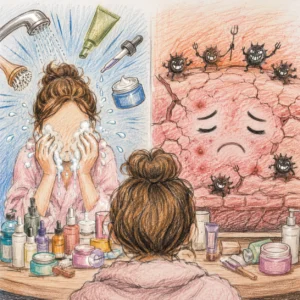
Have you ever looked in the mirror, spotted a fresh breakout, and immediately declared war on your skin?
Most of us have.
A pimple appears out of nowhere, and our first instinct is usually the same: scrub harder, wash more often, and throw every acne treatment we own at the problem. We convince ourselves that if one cleanser is good, three must be better. If a little exfoliation helps, daily scrubbing should work miracles.
So we reach for the strongest face wash, apply multiple acne treatments, and cleanse our face repeatedly throughout the day.
At first, it feels productive.
Your skin feels squeaky clean. Tight. Dry. Almost polished.
But then something strange happens.
Instead of clearing up, your skin becomes red, irritated, flaky, and somehow even oilier than before. New breakouts appear beside the old ones, and suddenly you’re trapped in a frustrating cycle that seems impossible to escape.
If this sounds familiar, there is a good chance that overwashing and over-treating are doing more harm than good.
The truth is that acne isn’t always caused by dirty skin. In many cases, the excessive effort to eliminate breakouts actually creates the perfect conditions for them to thrive.
Let’s explore why.
Your Skin Is Not a Dirty Surface
One of the biggest skincare myths is that acne happens because your skin isn’t clean enough.
While keeping your skin clean matters, your face is not a kitchen countertop that needs constant disinfecting.
Your skin is a living, breathing organ with its own protective ecosystem.
This ecosystem includes natural oils, beneficial microorganisms, and a protective barrier designed to keep your skin healthy.
When everything functions properly, your skin naturally defends itself against irritation, dehydration, environmental stressors, and even acne-causing bacteria.
However, when you repeatedly strip away these natural defenses through excessive cleansing and aggressive treatments, problems begin to appear.
Understanding Your Skin Barrier
Think of your skin barrier as a highly trained security team protecting an exclusive building.
Its job is simple:
- Keep moisture inside
- Keep harmful irritants outside
- Maintain balance
- Support healthy skin function
This protective layer is often called the acid mantle, a slightly acidic film that covers the skin’s surface.
When your skin barrier is healthy:
- Moisture stays locked in
- Oil production remains balanced
- Irritation stays minimal
- Bacteria struggle to thrive
When your skin barrier becomes damaged:
- Water escapes easily
- Irritants enter more easily
- Inflammation increases
- Acne becomes harder to control
Unfortunately, overwashing and over-treating are two of the fastest ways to damage this protective system.


How Overwashing Creates More Oil
Many people believe that oily skin requires constant cleansing.
Ironically, the opposite is often true.
The Stripping Stage
Every time you wash your face, you remove some of your skin’s natural oils.
A gentle cleanser removes excess oil and impurities while preserving balance.
A harsh cleanser removes almost everything.
When this happens repeatedly throughout the day, your skin loses the protective oils it needs to function properly.
The Emergency Response
Your skin doesn’t understand that you’re trying to fight acne.
It only recognizes one thing:
Its protective layer has disappeared.
As a result, your body enters defense mode.
The Oil Overproduction Phase
Your sebaceous glands begin producing more oil to replace what was removed.
Unfortunately, this emergency oil production often becomes excessive.
This explains why many people experience a confusing combination of symptoms:
- Tight skin after washing
- Excessive oil by midday
- Persistent breakouts
- Enlarged-looking pores
The more aggressively they cleanse, the more oil their skin produces.
It’s a cycle that can continue indefinitely.
Why Over-Treating Makes Acne Worse
Modern skincare offers countless acne treatments.
Salicylic acid.
Benzoyl peroxide.
Retinoids.
AHAs.
BHAs.
Sulfur treatments.
Clay masks.
While each of these ingredients can be effective when used correctly, problems arise when they are combined excessively.
Many people use several powerful treatments simultaneously, believing they will achieve faster results.
Unfortunately, skin doesn’t work that way.
1. Increased Inflammation
Acne is already an inflammatory condition.
The redness and swelling around pimples are signs that your immune system is actively responding.
When multiple strong ingredients are layered together, irritation increases dramatically.
This additional inflammation can:
- Increase redness
- Delay healing
- Make breakouts appear larger
- Trigger additional blemishes
Instead of calming acne, over-treatment often fuels it.
2. Barrier Damage and Micro-Irritation
Exfoliating acids help remove dead skin cells.
However, excessive exfoliation can strip away healthy skin before it is ready to shed naturally.
This leaves the skin vulnerable and sensitive.
Tiny areas of irritation develop throughout the skin’s surface.
These weakened areas allow bacteria, pollutants, and irritants to penetrate more easily, contributing to ongoing breakouts.
3. The Flaky Skin Problem
One of the most common signs of over-treatment is excessive flaking.
Many people assume flaking means the treatment is working.
Sometimes it simply means the skin is irritated.
These dead skin flakes don’t disappear instantly.
Instead, they can mix with excess oil inside pores.
The result?
- Blackheads
- Whiteheads
- Congested pores
- New breakouts
The very products intended to clear acne can contribute to future congestion when used excessively.


The Breakout Cycle Nobody Talks About
Many acne sufferers unknowingly get trapped in the same frustrating pattern:
Breakout Appears
↓
More Washing
↓
More Treatments
↓
Barrier Damage
↓
Excess Oil Production
↓
Increased Irritation
↓
More Breakouts
↓
Even More Washing
The cycle repeats over and over.
Because the breakouts continue, it feels logical to increase treatment intensity.
In reality, the solution often involves doing less.
Signs You’re Overwashing and Over-Treating
Your skin usually gives clear warning signs when it becomes overwhelmed.
Watch for these symptoms:
1. Constant Tightness
Healthy skin should feel comfortable after cleansing.
If your face feels stretched, tight, or uncomfortable, your cleanser may be too harsh.
2. Stinging Products
If water, moisturizer, or sunscreen suddenly starts burning, your skin barrier may be compromised.
3. Excessive Shine
Damaged skin often develops an unusual shiny appearance that resembles plastic wrap.
4. Persistent Flaking
Dry patches that remain despite moisturizing can indicate over-exfoliation.
5. New Texture
Tiny flesh-colored bumps spreading across the forehead, cheeks, or chin often signal irritation rather than traditional acne.
6. Increased Sensitivity
Products you once tolerated easily suddenly cause redness or discomfort.
These are all signs that your skin may need recovery rather than stronger treatment.
How to Reset Your Skin Barrier
The good news is that skin is remarkably resilient.
With proper care, your barrier can begin repairing itself within a few weeks.
Step 1: Simplify Everything
For the next two to four weeks, remove unnecessary products.
Focus on only three essentials:
- Gentle cleanser
- Fragrance-free moisturizer
- Broad-spectrum SPF 30+ sunscreen
Avoid:
- Scrubs
- Peels
- Strong acids
- Multiple active ingredients
Give your skin a chance to recover.
Step 2: Wash Less
More cleansing does not equal cleaner skin.
A simple approach often works best:
Morning
Rinse with lukewarm water.
Evening
Use a gentle cleanser to remove sunscreen, makeup, dirt, and pollutants.
This helps preserve your natural protective oils.
Step 3: Handle Skin Gently
Your towel matters more than you think.
Instead of rubbing:
- Use a soft towel
- Pat skin dry gently
- Leave slight moisture on the surface
Less friction means less irritation.
Step 4: Prioritize Hydration
Hydrated skin repairs itself more effectively.
Apply moisturizer immediately after cleansing while your skin remains slightly damp.
Look for ingredients such as:
- Ceramides
- Hyaluronic acid
- Glycerin
- Panthenol
These ingredients help reinforce the skin barrier and restore balance.


Reintroducing Acne Treatments Safely
Once your skin feels comfortable again, you can slowly bring active ingredients back into your routine.
The key word is slowly.
Introduce One Product at a Time
Choose one treatment and use it consistently before adding another.
This allows you to monitor your skin’s response.
Start Slowly
Instead of daily use, try:
- 1–2 times per week initially
- Gradually increase as tolerated
Use Recovery Days
Alternate treatment nights with simple hydration-focused nights.
Your skin needs recovery time.
Spot Treat Strategically
Treat the affected area only.
If you have one breakout on your chin, there is no need to apply strong acne medication across your entire face.
Targeted treatment minimizes unnecessary irritation.
The Real Secret to Clear Skin
The skincare industry often promotes the idea that more products equal better results.
In reality, healthy skin thrives on balance.
Clear skin isn’t achieved by attacking your face with stronger cleansers, harsher acids, or more aggressive treatments.
It comes from supporting your skin’s natural ability to protect and heal itself.
Your skin is not your enemy.
It isn’t breaking out because it is dirty.
It isn’t trying to sabotage your confidence.
It is simply responding to stress, hormones, genetics, environment, and sometimes even the products intended to help it.
When you stop fighting your skin and start working with it, remarkable improvements often follow.
Patience, consistency, and gentleness may not sound exciting, but they are often the most effective skincare tools available.
Sometimes the biggest breakthrough in your acne journey isn’t finding a stronger treatment.
It’s realizing that your skin may be asking for less.
References
American Academy of Dermatology – Acne Treatment Tips
National Institutes of Health – Skin Barrier Function
Mayo Clinic – Acne Causes and Treatment
Cleveland Clinic – Damaged Skin Barrier Guide