
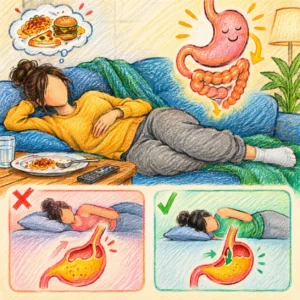
Maybe it was a mountain of creamy pasta, a perfectly grilled burger, or the kind of Sunday dinner that could comfortably feed a small village.
You finish the last bite, lean back, and suddenly realize your stomach has entered a completely different time zone.
Your eyelids become heavy. Your waistband feels suspiciously tighter. Your couch begins looking less like furniture and more like a medically necessary recovery station.
Naturally, you want to lie down.
Then comes the problem.
You recline, and twenty minutes later your chest starts burning. You burp and get a surprise replay of dinner. Your stomach feels like somebody inflated a basketball underneath your ribs.
Now you’re sitting there thinking, “I was just trying to relax. Why is my digestive system filing a formal complaint?”
We’ve all been there.
And while the internet is full of advice telling you to walk 10,000 steps, drink some mysterious green powder, eliminate carbohydrates, or purchase a probiotic that costs more than your actual dinner, there is a much simpler piece of physiology worth understanding.
It involves your stomach’s unusual shape, gravity, body position, and something commonly called the gastrocolic reflex.
You may also see the phrase Post-Prandial Gastrocolic Shunt used online, but it isn’t the standard medical term for this process. The established term is gastrocolic reflex: when food enters and stretches the stomach, signals can increase movement in the colon, essentially telling the lower digestive tract that new food has arrived and things need to keep moving.
And when it comes to lying down after eating, another simple trick gets interesting: your left side may be your digestive system’s preferred couch position—particularly if reflux is your problem.
So, let’s unpack the science without turning this into a medical textbook.
Your Stomach Is Not a Neat Little Balloon
Most of us imagine the stomach as a symmetrical pouch sitting somewhere in the middle of the abdomen.
It isn’t.
Your stomach is a curved, J-shaped organ that sits predominantly toward the left side of your upper abdomen. It has a natural curve, several regions, and an entrance from the esophagus at the top.
At the bottom is the pathway leading toward the small intestine through the pylorus.
In other words, your digestive system isn’t simply a straight pipe.
It’s more like a cleverly designed piece of biological plumbing.
Food comes down the esophagus, enters the stomach, gets mixed and churned, and gradually moves onward into the small intestine.
Your stomach also has an important gatekeeper at the entrance: the lower esophageal sphincter.
Think of it as a door between your esophagus and stomach.
It opens when you swallow.
It closes afterward.
When everything works normally, this helps keep stomach contents where they belong.
The trouble begins when stomach contents move back toward the esophagus.
That’s what produces the familiar symptoms of acid reflux: burning in the chest, sour or bitter fluid coming upward, burping, or an uncomfortable feeling behind the breastbone.
And here’s where body position becomes surprisingly relevant.
Why Lying Down Can Make Reflux Worse
Gravity is one of those things you don’t think about until you suddenly need it.
When you’re standing or sitting upright, gravity helps keep stomach contents lower in your abdomen.
When you lie down, that gravitational advantage changes.
If you already have a tendency toward reflux, lying flat soon after a large meal can make symptoms more likely because you’ve removed some of gravity’s assistance.
That’s one reason people with nighttime reflux are often advised to pay attention to body position.
And researchers have found something particularly interesting:
The left side appears to be friendlier to reflux than the right side.
A systematic review and meta-analysis found that left-side sleeping was associated with less acid exposure and faster acid clearance compared with right-side or supine positions in people with gastroesophageal reflux disease.
Another study using esophageal pH and impedance monitoring found that people spent less time exposed to acid and cleared reflux more quickly while lying on their left side than on their right side or back.
So this isn’t just another wellness influencer saying, “Trust me, bro. Sleep like this.”
There is actual physiological research behind the idea.
But there’s an important distinction.
Left-Side Lying Isn’t a Magical Digestion Button
Let’s clear up one major misconception.
Lying on your left side does not suddenly make your stomach digest food twice as fast.
It doesn’t “flush toxins.”
It doesn’t force your meal through your intestines.
And it certainly doesn’t guarantee that you’ll wake up thirty minutes later feeling like you have the digestive system of a superhero.
Your digestive tract is already doing its job.
Your stomach is mixing and processing the meal. Your small intestine continues digestion and nutrient absorption. Your colon handles its own portion of the process.
Your body doesn’t need you to manually position it like a piece of IKEA furniture.
What left-side positioning may do—especially for people prone to reflux—is create a more favorable physical arrangement that makes it harder for stomach contents to travel backward into the esophagus.
That’s a much more realistic claim.
And honestly, it’s still pretty impressive.
Meet the Gastrocolic Reflex
Now let’s talk about the part of the original concept that has a real medical name.
The gastrocolic reflex is a normal digestive response.
When food enters your stomach, the stomach stretches. That stretching sends signals through your nervous system and digestive tract.
The colon responds by increasing its muscular activity.
That’s why some people feel the sudden urge to use the bathroom shortly after eating.
And no, your new sandwich did not teleport through your entire digestive tract in twelve minutes.
Your body is simply making room.
Think of it like a crowded parking garage.
A new car arrives.
The attendant doesn’t need to push the new car through every level of the garage immediately. Instead, the arrival signals that some older cars need to move along.
That’s roughly the idea behind the gastrocolic reflex.
Interestingly, larger meals can produce stronger responses, and meal composition can matter too. High-calorie meals, particularly those containing significant amounts of fat and protein, can stimulate digestive hormones and intestinal activity.
So if you finish an enormous dinner and suddenly think, “Why do I need the bathroom right now?”
Congratulations.
Your gastrocolic reflex has entered the chat.
Why Your Left Side May Feel Better After Dinner
Now we can connect the pieces.
You’ve eaten a large meal.
Your stomach is stretched.
Your digestive system is actively processing food.
Your gastrocolic reflex may be stimulating movement farther down the digestive tract.
And you want to lie down.
If reflux is a problem for you, choosing your left side rather than your right side may reduce the likelihood or severity of reflux.
Why?
The exact mechanics involve the anatomy and geometry of the stomach and the connection between the stomach and esophagus. When you’re on your left side, stomach contents are generally positioned in a way that makes reflux into the esophagus less likely.
On the right side, studies have found greater acid exposure and slower clearance compared with the left-side position.
This doesn’t mean your right side is “bad.”
It means that if reflux bothers you, the left side is worth experimenting with.
Your body may basically be saying:
“Would you like to stop pouring dinner uphill?”
The Lazy Post-Meal Strategy
Here’s the part that requires almost zero athletic ability.
After a big meal, you don’t necessarily have to launch yourself into an intense workout.
But you also don’t have to immediately collapse completely flat.
Instead, try a simple routine.
Step 1: Stay Upright for a While
Give yourself some time sitting or standing upright after eating.
You don’t need to stare at the clock obsessively.
Have a conversation.
Wash a few dishes.
Make tea.
Walk around the house.
Basically, don’t treat your dining chair like a launchpad straight into horizontal mode.
Remaining upright can be particularly useful if you’re prone to reflux.
Step 2: If You Need to Recline, Try Your Left Side
When you’re ready to relax, experiment with lying on your left side.
This is especially worth trying if you’ve noticed that lying down after eating tends to trigger heartburn.
You’re not trying to force digestion.
You’re simply choosing a position that may be more reflux-friendly.
Step 3: Keep Your Upper Body Comfortable
If reflux is a recurring problem, slightly elevating your upper body can also be useful.
For nighttime reflux, positional approaches involving elevation and left-side positioning have been studied, with evidence suggesting that left-side positioning can reduce reflux compared with right-side positioning.
Just piling up several soft pillows under your head isn’t necessarily the best solution, though.
The goal is comfortable elevation of the upper torso rather than creating an awkward neck angle that leaves you feeling like you’ve spent the night sleeping inside a camping tent.
Step 4: Loosen the Clothing
This one is less glamorous but surprisingly practical.
If your belt is currently fighting for its life, give it a break.
Tight clothing around your abdomen can be uncomfortable after a large meal.
You don’t need to wear pajamas specifically designed for digestion.
You just need enough room to breathe without your waistband behaving like a boa constrictor.
Step 5: Listen to Your Body
If the left side feels comfortable, stay there.
If it doesn’t, change position.
There is no prize for maintaining one exact posture for thirty minutes.
Your body isn’t taking an exam.
What About Bloating?
This is where we need to be careful.
It would be tempting to claim that left-side lying magically eliminates bloating.
It doesn’t.
Bloating can have many causes, including the amount of food you ate, how quickly you ate, carbonated drinks, constipation, food intolerances, swallowed air, and the composition of the meal.
The gastrocolic reflex can increase intestinal movement after eating, but that doesn’t mean every uncomfortable stomach sensation is caused by “poor positioning.”
Sometimes the answer is simply:
You ate an enormous plate of pasta.
Your stomach is full.
Give it time.
And sometimes persistent bloating deserves a conversation with a healthcare professional rather than another internet hack.
Why a Gentle Walk Still Has a Place
There’s another misconception worth fixing.
This article isn’t saying walking after a meal is useless.
Quite the opposite.
A gentle walk can be a perfectly reasonable way to move after eating if you feel comfortable doing so.
The point is that you don’t need to believe that digestion only works if you’re marching around the neighborhood immediately after dinner.
There is a huge difference between gentle movement and punishing yourself because you ate dessert.
Food isn’t a debt you have to repay with exercise.
If you feel comfortable taking a relaxed walk, wonderful.
If you’re exhausted after a huge family dinner and want to sit upright and chat, that’s fine too.
Your digestive system doesn’t require a fitness boot camp to function.
The Bigger Lesson: Work With Your Anatomy
There’s something genuinely fascinating about all of this.
Your body is constantly responding to mechanical forces.
Position matters.
Gravity matters.
Pressure matters.
Muscle contractions matter.
Nerves and hormones coordinate countless digestive processes without you consciously directing any of them.
You don’t sit at dinner thinking:
“Okay, everyone, activate the gastric phase.”
Fortunately, your body has already handled the meeting.
Your stomach stretches.
Digestive secretions increase.
Muscles contract.
Food is gradually processed.
The gastrocolic reflex can stimulate movement in the colon.
And eventually, the entire digestive process continues whether you’re thinking about it or watching your favorite show.
That’s why small behavioral changes can sometimes be useful.
You’re not “hacking” your digestive system.
You’re simply giving normal physiology a little assistance.
When You Shouldn’t Blame Your Dinner Position
Here’s the serious part.
If you regularly experience severe heartburn, difficulty swallowing, persistent chest pain, vomiting, unexplained weight loss, bleeding, or symptoms that repeatedly interfere with your sleep or daily life, don’t assume the problem is simply that you’re lying on the wrong side.
Persistent reflux symptoms can be related to gastroesophageal reflux disease or other conditions and deserve appropriate medical evaluation.
Likewise, persistent or severe bloating, abdominal pain, major changes in bowel habits, or unexplained digestive symptoms shouldn’t automatically be treated with internet positioning tricks.
A couch position is not a diagnosis.
And a left-side nap isn’t a substitute for medical care.
The Real Post-Meal Takeaway
So, where does that leave us?
You don’t need to fear a big meal.
You don’t need to punish yourself for eating carbohydrates.
You don’t need an expensive collection of powders, pills, teas, rollers, or mysterious “gut reset” products sitting beside your kitchen sink.
And you don’t have to believe that one specific position will magically transform your digestion.
Instead, understand what your body is actually doing.
The gastrocolic reflex is a normal response to eating. Your stomach and intestines communicate constantly, coordinating movement and digestion.
And if lying down after eating tends to trigger reflux, the left-side position has genuine evidence behind it as a potentially helpful strategy. Research consistently points toward less reflux or faster acid clearance on the left compared with the right side in relevant populations.
That’s a much more useful takeaway than the promise of a magical digestive shortcut.
So next time you finish an enormous dinner and your couch starts whispering your name, you don’t necessarily have to choose between comfort and common sense.
Stay upright for a while.
If you need to recline and reflux is an issue, try your left side.
Keep things comfortable.
And let your digestive system do what it has been doing remarkably well since long before wellness influencers discovered the word “gut.”
Sometimes the smartest health strategy isn’t doing more.
Sometimes it’s simply positioning yourself better and getting out of your body’s way.
References
Cleveland Clinic — Gastrocolic Reflex
PubMed — Systematic review and meta-analysis of left-side sleeping and GERD
PubMed — Randomized trial of positional therapy for nocturnal reflux